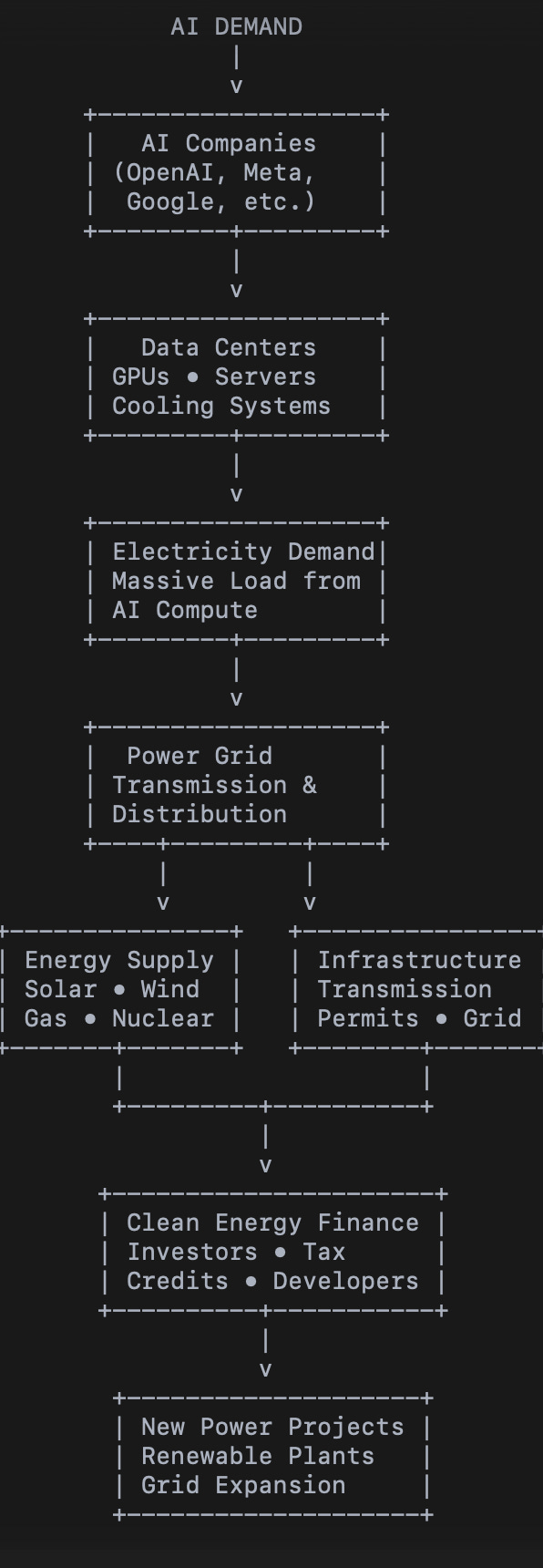
In this episode of the Snowpal Podcast, Krish Palaniappan sits down with Neil Winward, CEO of Dakota Ridge Capital and a seasoned advisor and investor in clean energy with over three decades of experience in structured and project finance (AI Newsletter). The conversation explores the rapidly growing intersection of artificial intelligence and energy infrastructure, unpacking how the surge in AI-driven data centers is creating unprecedented demand for power. Neil shares insights into clean energy financing, the challenges of grid infrastructure, and why the future of AI is deeply tied to the ability to generate, finance, and deliver energy at scale.
Neil works with clean energy developers and investors to help finance renewable energy projects. His role involves structuring capital solutions that allow large infrastructure projects to move from concept to reality. These projects often involve complicated financial arrangements that combine equity investment, debt financing, and government incentives.
Artificial Intelligence is advancing at an extraordinary pace. New models, powerful GPUs, and massive data centers are transforming industries and reshaping the global economy. Yet beneath the excitement surrounding AI lies a critical question that is often overlooked: can our energy infrastructure keep up with the rapid growth of AI computing? As the demand for AI systems grows, the need for electricity grows with it. Every model trained, every inference run, and every data center built ultimately relies on one foundational resource—power.
Podcast
AI Is Writing Checks the Grid Cannot Cash — on Apple and Spotify.
One of the most important incentives in the United States is the system of tax credits available for renewable energy development. These credits allow corporations with large tax liabilities to offset those liabilities by investing in energy infrastructure projects. Developers who may not have significant tax obligations themselves partner with investors who do, allowing both sides to benefit financially. This complex financial arrangement has become a cornerstone of renewable energy development in the U.S.
Because of these complexities, financing an energy project requires more than simply building a facility. Developers must assemble teams of lawyers, accountants, engineers, and financial advisors to ensure that the project meets regulatory requirements and qualifies for available incentives. Professionals like Winward help orchestrate this process, guiding projects through the financial and legal structures necessary to secure funding.
The Rapid Rise of Energy Demand
The global surge in AI infrastructure is dramatically increasing electricity demand. Large technology companies are investing billions of dollars into building new data centers designed specifically for AI workloads. These facilities house thousands of GPUs and specialized computing hardware that require enormous amounts of power to operate.
The scale of this demand can be difficult to comprehend. A single gigawatt-scale data center can consume as much electricity as approximately one million homes. As more companies deploy AI models and build new data centers, the cumulative impact on electricity demand is becoming substantial.
In regions such as Northern Virginia, where many data centers are concentrated, the effects are already visible. Massive facilities have appeared across the landscape, each requiring significant power and cooling infrastructure. These developments demonstrate how closely the future of AI is tied to the availability of energy.
The Hidden Bottleneck: Infrastructure
While many people assume the challenge lies in generating enough electricity, the real problem is often infrastructure. According to Winward, the United States can generate large amounts of power, particularly through renewable sources such as wind and solar. The greater challenge lies in transporting that power from where it is produced to where it is needed.
For example, areas like West Texas have abundant renewable energy resources and produce significant amounts of electricity from wind and solar installations. However, these generation sites are often located far from major population centers where electricity demand is highest. Without sufficient transmission infrastructure—high-voltage lines capable of carrying electricity over long distances—this power cannot easily reach cities where it is needed.
The situation becomes even more complicated when regulatory approvals and permitting requirements are involved. Building new transmission lines often requires navigating multiple jurisdictions, environmental reviews, and zoning regulations. These processes can take many years, slowing the expansion of energy infrastructure even as demand continues to rise.
Why Not Every Energy Project Gets Funded
Although the demand for electricity is increasing, not every energy project automatically becomes a successful investment. Investors evaluate many factors before deciding whether to fund a project. These include the experience and credibility of the developer, the regulatory approvals required for construction, the projected revenue generated by the project, and the ability of the facility to connect to the electrical grid.
Experienced professionals play a crucial role in assessing these factors. Winward emphasizes that evaluating a project’s viability requires both technical knowledge and judgment developed through years of experience. While data and financial models can provide valuable insights, the ultimate decision often depends on understanding how multiple pieces of information fit together within a complex system.
The Role of AI in Energy Finance
Ironically, AI itself is beginning to transform the way energy finance professionals work. Tools powered by artificial intelligence can now analyze large data sets, review legal documents, summarize engineering reports, and generate financial scenarios much faster than traditional manual processes.
For professionals like Winward, AI acts somewhat like a team of junior analysts who can rapidly process information. Instead of spending hours reading documents or running calculations, he can use AI tools to surface relevant insights quickly. However, the technology still requires human oversight. Experience remains essential for interpreting results, identifying risks, and making final decisions.
AI therefore accelerates analysis but does not eliminate the need for expertise. The tools are powerful, but they still rely on knowledgeable professionals who understand how to ask the right questions and interpret the answers.
A Growing Gap Between AI and the Grid
One of the most significant challenges facing the AI industry is the difference in speed between software development and infrastructure development. AI systems can be designed, trained, and deployed within months. Data centers can also be constructed relatively quickly once the necessary approvals are obtained.
Electrical infrastructure, however, moves at a much slower pace. Transmission lines, grid upgrades, and large-scale energy projects can take years or even decades to complete. This mismatch creates the risk that AI infrastructure may grow faster than the energy systems required to power it.
If this gap continues to widen, the availability of electricity could become a limiting factor for AI expansion. Addressing this challenge will require coordinated efforts among policymakers, energy developers, investors, and technology companies.
Looking Ahead
The future of AI is often discussed in terms of algorithms, models, and computing power. Yet the true foundation of the AI revolution is far more fundamental: electricity. Without reliable and abundant energy, even the most advanced AI systems cannot operate.
The conversation between technology and infrastructure is therefore becoming increasingly important. As companies race to build the next generation of AI systems, the energy sector must evolve just as quickly to support them. Bridging this gap will require innovation not only in software and hardware, but also in finance, regulation, and energy infrastructure.
In many ways, the success of the AI era may ultimately depend on how effectively we can modernize and expand the power grid that supports it.