

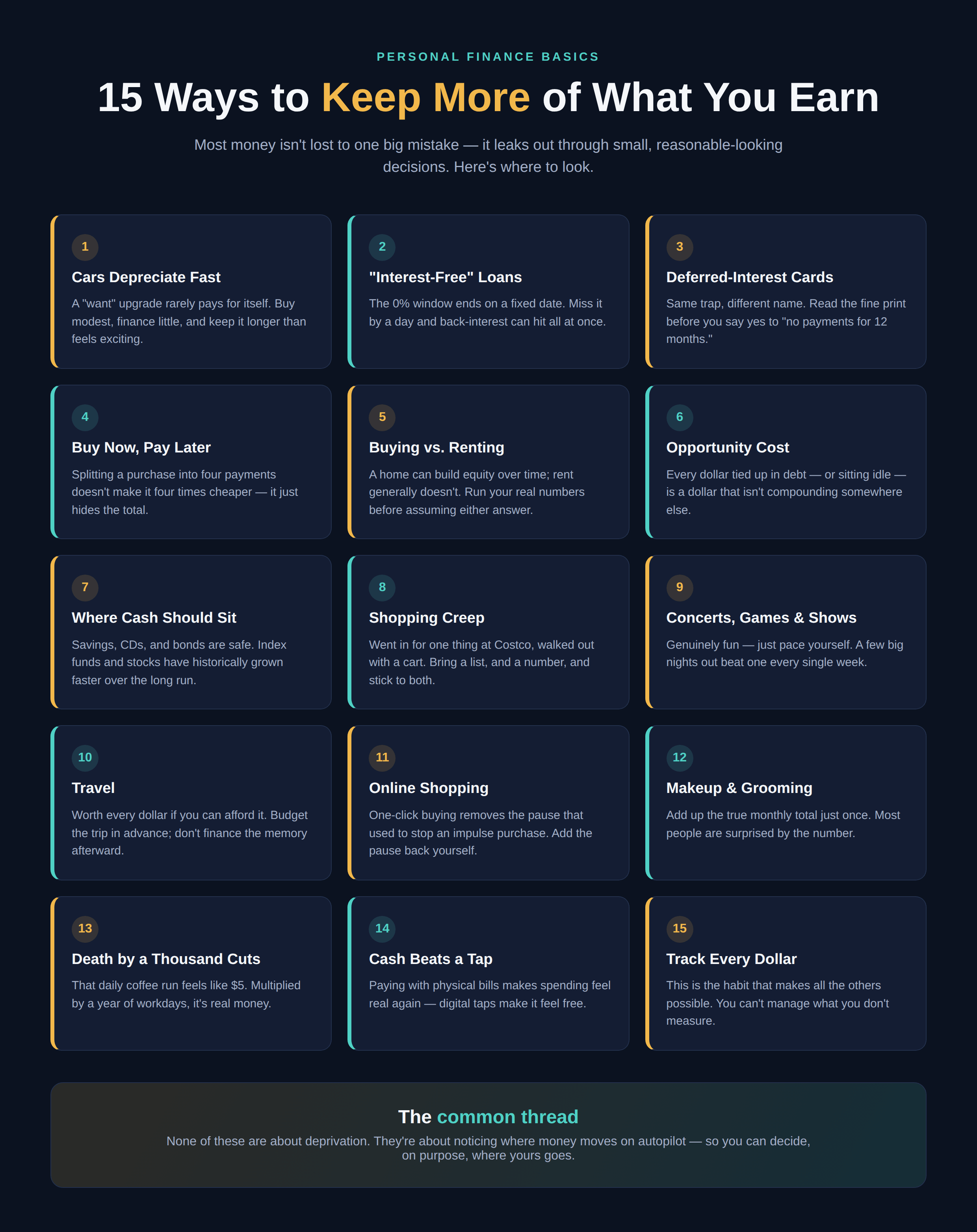
Most people don’t lose money in one dramatic moment. There’s no single villain—no one purchase that wrecks a budget. Instead, money leaks out through a long series of small, individually reasonable-looking decisions, each one easy to justify in isolation. The habits below are some of the most common leaks, and the fixes for most of them cost nothing but attention.
To make the numbers concrete, the examples use a hypothetical young U.S. couple with one child. They are rough planning estimates, not universal averages. Costs vary widely by location, income, and lifestyle, and several categories overlap, so the figures should not simply be added together.
Introduction
Personal finance rarely fails because of one catastrophic decision; it erodes through a compounding system of depreciation, financing costs, behavioral friction, recurring expenses, and lost investment returns. A car upgrade, deferred-interest purchase, oversized shopping trip, or daily convenience may appear manageable in isolation, but collectively these choices can redirect tens of thousands of dollars away from emergency reserves, debt reduction, homeownership, education, and long-term wealth. For a young couple raising a child, understanding this system is especially important: every dollar spent carries both an immediate price and an opportunity cost—the future value it could have created elsewhere. The fifteen categories that follow quantify these hidden tradeoffs and show how greater visibility, intentional limits, and better allocation decisions can convert ordinary spending into lasting financial security.
For context, the average U.S. household spent approximately $78,535 in 2024, or $6,545 per month, according to the U.S. Bureau of Labor Statistics.
1. A Car Is a Depreciating Asset—and the Bling Dies Quickly
A car starts losing value the moment it leaves the lot, and the fastest way to accelerate that loss is chasing the version with more bling: the bigger trim, the newer model year, or the upgrade that felt necessary at the dealership but stops mattering within a month.
The type of car matters less than the pattern around it—how often it gets upgraded, how many optional packages get added, and how much of the purchase gets financed. A modest, reliable car kept for eight to ten years will almost always beat a nicer one traded in every three, even though the second option feels more successful in the moment.
The payment is only part of the bill. AAA estimates that the average new vehicle costs about $1,072 per month to own and operate when depreciation, financing, fuel, insurance, maintenance, and fees are included. A family with two newer vehicles could easily devote $1,500 to $2,100 per month to transportation.
**Potential savings:** Keeping reliable cars longer, avoiding unnecessary upgrades, and replacing only one vehicle at a time could preserve roughly $400 to $800 per month, or $4,800 to $9,600 per year. The real luxury is not a prestigious badge; it is dependable transportation without a crushing payment.
2. Interest-Free Loans on Random Purchases
“Interest-free” financing on furniture, electronics, phones, appliances, or exercise equipment sounds like a gift. Even when the interest rate is genuinely zero, however, the purchase still commits future income.
A family could easily accumulate the following payments:
- Furniture: $125 per month
- Two phones: $80 per month
- Exercise equipment: $75 per month
- Electronics: $70 per month
That is $350 per month, or $4,200 a year, assigned to things purchased months ago. It is also $350 that cannot go toward an emergency fund, retirement account, vacation, or education savings.
Zero-percent financing is safest when the purchase was already planned and the money needed to pay for it already exists. Otherwise, it can make an unaffordable purchase appear affordable simply by shifting attention from the total price to the monthly payment.
3. Deferred-Interest Credit Cards
Deferred interest is more dangerous than a conventional zero-percent offer. If the balance is not fully paid by the promotional deadline, interest may be charged retroactively from the purchase date—not merely on the balance that remains.
Suppose the couple charges $2,000 for furniture on an 18-month deferred-interest card. If the account carries a rate near 30% and the promotional conditions are not satisfied, the resulting interest could approach $700 to $900, depending on the agreement and payment history. A $2,000 purchase can therefore become a $2,700 to $2,900 purchase.
The fine print is where the real terms live. Read it, create an automatic repayment schedule, and aim to eliminate the balance several months before the deadline. Waiting until the final billing cycle leaves no room for a missed payment, posting delay, or calculation error.
4. Buy Now, Pay Later
Buy Now, Pay Later services split a purchase into smaller installments, making the total easy to lose track of. Four payments of $50 don’t feel like $200, even though they are.
The greater danger is stacking several plans:
Clothing: $50 per month
Children’s equipment: $75 per month
Electronics: $100 per month
Household purchases: $75 per month
Together, those plans consume $300 per month, or $3,600 per year. The Federal Reserve reported that 15% of adults used BNPL in the preceding year and that nearly one-quarter of users had made a late payment.
BNPL is designed to make borrowing feel almost invisible. Before using it, ask whether the purchase would still happen if the entire amount had to leave the checking account today. If the answer is no, the installment plan may be disguising an affordability problem.
5. Buying a Home Versus Renting
This is one of the biggest financial decisions most people make, and it is rarely as simple as “buying is always better.” A mortgage payment can build equity over time, which is a genuine advantage renting doesn’t offer. But buying also involves interest, property taxes, insurance, maintenance, closing costs, and less flexibility to move.
Consider a $400,000 home with 10% down. At a mortgage rate near 6.75%, principal and interest alone would be about $2,335 per month. After adding property taxes, homeowners insurance, maintenance, and possibly mortgage insurance, the actual cost could reach $3,300 to $3,800 per month. A comparable rental might cost $2,300 to $2,700, depending on the market. The purchase could also require $50,000 to $70,000 in upfront cash for the down payment and closing costs.
That does not automatically make renting the better choice. Part of the mortgage payment builds equity, and ownership may provide valuable stability to a family. The right answer depends on how long the couple expects to stay, the local price-to-rent ratio, the property’s condition, and what the down payment could be doing elsewhere. Run the actual numbers for the specific home rather than treating either answer as a rule of thumb.
6. Opportunity Cost: What Else Could That Money Be Doing?
Every dollar tied up in debt has a cost that doesn’t appear on the receipt: what it could have done somewhere else. Carrying a loan isn’t just paying interest. It is also giving up the saving, investing, or financial flexibility that the monthly payment could have provided.
Suppose car loans, personal loans, and financed purchases consume $500 per month. That is $6,000 each year unavailable for other goals. If $500 per month were invested and earned a hypothetical average return of 8%, it could grow to approximately $91,000 after 10 years or $295,000 after 20 years.
Those returns are not guaranteed, but the principle ties much of this list together. The real cost of a purchase or loan is the price tag, the interest, and everything that money didn’t get to do.
7. Savings, Treasury Securities, CDs, Index Funds, and Stocks
Not all places to keep money serve the same purpose. Savings accounts, CDs, and Treasury securities are generally appropriate for emergencies and shorter-term goals because stability matters more than maximizing returns. Broad stock-index funds, including funds that track the S&P 500, may be suitable for long-term goals because they offer greater growth potential but can also fall sharply. Individual stocks add still more company-specific risk.
A young family able to set aside $1,000 per month might direct:
$500 toward an emergency fund
$200 toward shorter-term goals in CDs or Treasury securities
$300 toward diversified long-term investments
As a simple illustration, investing $1,000 per month for 10 years could produce approximately $147,000 at a hypothetical 4% return or $183,000 at 8%, compared with $120,000 in contributions. Neither result is promised.
The goal is to match each dollar to its timeline. Emergency money should not depend on the stock market being favorable when the furnace fails. At the same time, leaving money that will not be needed for decades entirely in a low-yield account can carry its own opportunity cost. This is general information, not personalized financial advice; the appropriate mix depends on the family’s goals, circumstances, and tolerance for risk.
8. Shopping: The $100 Plan That Becomes a $500 Receipt
Some of the greatest damage happens in categories that never feel like serious spending. A Costco or Target trip planned for $100 somehow becomes $500 because everything appears useful, is sold in bulk, or is presented as a deal.
If that happens once a month:
Planned spending: $100 per month
Actual spending: $500 per month
Budget overrun: $400 per month
Annual overrun: $4,800
A discount is not a saving if it causes the family to buy something it did not need. Use a list, avoid browsing unrelated aisles, and calculate the cart total before reaching the register. For clothing and other nonessential purchases, a 48-hour waiting period can reveal whether the item fills a genuine need or only creates a brief feeling of getting a bargain.
9. Concert Tickets, Games, Shows, and Other Events
Concerts, games, and live shows are genuinely enjoyable and can be worth paying for. The problem is not necessarily the experience; it is the total cost and frequency.
A family outing advertised as $100 per ticket might actually include:
Three tickets: $300
Service fees: $75
Parking or transportation: $40
Food and drinks: $75
Merchandise: $60
The $300 event becomes a $550 evening. Six such outings would cost approximately $3,300 per year, or an average of $275 per month.
Budget for the entire experience, not just the advertised ticket price. A dedicated entertainment fund allows the family to enjoy events without receiving the real bill on a credit-card statement weeks later.
10. Travel Is Good—If You Can Afford It
Travel isn’t a trap to avoid. It can be one of the more defensible uses of money because it produces lasting memories and family experiences rather than more household clutter. The caveat is affordability.
A one-week domestic trip for two adults and one child might cost:
Transportation: $1,000 to $1,500
Lodging: $1,500 to $2,000
Food: $700 to $1,000
Activities and local transportation: $700 to $1,000
That places the total at roughly $3,900 to $5,500 before easily overlooked expenses such as baggage fees, airport parking, pet care, and souvenirs. Saving $325 to $460 per month would fund the trip over a year.
A vacation budgeted for in advance and paid for with savings can be an excellent use of money. The same vacation financed with debt and paid off for the following year is a different financial decision, even if the destination is identical.
11. Online Shopping Every Day of the Week
Online shopping removes nearly every psychological barrier that once accompanied a purchase. There is no drive to the store and no time to reconsider—just a saved card and a button that says “buy now.”
A $20 household order on Monday, $35 of children’s clothing on Wednesday, and a $25 impulse purchase on Saturday may not feel excessive. But three $25 orders per week equal approximately $325 per month or $3,900 per year.
Much of this spending disappears into normal household clutter, which makes its cost even harder to remember. Keep nonessential items in the cart for 48 hours, disable promotional notifications, remove stored payment details, and designate one day per week for online orders. The purpose is not to ban online shopping; it is to restore the pause that convenience removed.
12. Makeup and Personal-Care Costs
Makeup, skincare, salon visits, hair products, manicures, and similar expenses are easy to underestimate because each purchase seems relatively small. Added together, they can become a meaningful recurring category.
A moderate monthly estimate might include:
Makeup and skincare: $75
Hair products or services: $75
Nails or other treatments: $50
That is approximately $200 per month or $2,400 per year. This is not an argument against personal care. It is an argument for making the total visible. Setting a monthly limit, using products before replacing them, and eliminating overlapping subscriptions can reduce the bill without eliminating the routine.
13. Death by a Thousand Cuts
A daily coffee purchase feels harmless—it’s a few dollars, barely worth thinking about. Small recurring purchases add up precisely because no single instance feels significant.
If both adults buy a $6 coffee five mornings per week, the household spends about $250 per month or $3,000 per year. Add lunches, delivery fees, forgotten subscriptions, convenience-store stops, and app purchases, and the small-expense category can readily reach $500 to $800 per month.
None of these pleasures has to disappear. Buying coffee twice a week rather than five times preserves the ritual while saving roughly $1,800 per year. The objective is not to declare every small purchase irresponsible. It is to notice when repeated convenience is quietly crowding out something the family values more.
14. Digital Money: Make Spending Feel Real Again
Paying with physical cash often feels more consequential than tapping a card or phone, and that friction can be useful. Digital payments make transactions convenient but can also make overspending harder to perceive.
Suppose the family spends $2,000 each month across groceries, dining, shopping, entertainment, and personal purchases. If cash envelopes and firm category limits reduce that spending by only 10%, the family retains $200 per month, or $2,400 per year.
Cash does not have to replace electronic payments for rent, utilities, or other fixed bills. It can be reserved for the two or three discretionary categories where spending most often gets away. When the envelope is empty, the category is finished until the next budget period.
15. Track Your Expenses and Know Where the Money Is Going
This is the habit that makes every other item actionable. It’s hard to fix a car-upgrade habit, a Costco overspend, or a coffee run nobody is counting if there is no visibility into where the money actually goes.
If a family spending roughly $6,500 per month finds that just 5% is disappearing into forgotten subscriptions, fees, food waste, duplicate purchases, and impulse spending, that represents $325 per month—or $3,900 per year.
Tracking doesn’t require a complicated spreadsheet. A budgeting app, a bank’s built-in categorization, or a weekly review can work. Sort spending into housing, transportation, food, childcare, debt, shopping, entertainment, travel, personal care, and saving. Then ask which purchases were worthwhile, which would not be repeated, and which category should be capped next month.
The point isn’t to judge every purchase. It is to know, with actual numbers, where the money goes instead of guessing.
The Bottom Line
A young family does not have to eliminate cars, travel, coffee, concerts, makeup, or online shopping. It needs to see their full cost. A handful of deliberate changes—keeping a car longer, avoiding overlapping payment plans, controlling impulse purchases, and tracking expenses—could realistically redirect $500 to $1,500 per month toward emergency savings, debt repayment, education, retirement, or another family goal.
That is $6,000 to $18,000 per year without giving up everything that makes life enjoyable. Saving is not simply about spending less. It is about deciding what deserves the family’s money before convenience, advertising, and easy credit make that decision for them.