

The way software gets built is changing fast—and not quietly. Tools powered by large language models are reshaping who can build, how fast teams move, and what “being a developer” even means. In a recent Snowpal podcast episode, Federico Sarquis, Head of Developer Relations at Crossmint, shared an unfiltered view from the front lines of fintech, AI-assisted development, and modern product teams .
Federico discusses the evolving landscape of software development, particularly the impact of AI and wipe coding. He shares insights on how non-developers can leverage AI tools, the importance of agency in hiring, and the changing dynamics of development teams. He also touches on the challenges in the FinTech space, the significance of compliance, and the future of programming languages. The discussion highlights the need for adaptability and creativity in the tech industry, as well as cultural insights from Argentina.
What emerged wasn’t hype or fear, but a more nuanced reality: AI isn’t replacing developers—it’s redefining leverage.
Podcast
Why “Vibe Coding” Actually Works - on Apple and Spotify.
What “Vibe Coding” Really Means
“Vibe coding” has become a loaded phrase. To some, it’s a shortcut. To others, it’s an insult. Federico reframes it as a spectrum, not a binary. At one end, developers use AI as a productivity boost—autocomplete, refactors, documentation. At the other, non-developers rely almost entirely on AI to translate ideas into working software.
The key insight? Vibe coding isn’t about avoiding code. It’s about not micromanaging it.
Instead of obsessing over every line, builders focus on intent, structure, and outcomes—letting AI handle the repetitive parts. This doesn’t lower standards; it shifts attention to higher-impact decisions.
Non-Developers Are Shipping Real Software
One of the most striking shifts is who gets to build. Product managers, designers, and founders—people who deeply understand user problems but don’t write code daily—are now creating real prototypes and even production features.
At Crossmint, designers have shipped UI changes directly to production using AI tools. Internal hackathon projects built by non-engineers have turned into real marketing campaigns. These aren’t toy demos—they’re business-relevant outputs.
The common thread isn’t technical skill. It’s clarity of vision. People who know what they want to build—and can describe it precisely—get the most value from AI-assisted development.
Why Developers Still Matter (A Lot)
Despite all this progress, Federico is clear: developers aren’t going anywhere.
AI excels at pattern matching, repetition, and translation. What it doesn’t do well—at least not yet—is judgment. Knowing when a change is risky, when consistency matters more than correctness, or when a “better” industry standard shouldn’t be applied retroactively—those are human calls.
In practice, AI behaves a lot like a junior developer with infinite stamina. It can produce impressive output, but it still needs direction, boundaries, and review. That’s why strong technical leadership matters more, not less.
The Myth of “AI Took the Jobs”
Layoffs at big tech companies have fueled anxiety that AI is eliminating roles. Federico pushes back on that narrative. Productivity gains don’t automatically mean fewer jobs—they often mean different jobs.
Right now, many developers are still learning how to use these tools effectively. Context switching, experimentation, and onboarding new AI workflows take time. The output may be higher, but efficiency isn’t linear yet.
More importantly, most layoffs reflect over-hiring cycles, economic uncertainty, and organizational recalibration—not AI replacing humans outright.
How Team Structures Are Shifting
What is changing is how teams are composed.
Clear lines between frontend, backend, DevOps, and even design are blurring. Developers touch more of the stack. Designers prototype with code. Testers focus less on manual checks and more on automation and system-level thinking.
The most valuable people now are “Swiss-army-knife” builders—those with strong fundamentals, high adaptability, and the agency to explore solutions independently.
You Still Can’t Vibe Code a Bank
There’s a hard boundary AI can’t cross: regulation.
In fintech especially, compliance, licensing, and legal frameworks are non-negotiable. You can spin up a wallet demo in minutes, but you can’t prompt your way past KYC laws, custody rules, or cross-border financial regulations.
AI accelerates implementation—not responsibility. Serious products still require domain expertise, legal oversight, and institutional trust.
Technologies
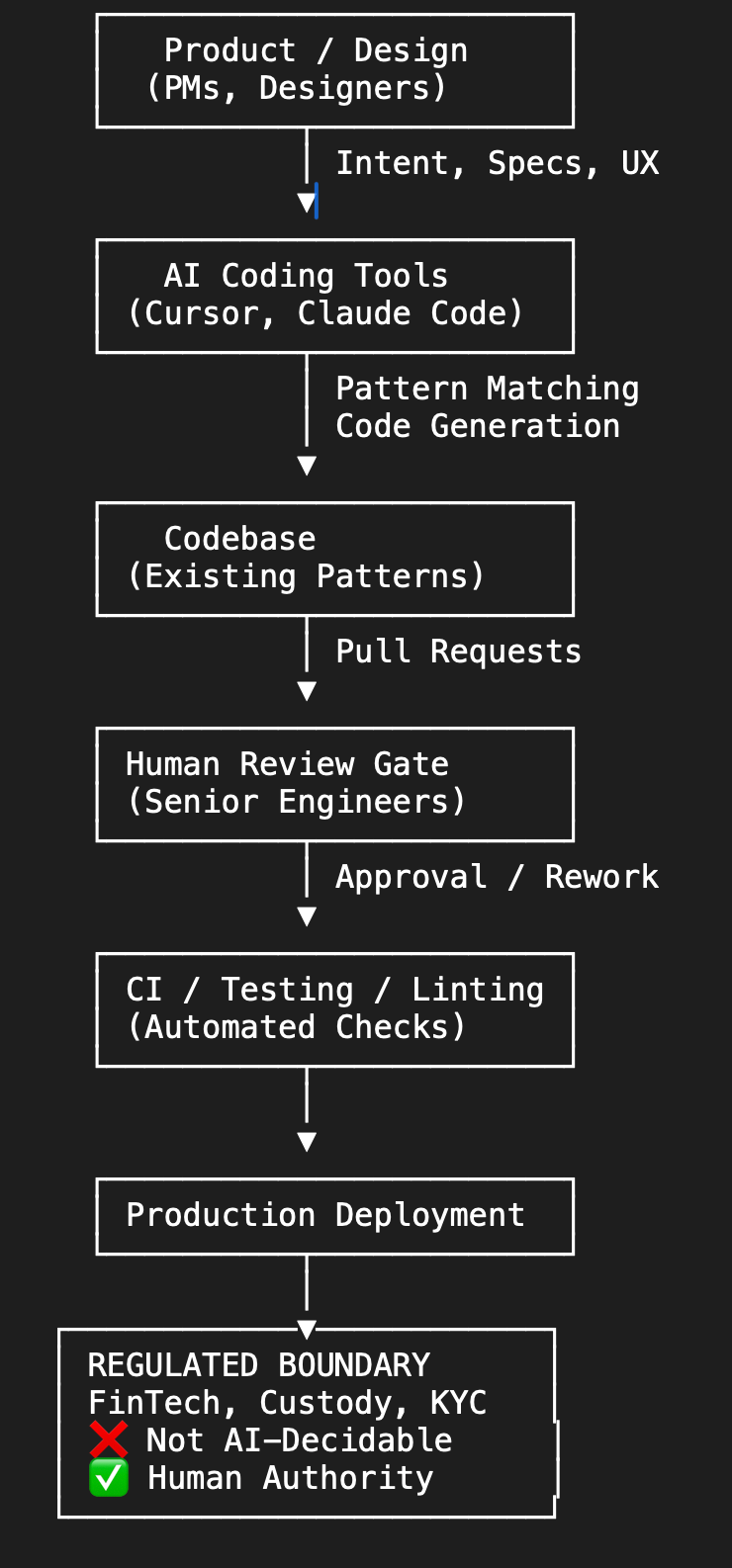
Federico repeatedly emphasizes that “vibe coding is a spectrum,” pushing back on the idea that AI usage is either all-or-nothing. In practice, he explains how tools like Cursor and Claude Code function inside real repositories by learning and reusing existing patterns: “AI will easily pick up on the patterns that were used in the codebase, even if they are not really great.” He explicitly compares AI-assisted contributors to junior engineers, stating, “I consider new kind of vibe coders as junior developers,” highlighting why human review, scoped permissions, and pull-request workflows remain essential. In this model, AI-generated changes still flow through standard processes such as PR reviews and CI validation in systems like GitHub or GitLab, reinforcing that AI augments—not replaces—engineering discipline.
The transcript also establishes a hard technical and operational boundary around regulated systems, especially fintech. While AI can rapidly assemble wallet integrations, SDK usage, and payment flows, Federico is blunt about its limits: “You cannot vibe-code a bank.” He explains that although cloud infrastructure on platforms like AWS and containerized deployments with Kubernetes make implementation easier than ever, regulatory context cannot be inferred from code alone. Custodial models, KYC/AML enforcement, licensing requirements, and jurisdictional constraints must be explicitly defined by humans, because “business requirements and regulations are very far away from vibe coding.” In this framing, AI accelerates execution, but accountability, compliance, and risk ownership remain fundamentally human responsibilities.
The Real Skill That Matters
If there’s one trait Federico looks for above all else, it’s agency.
Not a specific language. Not mastery of a framework. Agency—the ability to take a problem, explore options, leverage tools intelligently, and move forward without waiting for perfect instructions.
In an AI-augmented world, that mindset is the real differentiator.