

In a wide-ranging conversation with Sarbojit Mukherjee, the future of software came into focus as a blend of platform thinking, human-centered AI, decentralized systems, and a new way of measuring collaboration.
Software founders often talk about solving problems. Fewer talk about redesigning the environment in which those problems exist in the first place. In a recent podcast, Krish Palaniappan sat down with Sarbojit, founder and CEO of Baanda, for a discussion that moved well beyond the usual startup talking points. What began as a conversation about SaaS quickly expanded into a broader reflection on how software platforms might evolve in the coming years: not as isolated apps for isolated tasks, but as connected systems built around people, context, and adaptability.
Podcast
Beyond SaaS: Building Platforms Around People, Not Just Products — on Apple and Spotify.
At the center of Sarbojit’s thinking is a simple critique of the modern software landscape. Traditional SaaS, he suggested, often forces users to navigate a maze of disconnected tools, each built for a narrow use case. For small businesses and non-technical users especially, that can create unnecessary complexity. His company, Baanda, is trying to move in a different direction. Its current product, Bazaar, is not meant to stand alone, but to serve as one part of a larger software ecosystem. In Sarbojit’s framing, Bazaar is to Baanda what a flagship product is to a larger platform company: an entry point into a more expansive vision.
Software Platform As A Service
That vision is what he calls “software platform as a service.” The phrase is intentionally broader than SaaS. Instead of giving users one specialized tool at a time, the goal is to offer an integrated digital environment where different business functions can work together behind the scenes. A boutique owner might need a storefront and payments. A handyman may care more about marketing and customer acquisition. A shipping-heavy business might primarily need logistics support. In Baanda’s ideal model, each of those users can operate within the same platform while benefiting from shared systems such as accounting, checkout, and transaction management. The software becomes less a collection of subscriptions and more an operational foundation.
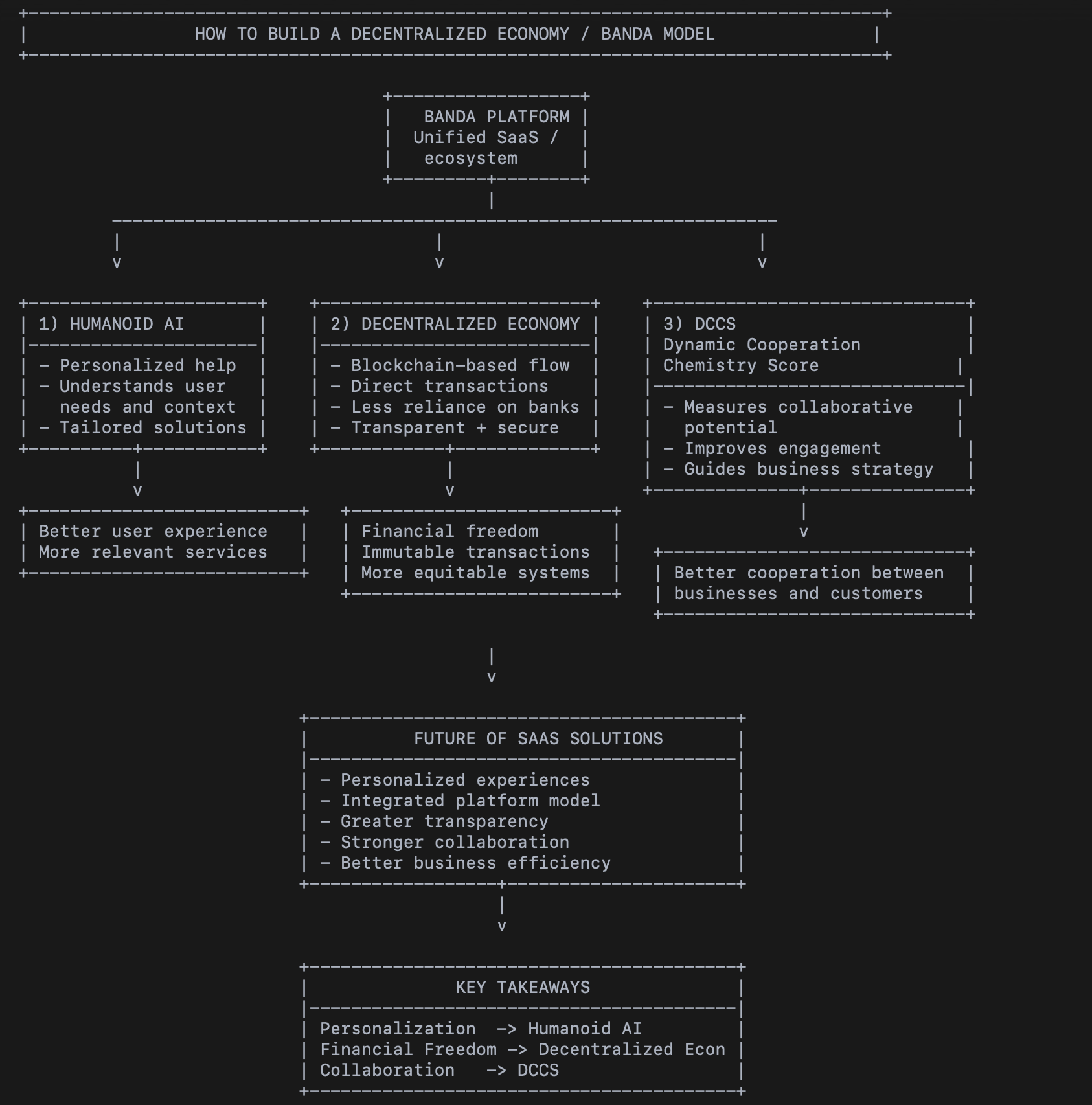
Three Pillars
What makes the conversation especially interesting is that Sarbojit does not stop at product design. He organizes his longer-term thinking around three pillars:
Humanoid AI
Decentralized economy
Dynamic cooperation chemistry score
Humanoid AI
These are not presented as isolated features, but as foundational ideas supporting the platform itself. The first, humanoid AI, is his attempt to describe a system that understands people in a more contextual and individualized way. Rather than treating users as generic profiles inside a workflow, he imagines AI that can recognize differences in ability, motivation, background, and need. In his telling, that has implications not just for commerce, but for education, service delivery, and the broader question of how systems should adapt to the people inside them.
Decentralized economy
The second pillar, decentralized economy, reflects a challenge to conventional financial infrastructure. Sarbojit argues that today’s economic systems remain too dependent on centralized authorities and inherited assumptions about how value should move. He points to blockchain and algorithmic models as potential building blocks for a more distributed transactional system, one less reliant on traditional gatekeepers. Whether one agrees with that outlook or not, it reveals the scale of his ambition: Baanda is not merely trying to become another business software platform, but a framework that could eventually rethink how value itself is managed and exchanged.
Dynamic cooperation chemistry score
Then there is the most unusual of the three pillars: dynamic cooperation chemistry score. Sarbojit describes it almost as a contextual trust or compatibility engine. Like a credit score, it would attempt to generate a probability-based measure, but instead of assessing repayment likelihood, it would estimate whether two people or entities are likely to work well together in a specific setting. Two individuals may be a poor match for one kind of collaboration and an excellent fit for another. A system that can account for personality, timing, skill, and context could, in theory, help guide partnerships, teams, and opportunities more intelligently. It is an abstract idea, but also a revealing one: much of Sarbojit’s worldview centers on the belief that human systems fail when they flatten people into static categories.
Technology Stack
Krish’s questions then grounded the discussion in software engineering reality. What does it actually look like to build a platform with such expansive ambitions in 2026? Sarbojit’s answer was more pragmatic than philosophical. Baanda, he explained, is built primarily on the MERN stack and integrates with tools and services such as AWS, Google, Stripe, EasyPost, Twilio, and SendGrid. The architecture is modular by design, built to evolve over time rather than lock the company into a rigid technical foundation. Even the distinction between the company website and the underlying application matters here: the public-facing site acts as a billboard, while the application itself is structured as a progressive web app meant to support gradual enhancement and long-term change.
That led naturally into one of the most current questions in software: how much of modern development can AI actually take over? Sarbojit’s answer was measured. He did not dismiss AI coding tools; in fact, he credited them with dramatically increasing what a small team can build. But he also argued that there is still a meaningful difference between generating code and designing a living system. AI, in his view, is highly effective at producing fragments, snippets, and functional components. Where it still falls short is in preserving the coherence of a large architecture over time, especially when systems are distributed, interconnected, and subject to constant change. In other words, AI may be a powerful amplifier, but not yet a substitute for architectural thinking.
How AI Is Changing Hiring
The hiring discussion pushed that idea further. If AI can generate code, summarize research, and support cross-functional work, what should companies actually look for in new hires? Sarbojit argued that rigid role definitions are beginning to erode.
The future may belong less to narrowly specialized job descriptions and more to people who can think across boundaries, absorb context quickly, and apply knowledge flexibly.
Formal credentials matter less, he suggested, than curiosity, problem-solving, and the capacity to respond to ambiguity. Even interviews, in that framework, should become more adaptive. A company may miss great candidates if it relies too heavily on fixed formats that reward quick responses over deeper thought.
Purpose of the Podcast
One of the strongest moments in the conversation came near the end, when Sarbojit turned the tables and asked Krish about the purpose of the podcast itself. Krish responded with a thoughtful reflection on learning in public. Too much startup storytelling, he noted, focuses on polished success narratives. What gets lost are the mistakes, uncertainties, and failed experiments that actually shape builders over time. His hope for the podcast is to make that less visible part of the journey more accessible: not just what people built, but how they thought, struggled, adjusted, and learned while building it.
That answer also serves as a fitting way to understand the larger conversation. This was not simply a founder describing his company. It was a conversation about what software might become when the goal is not just feature delivery, but system design at a human level. Sarbojit’s ideas range from practical to speculative, from current product architecture to future models of intelligence and trust. Not every vision this ambitious will unfold as imagined. But that is almost beside the point. What matters is the direction of the thinking: away from fragmented tools, toward adaptive platforms; away from static roles, toward dynamic capability; away from software as product, toward software as environment.
Summary
The podcast explores a vision for moving beyond traditional SaaS toward a broader “software platform as a service” model. Instead of forcing users to manage multiple disconnected tools for storefronts, payments, marketing, accounting, and logistics, the discussion presents the idea of a unified platform where these functions work together behind the scenes. The conversation also introduces three conceptual pillars supporting that vision: a more human-centered form of AI that adapts to individuals in context, a decentralized economic model that rethinks how value is exchanged, and a “dynamic cooperation chemistry score” designed to estimate how well people or entities might work together in different scenarios. Together, these ideas frame software not just as a collection of apps, but as an adaptive environment built around human needs and relationships.
The conversation then shifts into the practical realities of building such a platform. It covers the use of a MERN-based architecture, modular system design, and integrations with services like payments, messaging, shipping, and cloud infrastructure. A major theme is the role of AI in software development: AI tools are seen as highly useful for generating code snippets and accelerating implementation, but still limited when it comes to preserving the coherence of large, evolving systems. The podcast also examines how hiring is changing in response to these shifts, arguing that companies should increasingly value curiosity, adaptability, and context-driven problem solving over rigid job definitions or static credentials. In the end, the discussion becomes a broader reflection on how software, work, and collaboration may evolve together in an AI-shaped future.
If that shift does happen, the most important software companies of the future may not be the ones that build the most features. They may be the ones that understand people most deeply, connect systems most thoughtfully, and create the most coherent spaces for human work, exchange, and collaboration. That is the wager underneath Baanda’s vision, and it is what made this conversation worth paying attention to.