

The setup
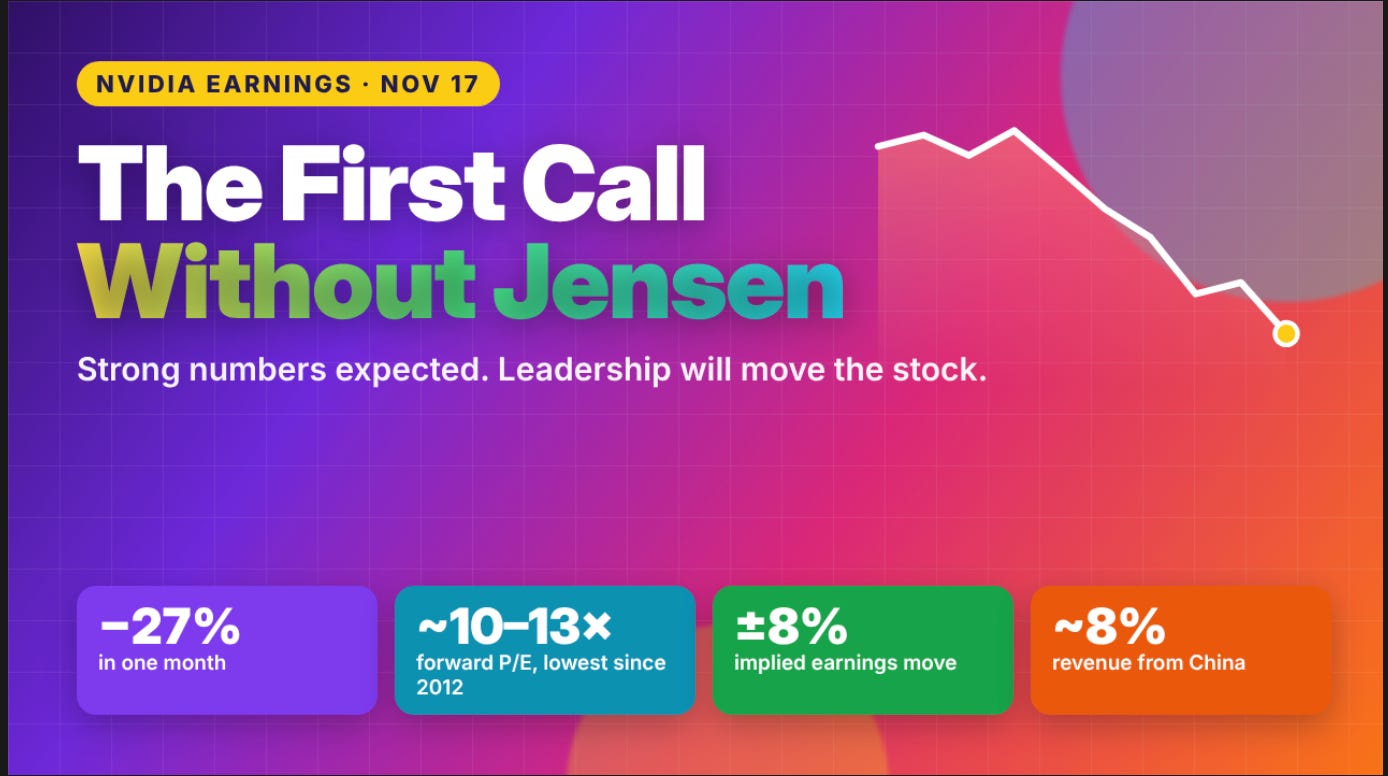
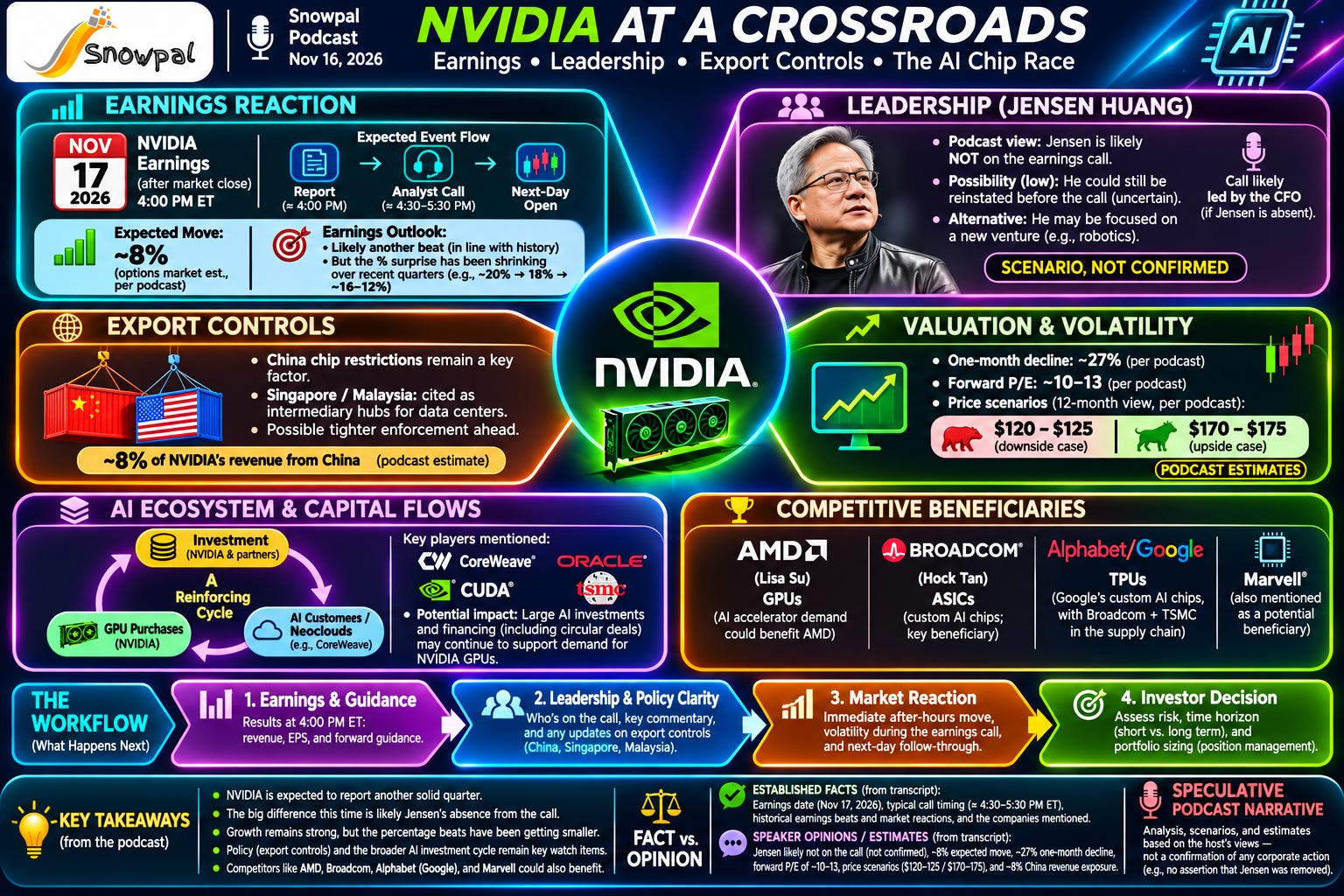
NVIDIA reports earnings on Tuesday, November 17, 2026, after the 4:00 p.m. ET close. Every NVIDIA report draws attention, but this one is different from any before it. It will be the first earnings call in the company’s history without co-founder Jensen Huang.
Huang resigned as president, CEO and board member on November 12, after the board opened an independent investigation tied to reports involving Megaspeed, a Singapore-based company that U.S. officials suspect of routing NVIDIA chips to China. CFO Colette Kress is interim CEO and is expected to lead the call. An open letter is circulating that urges the board to reinstate Huang. A reversal before tomorrow afternoon is very unlikely.
The thesis of this episode is simple. The numbers will probably be strong, and they probably won’t decide where the stock goes next.
Podcast
Earnings Without the Architect: NVIDIA’s First Report After Jensen Huang — on Apple and Spotify.
1. How the stock reacts on earnings day
From what I’ve seen trading NVIDIA reports, the stock usually reacts in two waves:
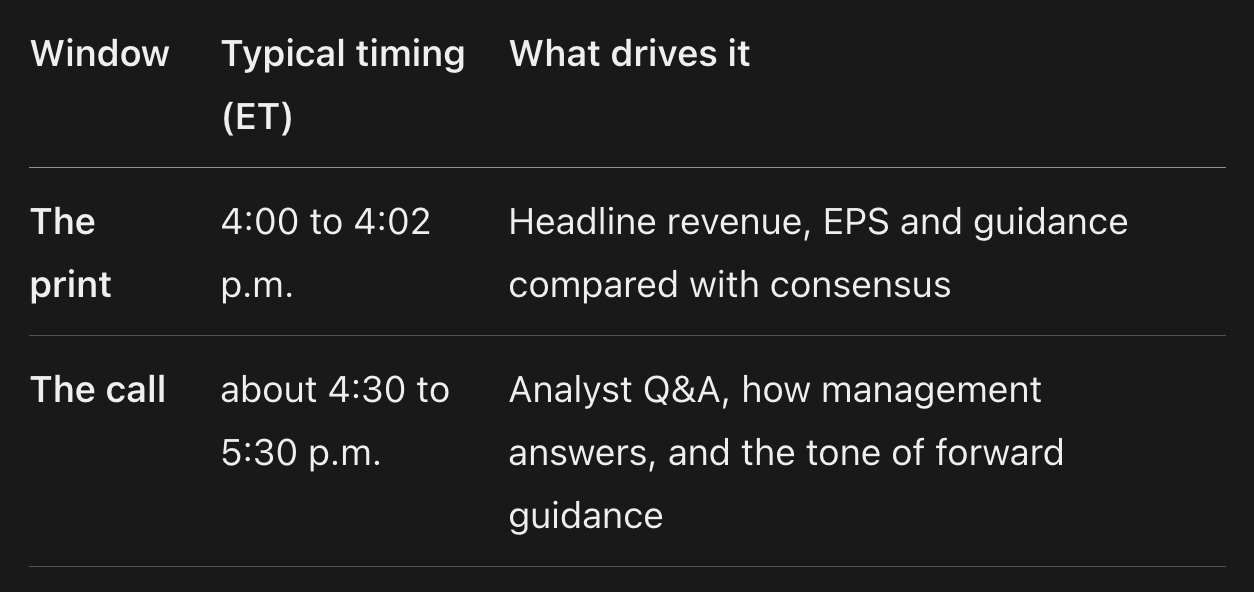
Trading volume during the call is often heavy, because the answers either confirm or undercut what the print suggested. Both waves are after-hours moves, though. What matters more is Wednesday’s open. A +7% after-hours pop doesn’t mean the stock keeps going that way the next day.
2. Bigger company, smaller beats
NVIDIA has beaten revenue, EPS and guidance for many quarters in a row. The size of the beat, though, has been shrinking. As an illustration of the pattern, not actual data, a 20% beat becomes 18%, then 16%, then 12%.
That’s basic scale. Growing a $2T company by a given percentage is far easier than growing a $5T company by the same amount. There is only so much capital in the world at any one time. The market sometimes punishes a beat whose percentage growth has slowed, even when the dollar growth is still enormous.
3. Reading the pre-earnings tape
Figures cited on the show, as of the November 16 close:
Price: about $155 to $157
Last month: down about 27%, a loss of well over $1 trillion in market value. The company went from above $5T to under $4T.
Year to date: down about 16%, despite beating every report this year
Recent post-earnings moves: usually around ±5%, with +8% after the August 26 report
Options-implied move: about ±8%
Price context: a mid-$150s start would be about the lowest level in roughly 18 months. The last comparable level was about $134 in mid-2025.
An ±8% implied move looks reasonable, maybe even modest, given how far the stock has already fallen. Price levels and the 50, 100 and 200-day moving averages aren’t predictive in themselves, but they tell you where you stand.
4. Valuation: the cheapest in more than a decade
NVIDIA’s forward P/E is about 10 to 13. The last time it was below 12 was back in 2012, well over a decade ago.
Consensus expects another beat on both the top and bottom lines. Last quarter’s revenue was about $96B, and this quarter could reach $100B or more. If NVIDIA misses or guides below expectations, that would change everything, and the sell-off would probably continue. That outcome looks unlikely. A good report is mostly priced in. The risk is mostly outside the numbers.
5. Why fundamentals may not drive this reaction
If the report is clean, the after-hours move will depend on the questions analysts ask and how they get answered. Some things to watch:
Leadership questions. Will analysts ask about the investigation, a permanent CEO, or reinstatement?
A narrowed call. Management may decline to talk about an ongoing investigation and keep the Q&A focused on financial results. That’s a real possibility and arguably the most likely one. It could leave the market without answers to its biggest questions.
A different tone. A call led by an engineer-founder will feel very different from one led by a finance executive, however capable she is.
6. China, export controls and the Singapore loophole
The policy argument
U.S. export controls already stop NVIDIA from selling its best current chips to China. Huang has long argued against those controls. His view is that if China can’t buy American chips, it will build its own chip and software stack, and the U.S. will lose its AI leadership.
My counterpoint: if I were China, I’d be building my own chips anyway, so I wasn’t dependent on a supplier that a regulator can cut off at any time. Selling the chips doesn’t remove that motivation. Still, I wasn’t the one running a multi-trillion-dollar company, so I may be missing something.
The loophole
The New York Times reported that lawmakers may move to close the third-country loophole. Under it, chips aren’t sold to China directly. They go to data centers in countries such as Singapore or Malaysia, which then serve customers based in China. In practice, that’s the same as selling to China. Congress is also advancing related bills, including the Remote Access Security Act, which targets Chinese access to U.S. chips through cloud services.
Running the numbers
NVIDIA’s China revenue was about $7 to 8B last quarter, or about 8% of total revenue. For comparison, Apple’s China share is about 15%.
Here is a rough stress test. If NVIDIA lost all China revenue and earnings fell proportionally:

Conclusion: losing China would clearly hurt the bottom line. Even so, NVIDIA would still be cheap by historical standards, especially if demand elsewhere makes up some of the lost volume.
7. What happens if there’s a fine
If investigators find export-control violations by Huang personally or by NVIDIA as a company, a fine is likely, possibly in the tens of billions of dollars. Past cases offer some perspective. Fines against Meta and Google were small relative to revenue and market cap, and they were often spread over several quarters. The financial hit from a fine is real but probably limited. The bigger risk is the effect on reputation and leadership.
8. The founder premium and circular financing
The hardest thing to measure is what Huang personally carried:
Circular financing. NVIDIA invests in small and mid-sized AI companies that then buy NVIDIA chips. Bloomberg mapped these links across NVIDIA, Google, Oracle, Broadcom, Nebius, CoreWeave and other neoclouds. Huang held much of this web together through his personal clout.
Relationships. His reach in the U.S., in Taiwan and elsewhere helped make hundreds of billions of dollars in deals possible.
Engineering and business vision together. That combination is rare even among very capable successors.
Those things can’t simply be handed to someone else.
9. Will he come back?
The precedents don’t fit neatly. Sam Altman was back at OpenAI within days. Steve Jobs took more than a decade to return to Apple. This case will probably follow its own timeline.
My speculation: I’d be surprised if Huang isn’t reinstated eventually, perhaps 6 to 18 months after things settle and possibly by the end of 2027. He has the money and the backing to start a new company, and Elon Musk has publicly said he’d hire him. But NVIDIA took more than 30 years to build. The GPUs, CUDA and the rest of the IP are there, and that’s where his life’s work is. If he does return, a sharp relief rally is plausible. If he doesn’t, the market will have to price NVIDIA without its founder.
10. Who could benefit
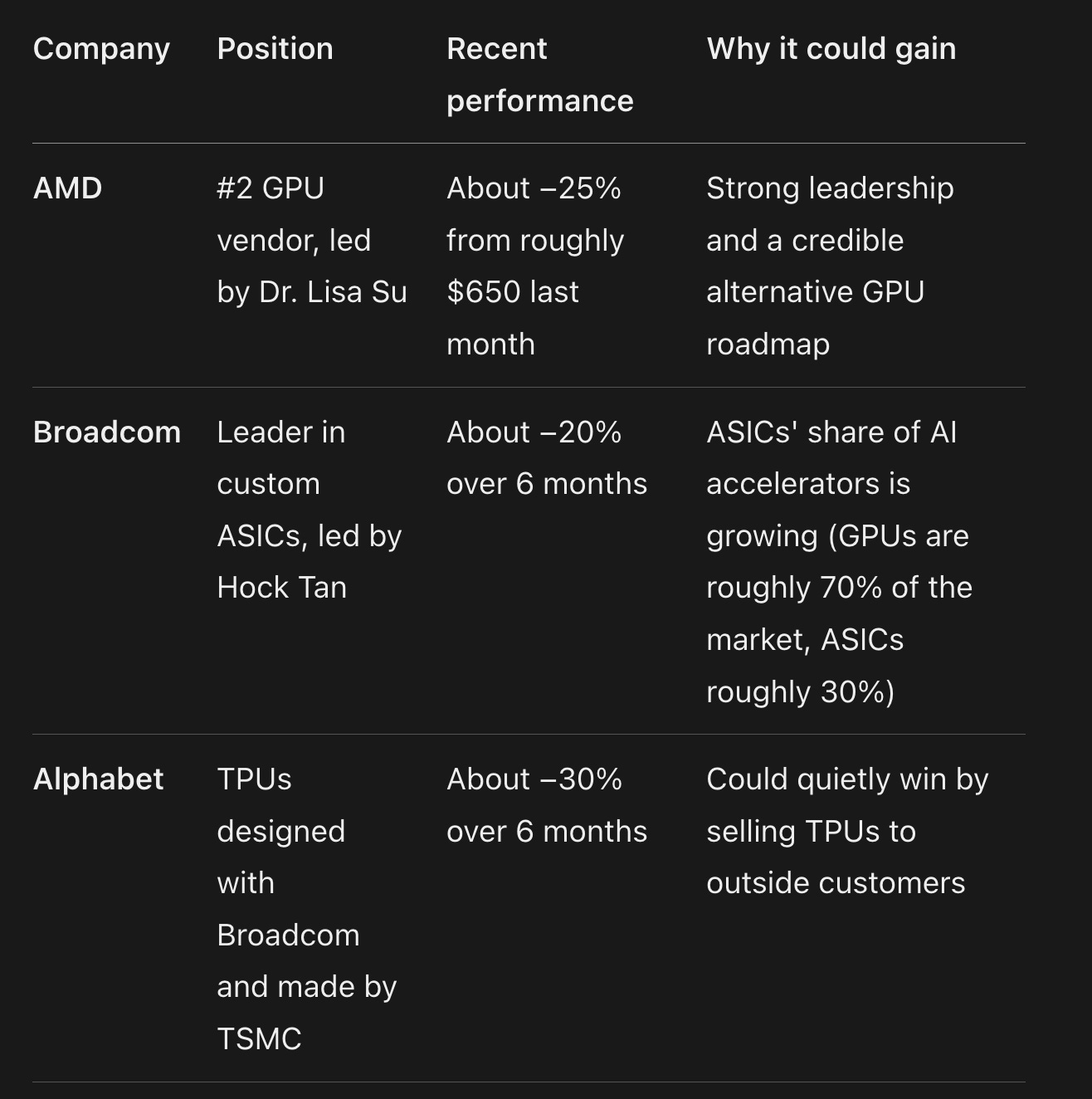
Most of the semiconductor sector has sold off along with NVIDIA, so any benefit to these companies is a long-term argument, not a quick trade.
11. Thinking like an investor, not a trader
For day trades, I often don’t know who runs a company. For positions I hold overnight or long term, leadership matters to me. That means the products, the strategy and the person leading the company. Huang was one of my favorite CEOs for years. Between the events of the past week and reports about his leadership style, I see NVIDIA differently now. It’s still an exceptional company, possibly the company of the AI era, but the person leading it has changed.
If you’re deciding whether to buy at these prices, here are the questions to ask:
Risk versus reward. The valuation is attractive, but there’s a lot of risk attached to it.
Position size. What share of your portfolio are you willing to risk?
Holding period. Five years from now, will this be noise or a fundamental change in how NVIDIA operates?
Strategic importance. NVIDIA sells roughly 90% of AI chips. Is there political will to protect the company, and possibly its founder?
Scenarios for Wednesday
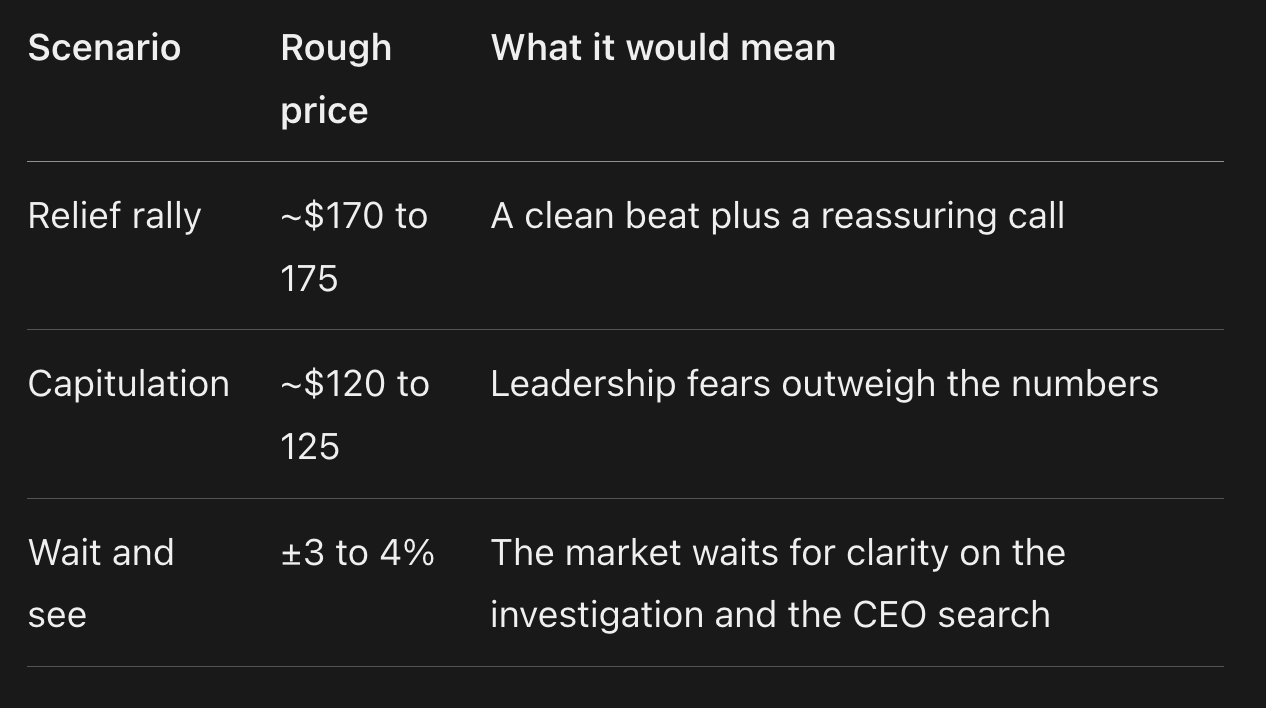
Whatever happens, Tuesday afternoon will be one of the most closely watched reports in NVIDIA’s history.
Disclaimer: This article reflects personal opinion and speculation for entertainment and educational purposes. It is not investment advice. Figures are approximate and were cited live on the podcast. Check them independently before acting on them.
Snowpal builds domain-agnostic Backend-as-a-Service APIs. Find us on AWS Marketplace.