

Artificial Intelligence is fundamentally altering the software engineering lifecycle by embedding generative and reasoning capabilities directly into development workflows. Modern AI systems—particularly large language models (LLMs), code-generation models, and agent frameworks—are no longer peripheral productivity tools; they are becoming core execution engines within product development, infrastructure management, and business operations.
In practical terms, this shift manifests as AI-assisted code generation, automated test creation, rapid prototyping, infrastructure orchestration, and increasingly autonomous agents capable of executing multi-step workflows. The traditional separation between requirements definition, implementation, testing, and deployment is compressing as AI systems enable real-time iteration and context-aware development.
Simultaneously, infrastructure is evolving to support AI-native architectures. GPU-accelerated compute, vector databases, model context protocols, inference pipelines, and distributed orchestration layers are becoming standard components of modern stacks. Organizations must now design systems that integrate deterministic software logic with probabilistic AI outputs, introducing new considerations around reliability, observability, security, and cost optimization.
This transformation is not incremental—it represents a structural shift in how software is conceived, built, deployed, and monetized. As AI capabilities mature, technical teams must adapt their architectures, workflows, and skill sets to operate effectively in an AI-augmented engineering environment.
Podcast
AI Fluency: The New Career Superpower - on Apple and Spotify.
Introduction: Living on a Moving Platform
Artificial Intelligence is no longer a future possibility—it is actively reshaping industries in real time. Conversations with founders, engineers, and product leaders reveal a consistent theme: AI is not simply enhancing workflows; it is redefining how work gets done. The next 6–12 months are likely to create lasting structural changes across software development, hiring, infrastructure, and business models.
AI Is Rewriting Software Teams
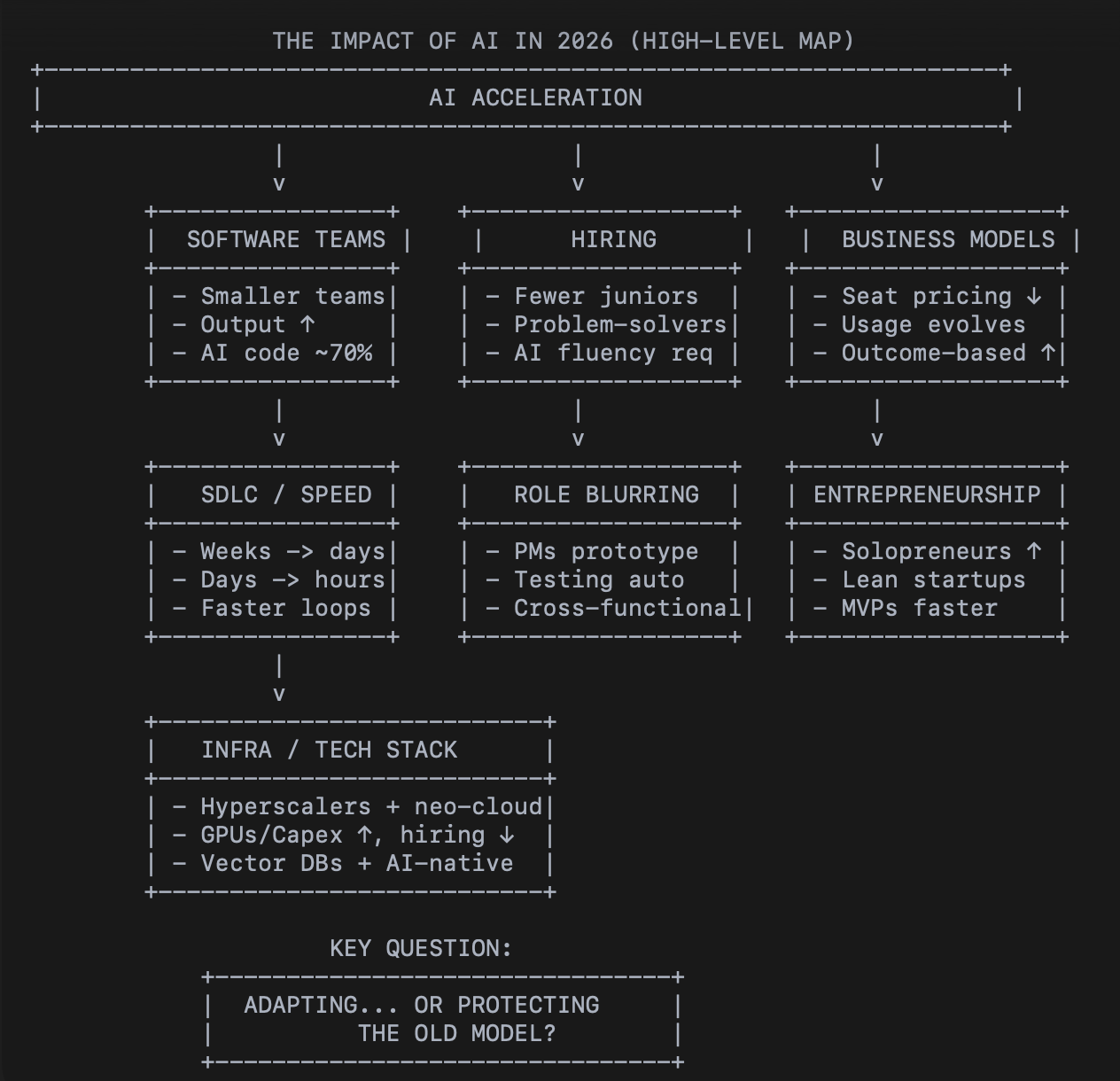
One of the most visible changes is the compression of development cycles. Work that once took weeks now takes days, and tasks that once required days can now be completed in hours. In many teams, roughly 70% of the code is AI-generated, with developers focusing more on refining, reviewing, and architecting rather than writing every line from scratch. Teams are becoming smaller, yet output is increasing. The traditional sprint model and software development lifecycle are evolving to accommodate faster iteration and shorter feedback loops.
Roles Are Blurring and Junior Hiring Is Shrinking
The clear separation between developers, testers, product managers, and DevOps engineers is fading. Product managers increasingly generate functional prototypes before handing off work. Tests are automatically generated. Developers double as reviewers and architects. Many companies are reducing or eliminating junior developer hiring, relying instead on smaller teams of experienced engineers augmented by AI tools. Cross-functional adaptability and AI fluency have become essential skills across all roles.
AI-driven disruption is not speculative—it is already underway. The platform is moving, and the pace is accelerating. Those who adapt quickly will shape the next era of software and business.
Non-Developers Can Now Build Software
A major shift is the democratization of software creation. Founders with no formal coding background are building prototypes and, in some cases, reaching production without full-time developers. While senior engineers remain critical for scaling, performance, and security, they are no longer the starting requirement for launching a product. This dramatically lowers the barrier to entrepreneurship and experimentation.
Hiring Now Prioritizes Problem Solvers
Companies are moving away from hiring narrowly defined language specialists. Instead, they seek strong problem solvers who can leverage AI tools effectively, adapt quickly, and deliver functional outcomes. Coding knowledge still helps, but raw coding ability alone is no longer sufficient. AI fluency is now baseline competence for developers, product managers, consultants, and even sales teams.
Infrastructure and Tech Stacks Are Evolving
The infrastructure landscape is shifting as well. While traditional hyperscalers like AWS, Azure, and Google Cloud remain dominant, AI-focused “neo-cloud” providers are emerging with GPU-first architectures and AI-centric tooling. Tech stacks are evolving to include vector databases, model orchestration layers, and AI-native components. Companies must be cautious about vendor lock-in while adapting to this rapidly changing ecosystem.
SaaS Is Evolving, Not Dying
Enterprise software is not disappearing, but pricing and engagement models are changing. Seat-based pricing faces pressure as companies reduce headcount. Usage-based models must adapt as AI agents optimize workflows and reduce repetitive calls. Outcome-based pricing is gaining traction, where customers pay for results rather than activity. SaaS companies must continuously adapt their business models to remain competitive.
Entrepreneurship and Solopreneurship Are Rising
As automation increases and traditional roles shrink, entrepreneurship is becoming more accessible. Solopreneurs can now build and ship products without large teams or heavy capital investment. AI tools reduce the need for early funding and allow founders to validate ideas quickly. The possibility of ultra-lean startups reaching significant scale is increasing.
Experience, Education, and Compensation Are Being Reweighted
Years of experience matter less than adaptability, recent relevance, and AI fluency. Continuous upskilling is mandatory. College degrees still signal commitment and rigor, but they are no longer strict requirements in software. Education models themselves may undergo transformation in the coming decade. Meanwhile, compensation structures are likely to shift, with some AI-heavy roles commanding higher pay while others face downward pressure.
What Matters Most Now
The defining traits of 2026 are cross-domain thinking, speed of execution, AI fluency, adaptability, and the ability to ship quickly. Output expectations are rising, and clients are becoming more sophisticated in their use of AI tools. The fundamental question facing individuals and organizations is simple: are you adapting to the new model, or trying to protect the old one?
Summary
Here’s a quick recap —
Teams are becoming smaller and more efficient.Non-developers can now complete up to 70% of traditional development work, often reaching proof-of-concept (POC) stage and, in some cases, even beyond.Team composition has shifted. Fewer junior developers are needed, and senior developers increasingly act as facilitators, orchestrators, and reviewers rather than sole builders.Over 70% (or more) of code is now AI-generated, fundamentally changing how software is written and reviewed.Software development life cycles (SDLC), roles, architecture, and technologies have evolved significantly. Software can no longer be built the way it was in the past.Turnaround times have compressed dramatically, dropping from days to mere hours in many cases.Organizations face a strategic split:Some maintain the same team size to accomplish significantly more.Others aim to achieve the same output with fewer resources.
The hiring process has changed. Employers now prioritize strong problem-solvers over language-specific coders, although language awareness remains valuable.What matters most is your ability to solve cross-domain problems quickly using modern AI tools, rather than your diploma, certifications, or total years of experience.Practical AI fluency is essential. Theoretical understanding alone is no longer sufficient — hands-on experience is critical.Long tenures are less emphasized. Employers care more about what you’ve accomplished in the past decade than total years of experience. Staying current is essential.A college degree is not strictly required, but it still signals important traits, such as commitment, discipline, and foundational thinking.A major shift is expected within the next two years. Some roles will disappear, while entirely new roles will emerge.Entrepreneurship is rising relative to traditional employment, driven by layoffs and AI-enabled leverage.The probability of solopreneur-driven unicorns has increased significantly.Neo-cloud providers are challenging traditional hyperscalers as the default choice.Neo-clouds specialize in high-performance computing — particularly GPU-as-a-Service (GPUaaS) — optimized for AI/ML workloads. Unlike traditional hyperscalers, they focus on raw compute power, faster deployment, and lower costs for training and inference.Vendor lock-in remains a real concern, as there is limited interoperability across cloud providers.The SaaS model is evolving. Enterprise software companies are not disappearing, but they must deeply integrate AI into their offerings. Traditional seat-based pricing models are unlikely to remain viable.Capital expenditure (CapEx) is increasing, which will likely impact operational expenditure (OpEx), including reduced hiring and leaner workforce strategies.Globally, the U.S. and China are leading AI innovation in different ways, while India is likely to remain a major back-office AI services hub. Outsourcing will not disappear, but it will shift toward outcome-based engagements rather than labor-arbitrage models.