

Ten technology giants are making very different bets on AI. As earnings, valuations and a market correction reshape the picture, the real question is which of them can turn AI leadership into lasting profit.
Artificial intelligence is driving one of the biggest shifts the technology industry has seen in decades. It is changing how businesses operate, how people find information, and how the world’s largest companies spend their money. Some are pouring hundreds of billions of dollars into AI infrastructure. Others are designing specialized processors, expanding cloud platforms, or chasing ambitious goals in autonomous vehicles, robotics and space.
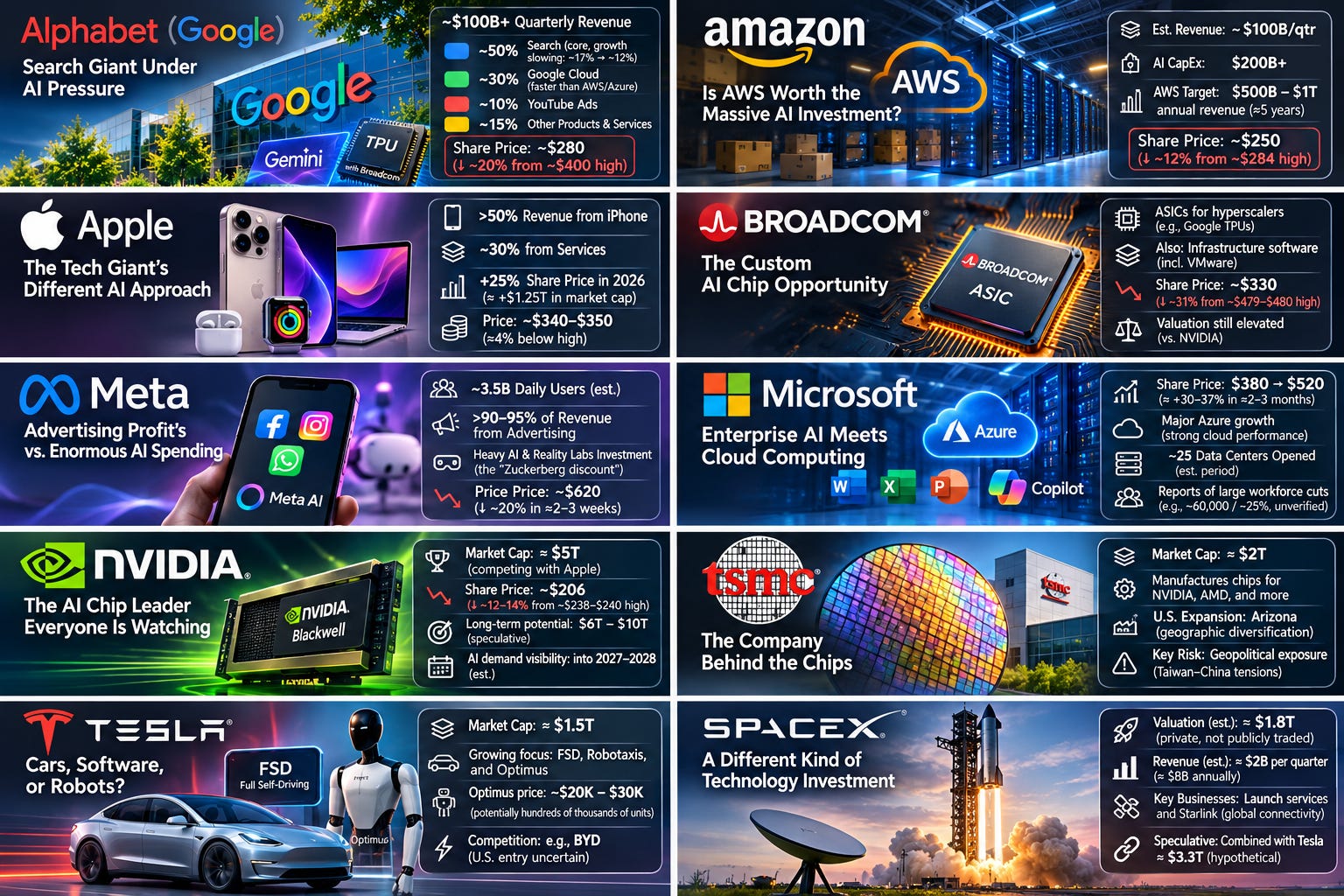
In this podcast, I look at ten of those companies: Alphabet, Amazon, Apple, Broadcom, Meta, Microsoft, Nvidia, Taiwan Semiconductor Manufacturing Company (TSMC), Tesla and SpaceX. Not all of them are hyperscalers in the traditional sense, but together they account for a large share of the AI economy. For each, we cover earnings, share-price moves, capital spending, competitive advantages, valuation and long-term prospects, including the real possibility that some of today’s leaders will eventually lose their edge.
The timing makes this especially interesting. Tech stocks have pulled back after a strong year, and several big names are trading well below their highs. The episode was also recorded around the November 2026 U.S. midterm elections, which historically have been followed by strong months for stocks. Against that backdrop, the question isn’t simply which companies will benefit from AI. It’s which ones can turn technological leadership into durable profits, and whether their share prices already assume too much.
Podcast
Big Tech's $Trillion Gamble: AI, Earnings, and the Next Market Winners — on Apple and Spotify.
Alphabet (Google): Can AI Disrupt the King of Search?
Alphabet reported earnings shortly before we recorded, and I seriously considered trading around them. I passed, not because I expected weak numbers, but because I’m worried about the future of Google Search. By my rough recollection, Alphabet brings in more than $100 billion a quarter, with search making up about half, Google Cloud around 30%, YouTube ads around 10% and everything else roughly 15%. Those estimates don’t add up neatly to 100%, but the point stands: search is the engine of the business, so any lasting damage to its economics matters a great deal.
What concerned me most was the slowdown. Search revenue grew about 12% year over year this period, down from roughly 17% in an earlier comparable period. Alphabet isn’t losing search revenue outright, but when one product carries this much of the company, even a modest drop in growth can hit the valuation hard, and it may signal changing user habits, tougher competition or a maturing business. My own habits are part of why I worry. I used to rely on Google for everything, and now I turn to ChatGPT, Claude and other AI assistants for many of those same questions. That’s one person’s experience, not data, but I doubt I’m alone. Generative AI gives people direct, conversational answers instead of a list of links, and Google now faces real competition from companies that were never considered search rivals. Gemini and AI-powered search may boost engagement, but more time spent doesn’t automatically mean more ad revenue if AI answers are cheaper to monetize than traditional search.
Alphabet is far more than search, though. Google Cloud is growing quickly and competing harder with AWS and Azure, and may be growing faster than both, though that’s worth checking against their reports. Google also designs its own AI chips, called Tensor Processing Units (TPUs), with help from Broadcom. Custom silicon could reduce its reliance on outside suppliers like Nvidia, and I wonder whether Google might eventually sell more of that computing power to other companies rather than keeping it mostly in-house.
On the stock itself, Alphabet was trading just under $280 at recording time, against a high I recalled as roughly $400. By my estimate, it fell about 20% before earnings and another 10–12% after, wiping out perhaps $500 billion in market value. These are approximate figures, and the $400 high in particular needs confirming. None of this changes the fact that Alphabet, under Sundar Pichai, is an extraordinary company with world-class engineers, deep pockets and a broad product lineup. The question is whether Cloud, Gemini, TPUs and YouTube can produce enough new profit to offset any structural pressure on search. The investment question: is the share-price weakness a buying opportunity, or an early sign that the economics of Alphabet’s most important business are changing?
Amazon: Is AWS Worth the Massive AI Investment?
Amazon’s latest earnings showed how jumpy investors have become about AI spending. As I recall, the stock dropped about 11% after hours, recovered to a 5–6% loss, and by the next session was down less than 2%. Notably, Amazon hadn’t backed away from its aggressive infrastructure plans. Investors simply seemed to weigh the enormous spending against AWS’s growth potential and decide it was acceptable, a good reminder that the first after-hours reaction rarely has the final word.
The spending really is enormous. We discussed Amazon potentially putting more than $200 billion into capital expenditure, mostly for AI data centers and hardware, though that’s my estimate rather than confirmed guidance. Spending on that scale isn’t good or bad in itself; what matters is demand, utilization, pricing, depreciation and the returns those assets earn over their lifetime. Here AWS is the key. Amazon’s retail business generates huge revenue on thin margins, while AWS, though a smaller slice of sales (I loosely estimated total quarterly revenue at around $100 billion), has long produced an outsized share of operating profit. Because AI demand flows into a business Amazon already runs profitably, it can grow something proven instead of inventing a new model.
The upside case is striking. I mentioned a scenario, which I attributed to Amazon leadership, where AWS grows to between $500 billion and $1 trillion in annual revenue over roughly five years. The exact source and timeframe need verifying, and it shouldn’t be plugged into a valuation model without scrutiny, but it shows the scale investors are imagining. AWS still faces stiff competition from Azure and Google Cloud, both spending heavily on AI. At recording time, Amazon traded around $250, roughly 12% below a recalled high of about $284. I called that an interesting potential entry point, but a lower price alone doesn’t make a stock cheap. The investment question: can AWS produce enough new revenue and profit to justify Amazon’s massive infrastructure bets while holding its ground against Microsoft and Google?
Apple: The Tech Giant Taking a Different Approach to AI
Apple works very differently from the cloud and chip companies on this list. The iPhone still drives more than half of its revenue, backed by fierce brand loyalty, premium pricing and an ecosystem that keeps customers inside Apple’s world. Services such as subscriptions and software add recurring revenue, which I estimated at around 30% of the total, though that figure should be checked. This mix of hardware and steady services income means Apple’s fortunes don’t hinge on data center construction or chip demand the way its peers’ do.
The stock has had a remarkable year, up roughly 25% in 2026 for a company nearing a $5 trillion valuation. From a $5 trillion base, that would be about $1.25 trillion in added value. At recording time, I had it trading near $340–$350, about 4% below its high, with Apple and Nvidia trading places as the world’s most valuable public company. Those numbers are from memory and need confirming. Partly in jest, I described Apple as spending very little on AI infrastructure, but the serious point is that its business simply doesn’t need the data center footprint of AWS, Azure or Google Cloud. What matters more is product launches and holiday demand. We discussed a premium device I recalled as the “Duo,” priced somewhere between $2,000 and $3,000 (name and price both need verifying), along with a possibly faster release cycle and how a strong holiday quarter could lift earnings.
The catch is valuation. Apple trades at a relatively high forward P/E compared with several peers, a premium investors pay for its ecosystem, brand, cash generation and loyal customers. But a premium sets a high bar, and brand strength doesn’t protect against slower growth, competition or disappointing returns. The investment question: can Apple keep delivering strong earnings and shareholder returns without matching its rivals’ huge AI infrastructure spending?
Broadcom: The Custom AI Chip Opportunity
Broadcom stands out in AI semiconductors because it doesn’t sell what Nvidia sells. Nvidia’s GPUs are flexible processors that handle a wide range of workloads. Broadcom specializes in application-specific integrated circuits (ASICs), chips built for one job that can be far more efficient at it. Its role helping big tech companies design custom AI chips, including Google’s TPUs, puts it in a strong position as hyperscalers try to cut costs, boost performance and control more of their own hardware. AMD competes with Nvidia head-on in GPUs, and Marvell works in custom silicon and networking, but Broadcom’s ASIC focus means it doesn’t compete with Nvidia the way AMD does.
The company is led by Hock Tan, who is originally from Penang, Malaysia, a detail I mentioned because of my family’s ties there, though leadership and results are what count for investors. Broadcom is also more than a chip company. Its acquisition of VMware gave it a large infrastructure software business, which matters when you assess its overall revenue, profit and valuation.
Its share price saw one of the sharpest drops in the series, falling from a recalled high of about $480 to around $330. Using those rounded numbers, that’s a decline of about 31% (I estimated 30–33% on the podcast). A big drop doesn’t automatically make a stock cheap, though. If earnings expectations fall or the old valuation was too rich, a stock can stay expensive even after a steep slide, and Broadcom still carries relatively high trailing and forward P/E ratios compared with Nvidia. We also touched on the increasingly circular nature of AI financing, where companies like Nvidia invest in businesses that then buy their products. These arrangements can be legitimate, but investors should ask whether the underlying demand is real and whether customers can keep funding their commitments. I raised concerns about borrowing, off-balance-sheet deals and credit default swaps, but to be clear, credit default swaps transfer credit risk rather than hide capital spending, and there’s no evidence Broadcom used any particular financing structure. The investment question: does Broadcom’s steep correction create an opportunity, or does its valuation still assume too much AI growth?
Meta: Advertising Profits Versus Enormous AI Spending
Meta makes its money from advertising across Facebook, Instagram, WhatsApp and the rest of its apps. By my rough estimate, ads account for more than 90% of revenue, and Meta reaches something like 3.5 billion people a day (Meta reports several engagement measures, so the exact figure needs checking). That audience makes Meta hard to ignore for any business. At Snowpal we also advertise on LinkedIn and elsewhere, but Meta’s reach makes it central to customer acquisition. My sense is that organic reach is getting harder, which may push businesses to rely even more on paid ads, though that’s an observation rather than a proven trend.
Investors have long applied what I call the “Zuckerberg discount,” a lower valuation reflecting Mark Zuckerberg’s willingness to spend heavily on bets with uncertain payoffs, such as Reality Labs and AI infrastructure. Reality Labs has lost a great deal of money while the ad business keeps producing large profits, and the tension is whether those long-term bets will pay off or simply consume cash that could go to shareholders. The stock’s ride this year shows how quickly sentiment can swing. I recalled Meta trading near $750 before an earlier earnings report, falling more than 10% right after, and eventually dropping below $600, a decline of at least 20%. It then rallied on excitement about new products and AI, only to sell off again when Meta reaffirmed its big spending plans. At recording time, it was around $620 after a drop of nearly 20% over two or three weeks.
AI can make Meta’s existing business better through sharper ad targeting, recommendations, engagement and conversions. But Meta faces a different monetization challenge than AWS or Azure. Cloud providers bill customers directly for computing, while Meta mostly captures AI’s value indirectly through better ad performance. We also mentioned a new product I recalled as “Muse” that had generated buzz, though its identity and results need verifying. The bigger question is whether Meta can build meaningful new AI revenue on top of its ad engine. The investment question: can Meta’s huge audience and ad profits fund its AI ambitions without capital spending overwhelming future returns?
Microsoft: Enterprise AI Meets Cloud Computing
Microsoft has staged a strong comeback. The stock traded around $380 roughly two to three months before the recording and climbed back to about $520. I called it a 30% gain on the podcast; using those rounded prices it’s closer to 37%, a big move for a company this size. Part of that was catch-up, since Microsoft had lagged earlier, but its cloud business is clearly firing. Azure is benefiting from strong demand for computing and AI services, and Microsoft’s biggest advantage is distribution. Companies already using Microsoft 365, Azure and GitHub can add AI features without overhauling their technology, giving Microsoft several ways to cash in: cloud infrastructure, software subscriptions and productivity tools.
The build-out is happening fast. I mentioned Microsoft opening about 25 data centers recently, though I wasn’t sure whether that was in one quarter or year to date, and the figure needs verifying. Either way, turning that new capacity into profitable demand is critical given how much the industry is spending. I also brought up reports or impressions of large workforce cuts or voluntary retirement programs, speculating about figures as high as 25% of staff or around 60,000 employees. Those numbers are unconfirmed and shouldn’t be treated as Microsoft announcements, nor should any job cuts automatically be blamed on AI. Still, the broader idea is worth watching: if AI agents can automate work employees used to do, Microsoft could improve its own margins while selling the same capabilities to customers.
Under Satya Nadella, Microsoft has become a leading enterprise cloud and software company, and we spoke highly of its management. The issue is price. After its rebound, the stock sits fairly close to its highs, which makes it less obviously attractive than names that have corrected more. Forward P/E, price-to-sales, earnings growth and capital spending all matter in judging what return it can deliver from here. The investment question: can Microsoft’s enterprise reach and Azure growth generate enough earnings to justify its valuation after such a strong recovery?
Nvidia: The AI Chip Leader Everyone Is Watching
Nvidia is approaching a $5 trillion valuation and trades places with Apple as the world’s most valuable company. Under Jensen Huang, it has become the essential supplier of the GPUs used to train and run AI models, and its lead rests not only on hardware but on its software ecosystem, engineering depth and close customer relationships. At recording time, the stock was around $206, against a high I put at $238–$240. From $240, that’s a drop of about 14% (I said roughly 12% on the podcast). It had traded around $215, $220 and $225 in prior months, which made me wonder whether the dip might be a good time to build a long-term position gradually. That wasn’t a call to buy right away, just an observation about how a correction shifts the balance between price and expected returns.
Could Nvidia reach $6, $7, $8 or even $10 trillion? Going from $5 trillion to $10 trillion means doubling, which gets harder the bigger a company becomes. Future gains depend on earnings growth, valuation multiples and holding its competitive position, and I’d caution against leaning too much on analyst price targets, which shift quickly. Competition comes from two directions. AMD challenges Nvidia directly in GPUs, while Google, Amazon and other hyperscalers are designing their own chips. Those in-house chips may not compete everywhere, but every one a customer builds for itself is one it doesn’t buy from Nvidia, and that can shrink Nvidia’s market even if the hyperscaler never sells chips to anyone else.
There are also questions about how long the current boom lasts. I speculated that Nvidia and other suppliers may have demand lined up several quarters ahead, possibly into late 2027 or early 2028, though that’s an estimate, not a confirmed backlog. Eventually the build-out will mature, and customers may slow purchases, squeeze more out of existing hardware or switch architectures. Depreciation matters too. If these expensive chips stay useful for four to six years, the economics look one way. If newer generations make them obsolete sooner, they look worse, although older chips could be resold to smaller data centers that don’t need the latest hardware. On the positive side, demand is spreading beyond the big cloud providers to governments and enterprises building private AI, and sovereign AI efforts, where countries want their own computing capacity, could widen the market further. The investment question: can Nvidia keep its lead and pricing power as its biggest customers build alternatives and AI infrastructure economics evolve?
TSMC: The Company Behind the Chips
Taiwan Semiconductor Manufacturing Company holds a crucial spot in the industry because it actually makes the advanced chips that Nvidia and other designers create. Designing a chip is only half the job. Someone has to manufacture it at scale, and that takes enormous capital, deep engineering expertise and extreme precision. With a market value approaching $2 trillion, TSMC benefits from demand across many customers and product types rather than depending on any single AI application. The trade-off is that chipmaking is capital-intensive and cyclical, so TSMC must keep pouring money into cutting-edge factories.
Geography is the other big factor. TSMC is expanding in Arizona to build manufacturing capacity in the United States, but it remains headquartered in Taiwan, where tensions with China add a layer of risk. I’m more cautious about companies with that kind of exposure, even while recognizing TSMC’s engineering strength and importance. That risk isn’t necessarily a reason to avoid the stock, but it belongs in the analysis alongside valuation and growth. The investment question: can TSMC’s manufacturing leadership and broad customer base outweigh its geopolitical exposure and capital-heavy business model?
Tesla: Is the Future About Cars, Software, or Robots?
Tesla, valued at around $1.5 trillion, is hard to judge with normal car-company metrics because so much of its story rests on technologies that may take years to reach real scale: self-driving software, robotaxis and humanoid robots. Full Self-Driving (FSD) was a big part of our discussion. I suspect some buyers now choose Tesla specifically for FSD rather than just picking an electric car. If adoption grows, subscriptions and other recurring payments could become a major revenue stream, but that depends on how well the technology performs, how regulators respond and whether customers feel it’s worth paying for month after month. Robotaxis could go further, creating a business model quite different from selling cars. Tesla is rolling out autonomous rides in select cities, yet the economics are still unproven, with fleet utilization, maintenance, insurance, regulation, reliability and demand all affecting profitability.
The boldest idea is Optimus, Tesla’s humanoid robot. We speculated about prices around $20,000 to $30,000 per unit and the possibility of selling hundreds of thousands a year if the technology works. These are hypothetical scenarios, not forecasts. If robots could reliably do valuable work at those prices, the market could be huge, but demos and ambitions are not the same as proven manufacturing, real demand and profits. Meanwhile, competition in electric vehicles is fierce, especially from BYD. I’m skeptical that BYD will easily enter the U.S. passenger car market given political, regulatory and security hurdles, but Tesla sells worldwide and already competes with Chinese automakers in many markets.
Tesla’s trailing and forward P/E ratios are high compared with more established tech companies, a sign that investors are paying mostly for future possibilities rather than today’s earnings. The stock can swing wildly day to day, so time horizon and risk tolerance matter a lot. True believers in autonomy and robotics may happily ride out long stretches of uncertainty, while skeptics may prefer to stay on the sidelines. The investment question: how much of Tesla’s valuation is supported by its current business, and how much depends on ambitious future technologies succeeding?
SpaceX: A Different Kind of Technology Investment
SpaceX came up with an estimated valuation of around $1.8 trillion, a figure from memory that needs checking. The recording also referred to a SpaceX IPO and later share-price moves; its listing status should be confirmed before publication, because a private-market valuation can’t be read the same way as the constantly traded market cap of a public company. We also played with the idea of combining Tesla and SpaceX. Using the rough figures of $1.5 trillion and $1.8 trillion, the combined company would be worth about $3.3 trillion, bigger than many established tech firms. That’s purely a hypothetical exercise, not evidence of any planned merger.
On revenue, I recalled about $2 billion a quarter, set against much larger long-term ambitions attributed to Elon Musk, and both need verifying. The gap between them illustrates a core challenge: when a valuation rests on growth far in the future, small changes in assumptions produce huge swings in value. SpaceX does have tangible businesses to anchor it, including rocket launches for commercial and government customers and Starlink’s recurring satellite internet revenue, though infrastructure costs, competition, regulation and capital spending still weigh on the picture. Like Tesla, SpaceX pairs bold goals with real uncertainty about execution and timing, so investors need to separate what management hopes to do from what it has already proven, and decide how much volatility they can live with. The investment question: can SpaceX’s launch and satellite businesses generate enough sustainable profit to justify its ambitious valuation and growth expectations?
Beyond the Giants: AMD, Marvell, Micron and Emerging AI Infrastructure
Several other companies deserve attention. AMD, led by Dr. Lisa Su, has grown from a much smaller player into a major force in advanced computing and AI accelerators, and I recalled it approaching a trillion-dollar valuation, though that needs checking. I also mentioned that Lisa Su and Nvidia’s Jensen Huang are relatives, and both run impressive companies. Marvell works in custom silicon and AI networking, while Micron matters because memory is essential to advanced AI computing, making it worth a closer look in a future episode. We also touched on newer AI cloud providers such as CoreWeave and Nebius. These companies may offer faster growth than the giants, but their smaller size brings bigger risks around financing, customer concentration and execution.
The Bigger Picture: Valuation, Market Timing and Risk
Because we recorded around the November 2026 midterms, we discussed a historical pattern: over roughly the past four decades, stocks have often done well in the nine months after midterm elections. It’s just as important to look at the nine months before, and history offers context, not guarantees. Valuations, interest rates, earnings and the economy can make each cycle very different. The backdrop also included a sharp tech sell-off, with the Nasdaq falling an estimated 1,200–1,500 points over two sessions (exact size and dates need checking) after a strong run in tech and semiconductor stocks. Corrections like this can create opportunities, but the key is telling a temporary mood swing apart from a real decline in a company’s fundamentals.
Valuation came up again and again. Forward P/E compares the share price with expected earnings, trailing P/E uses past earnings, price-to-sales measures value against revenue, and the PEG ratio relates the P/E to expected growth. My general impression was that Nvidia, Alphabet and Meta looked more attractive on some forward measures, Broadcom and Apple looked relatively expensive, and Microsoft fell somewhere in between. These were impressions, not a verified side-by-side comparison, and no exact ratios were given on the podcast, so adding numbers would require independent research.
Then there’s portfolio construction. You can spread money across many companies or concentrate it in a few, as investors like Warren Buffett and Bill Ackman are known for. Concentration can deliver outsized returns when you’re right and painful losses when you’re wrong, while diversification reduces reliance on any single outcome without removing market risk. The right mix depends on your time horizon, finances and tolerance for swings. I also talked about dollar-cost averaging, buying shares of a company like Nvidia gradually rather than all at once. That reduces the pressure to pick a perfect entry point, but averaging down doesn’t make a falling stock safer, so you have to keep checking whether your original thesis still holds. Finally, there’s opportunity cost. Even if all ten companies thrive, their stock returns could differ wildly, with one doubling while another goes nowhere for years. Money in one can’t be working in another, so the challenge isn’t just finding great businesses. It’s picking investments whose expected returns justify their risks.
By the Numbers
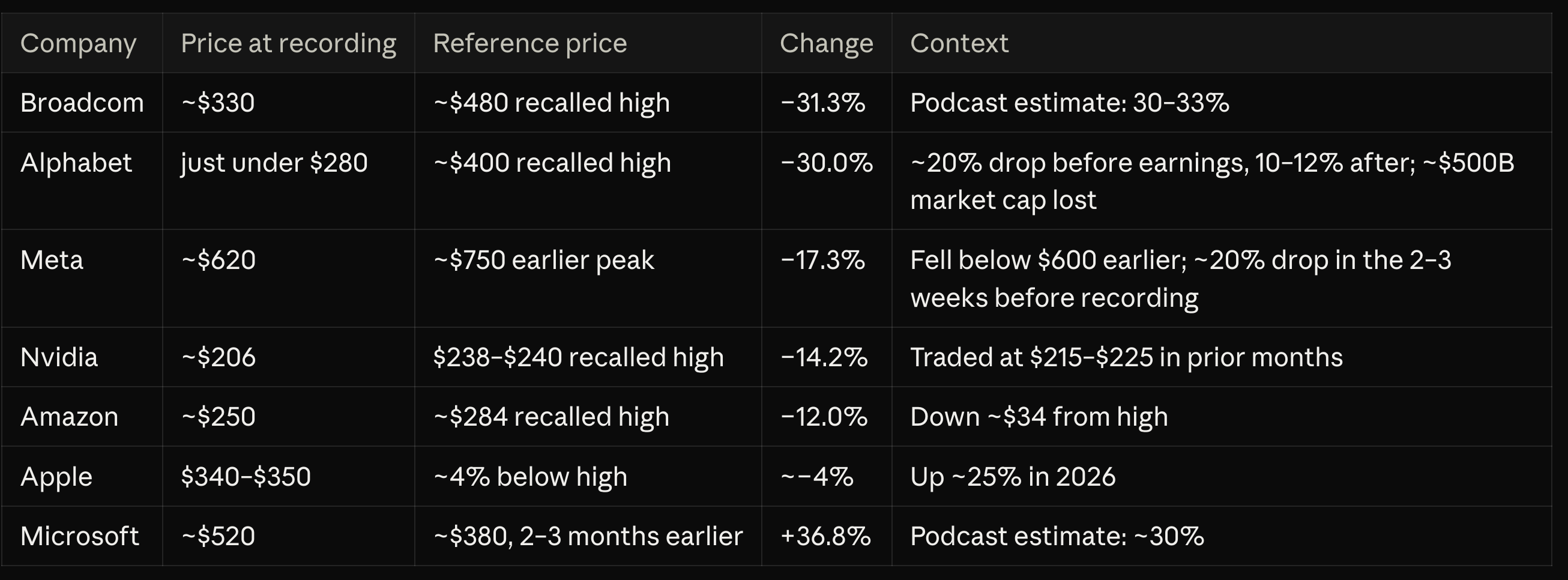
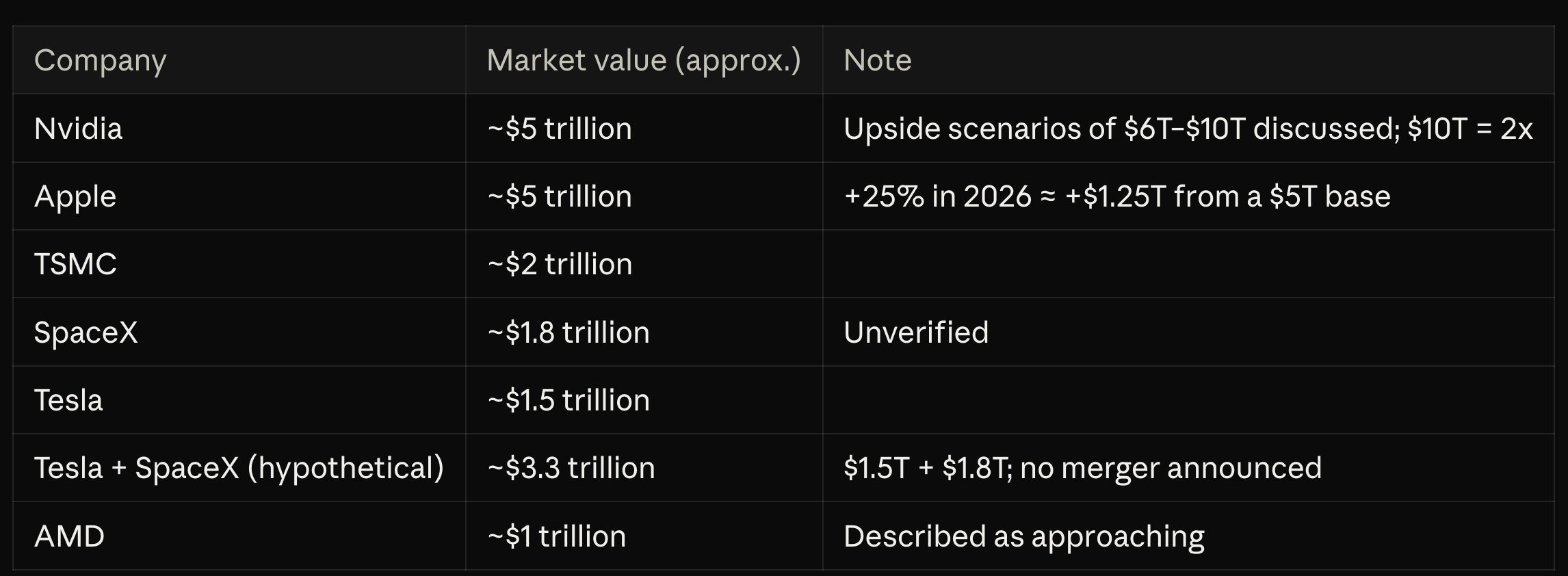
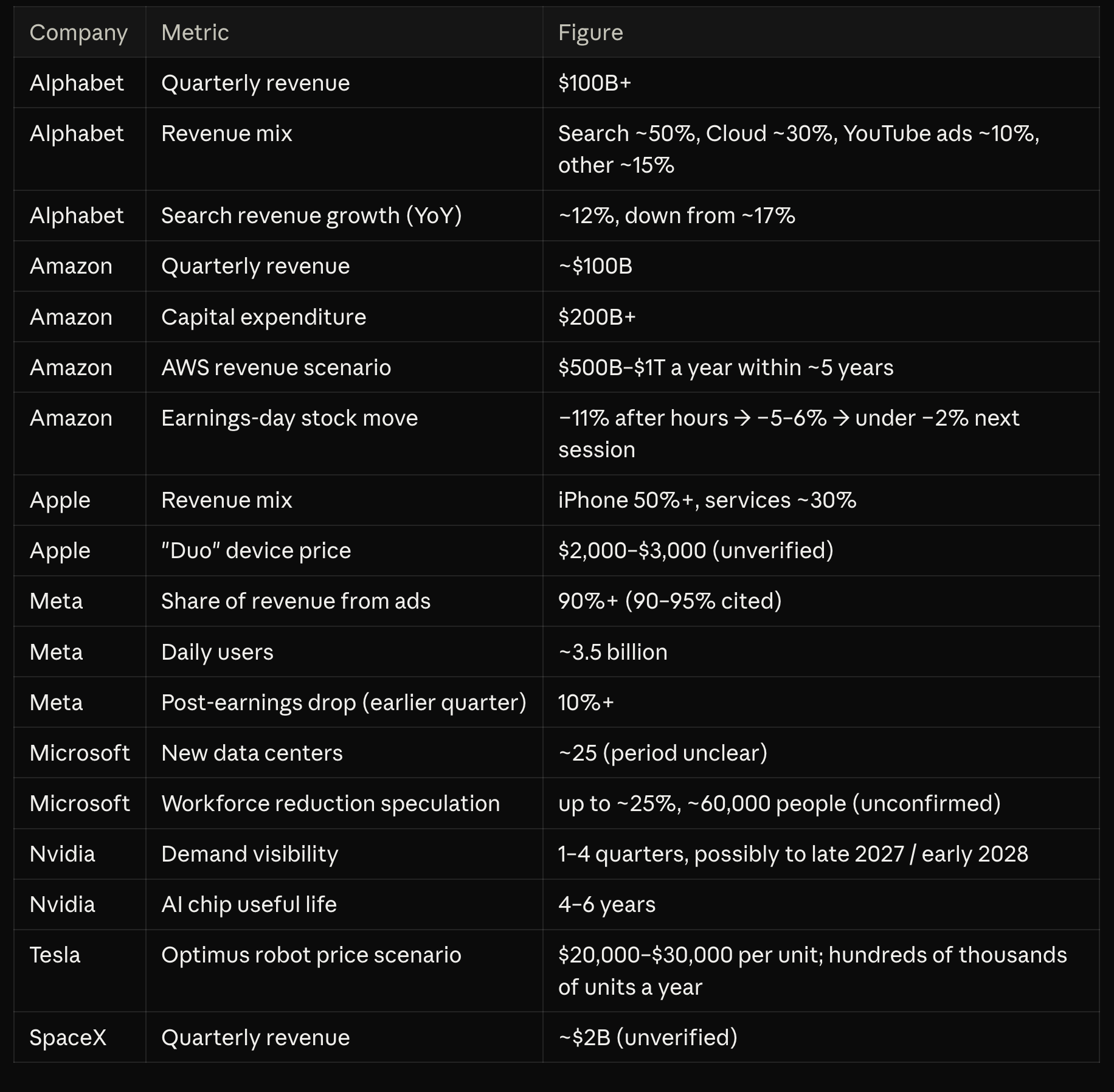
All figures are approximate recollections and as of November 2026; percentages are calculated from those rounded numbers and are unverified.
Share prices at recording
Valuations
Revenue, spending and growth
Market backdrop

Final Thoughts: Not Every AI Winner Will Be a Stock Market Winner
AI is opening huge opportunities across chips, cloud computing, enterprise software, advertising, consumer devices, self-driving cars, robotics and space. The ten companies in this series come at it from very different angles. Nvidia supplies the critical hardware, Broadcom enables custom silicon, TSMC manufactures the chips, and Amazon, Microsoft and Google run the major cloud platforms. Meta and Apple bring massive consumer ecosystems, while Tesla and SpaceX chase ambitious technologies with potentially transformative long-term payoffs.
But technological leadership doesn’t guarantee good investment returns. Capital spending has to turn into profit, competitive advantages have to last, and valuations have to rest on realistic expectations. Tech history is full of companies that once seemed untouchable. IBM was among the most influential names in computing, yet the industry moved in ways that changed its standing, and today’s leaders could face similar shifts as AI changes how software, infrastructure and consumer products are built and sold. Some of these companies may one day be worth $6, $8 or even $10 trillion. Others may struggle to hold their current values, and new competitors will emerge.
The real challenge isn’t figuring out which companies are involved in AI. It’s identifying which ones can turn that involvement into sustainable earnings, strong returns on capital and long-term shareholder value. A wonderful company can still be a disappointing investment if you overpay, while a temporary correction can create an opportunity when the business underneath remains strong. The questions worth continuing to explore are simple to ask and hard to answer: which companies have the strongest competitive advantages, which can monetize AI most effectively, which are taking on too much financial risk, and which are priced well enough to reward investors for the uncertainty they’re accepting?
Editor’s note: This article reflects the estimates, market observations and opinions shared on the Snowpal podcast recorded in November 2026. Prices, valuations, percentages, company statements and hypothetical scenarios have not been independently verified and should be fact-checked before publication. This is educational commentary, not personalized financial advice.