

In this conversation, Rick Bentley, Founder NASDAQ:CSAI, Founder/CEO Hydro Hash, discusses the rising costs of compute in AI, the challenges faced by smaller companies in accessing necessary technology, and the implications of AI on the job market. He emphasizes the importance of building data centers and exploring cost-effective solutions for AI compute. The discussion also touches on the future of education, vocational skills, and the impact of AI on outsourcing and consulting.
Introduction
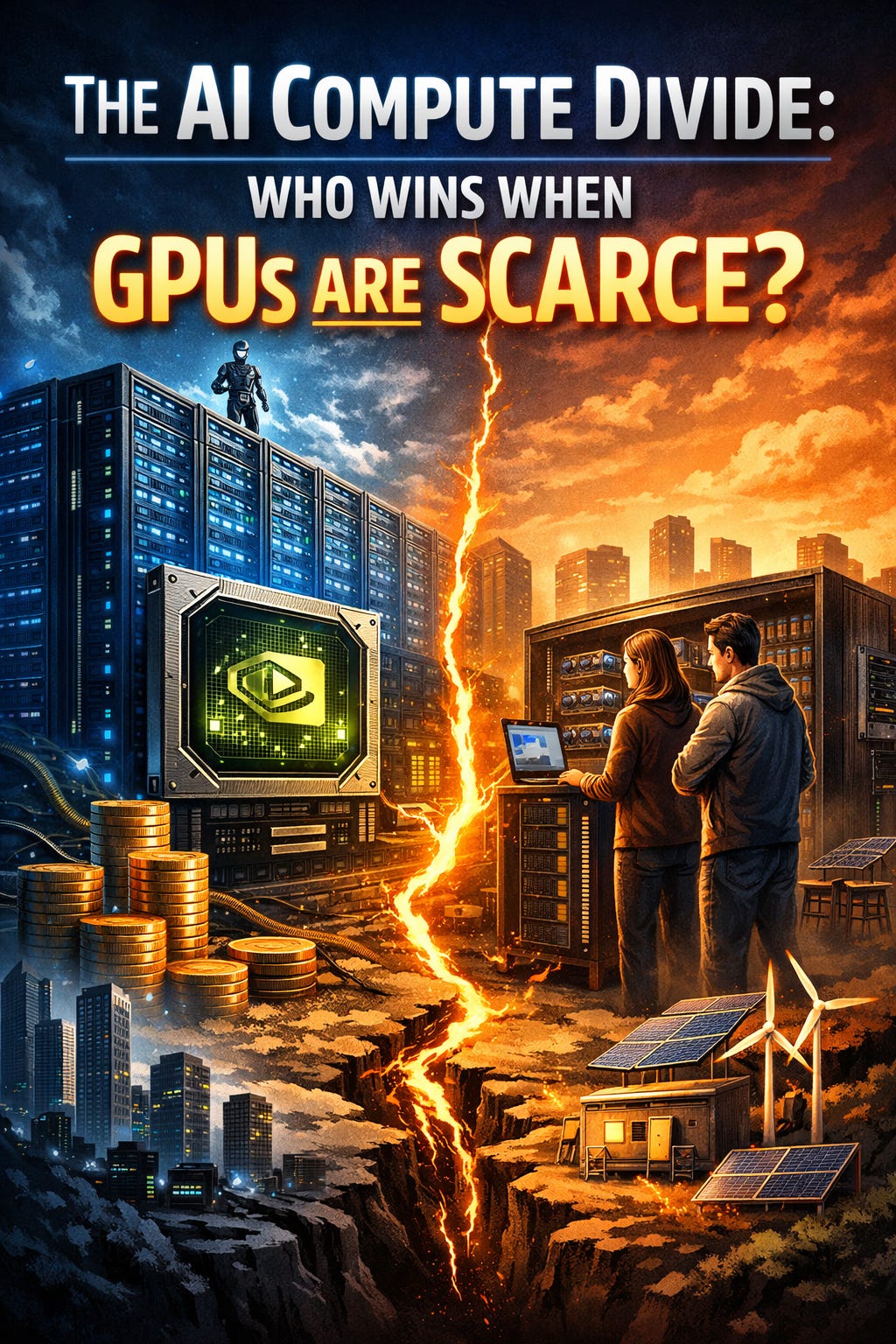
Artificial intelligence is reshaping the technology landscape at a pace few anticipated. While much of the public conversation focuses on breakthrough models and consumer-facing tools, a quieter but more consequential battle is unfolding underneath: access to compute.
Hyperscalers like Meta, Google, Microsoft, and Amazon are spending tens of billions of dollars on AI infrastructure, locking up the most advanced chips and data center capacity. This raises a critical question for everyone else: how can startups and mid-sized companies compete when the raw materials of AI are increasingly out of reach?
This article explores that question through insights shared by serial entrepreneur Rick Bentley, drawing on real-world examples of alternative compute strategies, hardware choices, and organizational shifts.
Podcast
AI’s Hidden Bottleneck: Compute, Capital, and Control — on Apple and Spotify.
1. The Explosion of AI Compute Costs
AI is fundamentally compute-intensive. Both training models and running inference at scale require enormous processing power.
Today, the most advanced AI workloads rely on NVIDIA GPUs such as the H200 or B200, which can cost upwards of $40,000 per card—if you can even get one. Hyperscalers place massive bulk orders, often consuming nearly all available supply. For smaller players, this creates a “compute desert,” where access is limited and prices are dictated by cloud providers .
As a result, companies that rely entirely on public cloud GPU instances face mounting operational costs, often paying many times the hardware’s original value over the life of a rental.
2. Why Cloud Alone Is No Longer Enough
Public cloud platforms were built to make infrastructure easier—but not cheaper. Their business model depends on margin, and AI workloads are now among the most profitable offerings.
For companies attempting to compete with hyperscalers while running on hyperscaler infrastructure, the math rarely works. Margins compress, pricing power disappears, and innovation slows. At sufficient scale, continuing to rent compute becomes a strategic liability rather than a convenience.
This is why many large software companies—Salesforce, Adobe, ServiceNow—have already begun investing heavily in their own data centers, even though infrastructure is not their core business.
3. GPUs vs ASICs: Understanding the Hardware Tradeoffs
Not all chips are created equal.
GPUs (Graphics Processing Units)
GPUs excel at massively parallel workloads and remain the dominant choice for AI training and inference. NVIDIA’s success stems from making GPUs programmable for general-purpose compute, not just graphics.
ASICs (Application-Specific Integrated Circuits)
ASICs are custom-built for narrow tasks. They dominate crypto mining but are far less flexible. In AI, especially with large language models, heavy memory (VRAM) requirements make ASICs less compelling.
Large players like Google have built Tensor Processing Units (TPUs), but designing and manufacturing custom chips requires billions in capital and years of iteration—placing ASICs firmly out of reach for most companies .
4. A Practical Alternative: Building “Off-the-Grid” Compute
One of the most compelling insights from the conversation is that you don’t need hyperscaler-grade hardware to do serious AI work.
Instead of $40,000 data-center GPUs, many AI workloads perform exceptionally well on consumer-grade NVIDIA cards (such as RTX-series GPUs) that cost a fraction of the price. These cards often have:
More raw compute cores
Less VRAM (which is acceptable for non-LLM workloads)
Far better price-to-performance ratios
When paired with strategic data center locations—areas with cheap electricity, cool climates, and lower real estate costs—the total cost of compute can drop by up to 90% compared to cloud pricing .
The key insight:
Data centers are just machines turning electricity into heat. If you control power, cooling, and hardware choices, you control your costs.
5. Vertical Integration as a Competitive Advantage
Historically, software companies avoided infrastructure ownership. Today, that mindset is changing.
Owning compute:
Protects margins
Preserves competitive intelligence
Enables experimentation without runaway cloud bills
While outsourcing infrastructure reduces upfront capital expenditure, it almost always increases long-term operational costs. The companies that win in AI will increasingly be those that vertically integrate compute as a core competency, even if reluctantly at first.
6. AI’s Broader Impact on Jobs and Companies
AI disruption is not landing where many expected. Instead of blue-collar labor, white-collar professions—software development, law, medicine, consulting—are being reshaped first.
AI already:
Drafts legal agreements
Assists medical diagnostics
Generates production-grade code
For software teams, AI is no longer optional. If a company builds software the same way it did two years ago, it is likely already behind. The upside, however, is enormous: small teams can now build what once required dozens of engineers.
This mirrors past industrial revolutions—fewer workers per unit of output, but dramatically more output overall.
7. Education, Skills, and the Return of the Trades
The AI era is also forcing a re-evaluation of education paths.
Traditional college degrees remain valuable—but only when aligned with real economic demand.
Many vocational and technical trades (electricians, technicians, infrastructure specialists) are becoming more valuable, not less.
If a job exists entirely “on the other side of a screen,” it is far more likely to be automated.
Ironically, the physical work of maintaining AI infrastructure may prove more resilient than many white-collar roles.
Conclusion: Competing in the Age of AI Compute Scarcity
The AI revolution is not just about smarter models—it’s about who controls the infrastructure beneath them.
For startups and mid-sized companies, the path forward is not to outspend hyperscalers, but to outthink them:
Use the right hardware, not the most expensive
Build compute where power and cooling are cheap
Treat infrastructure as strategy, not overhead
Embrace AI as a force multiplier, not a threat
Disruption is uncomfortable—but it is also where the next generation of winners is being forged .