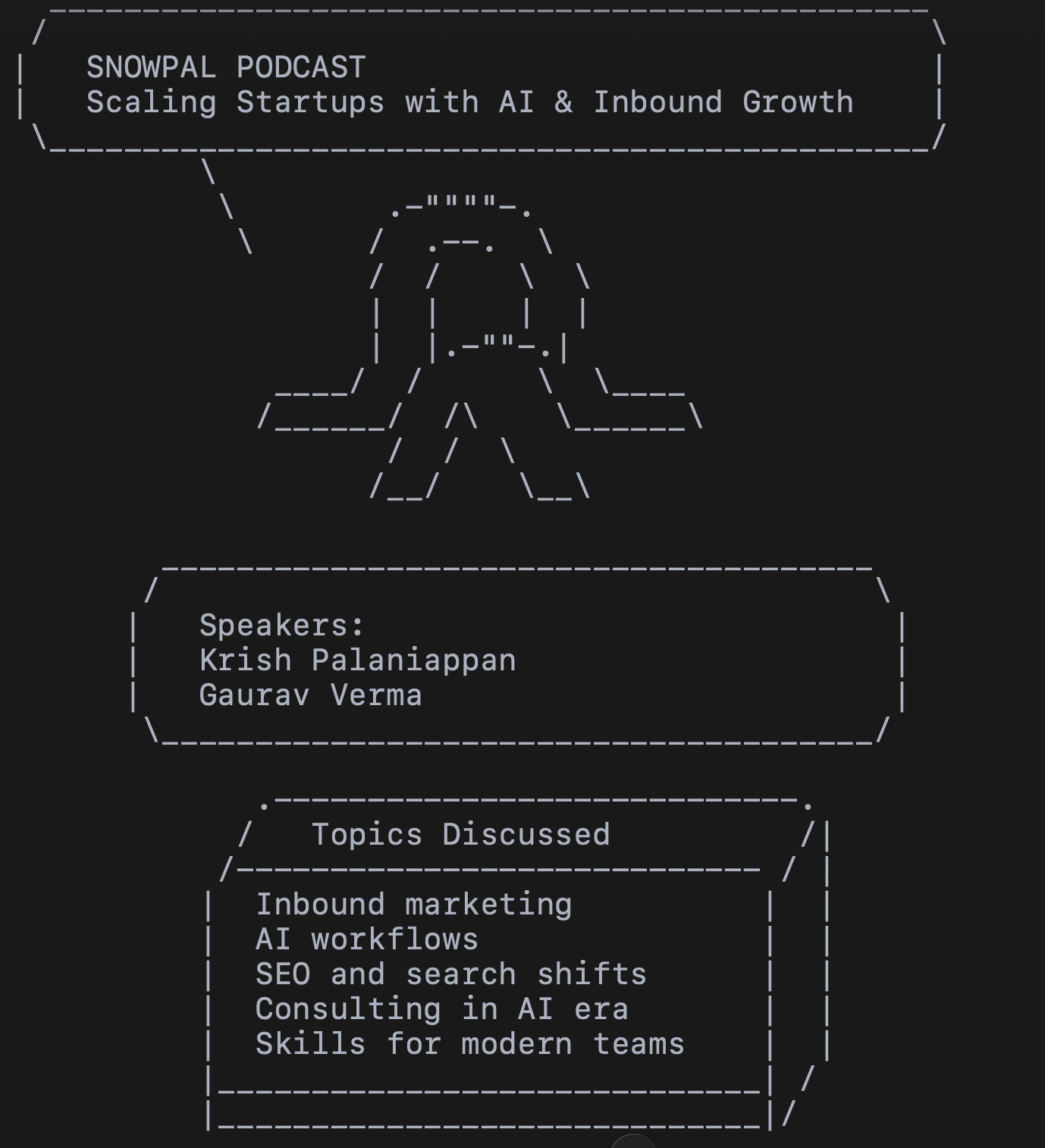
In this episode of the Snowpal Podcast, Krish hosts Gaurav Verma, Chief Marketing Officer at Kanerika, for a conversation about scaling early-stage technology companies. Their discussion explores how startups can build effective inbound marketing engines with limited budgets, leverage AI to streamline marketing workflows, and distribute content across modern platforms. They also examine the shift from traditional SEO to broader search strategies, the evolving future of consulting in the AI era, and the skills professionals need to succeed in a rapidly changing technology landscape.
Scaling an early-stage company is one of the most challenging phases of building a business. Limited budgets, evolving markets, and the need to establish credibility make growth difficult. In a recent discussion on the Snowpal Podcast, marketing leader Gaurav Verma shared insights on how early-stage companies can build a scalable inbound marketing engine, leverage AI, and rethink consulting and hiring strategies in the modern tech landscape. This article summarizes the key lessons from that conversation and explores practical approaches for startups and growing technology companies.
Podcast
How AI Is Reshaping Marketing, Consulting, and Startup Growth — on Apple and Spotify.
The Challenge of Scaling with Limited Budget
Early-stage companies rarely have large marketing budgets, which means growth strategies must rely more on creativity, experimentation, and prioritization than on spending. When Gaurav joined his organization’s marketing leadership, the team faced exactly this situation: a brand that had existed for years but lacked a strong inbound marketing engine. The mission was to grow the brand with minimal financial resources. The first phase focused on fixing foundational elements such as improving the company’s social presence, rebuilding the website quickly and affordably, creating essential sales collateral and messaging, and defining what the company actually stood for in the market. Using cost-effective tools such as WordPress, the team rebuilt the company website rapidly while aligning messaging around its identity as a data, AI, and automation company.
Building an Effective Inbound Content Engine
Inbound marketing works best when content is organized around clear categories that attract different audiences. Successful inbound engines typically include several content buckets. One important category is problem–solution content that explains common industry challenges and how a solution solves them. This often includes use cases, industry-specific applications, and technology implementation examples. This type of content connects directly to buyer intent and helps establish expertise in the field.
Another effective approach involves tools and utilities that attract users actively researching solutions. Examples include AI readiness assessments, ROI calculators for technology migrations, or free AI agents and automation tools. These assets can generate marketing-qualified leads because users often provide contact information to access them.
Comparison content is another powerful category because it helps buyers evaluate options when they are close to making decisions. Examples include platform comparisons, vendor-versus-vendor evaluations, and technology stack comparisons. These topics tend to attract high-intent audiences who are already researching solutions and looking for guidance.
Technical documentation and “jobs to be done” content are also important for reaching engineering and technical audiences. These topics include developer documentation, technical guides, and implementation playbooks that provide practical insights into workflows and system implementation. This type of content builds credibility with engineers and technical decision-makers who are evaluating complex solutions.
Thought leadership content adds another dimension by communicating a company’s long-term vision and industry perspective. This includes opinion articles, insights from leadership, and commentary on emerging trends. While thought leadership pieces may not always drive immediate conversions, they strengthen brand authority and help position the organization as a trusted voice in the industry.
The Shift from SEO to “Search Everywhere Optimization”
Traditional SEO strategies are evolving rapidly as AI-powered search becomes more common. In the past, users searched Google and clicked links to visit websites. Today, AI-generated summaries often provide answers directly within search pages, reducing the number of clicks directed to external sites. According to the discussion, companies may lose as much as 50–60 percent of the clicks they previously received because AI overviews summarize content instead of directing users to the source pages.
As a result, marketing strategies must move beyond traditional search engine optimization. The emerging approach can be described as “search everywhere optimization.” Instead of focusing solely on Google rankings, companies must build visibility across multiple platforms including Google search, YouTube, social media platforms, online communities such as Reddit, and authoritative knowledge sources like Wikipedia. The objective is to build topical authority across the entire internet rather than relying only on search engine rankings.
Content Distribution Across Platforms
Another challenge for startups is determining where to distribute their content. Creating unique content for every platform is unrealistic for small teams with limited resources. Instead, organizations should concentrate on a few high-impact channels that align with their audience. For many B2B technology companies, the most effective platforms are LinkedIn and YouTube, particularly YouTube Shorts. Short-form vertical video has become highly effective because it is inexpensive to produce, easy to distribute across multiple channels, and more likely to generate engagement than long-form formats.
Content such as AI tips, data insights, migration advice, or practical technology hacks can capture attention while providing useful information. By repurposing these short videos across different platforms, companies can maintain a consistent presence without dramatically increasing production costs.
Leveraging AI to Scale Marketing
Artificial intelligence is transforming marketing workflows and enabling small teams to accomplish tasks that previously required large departments. Instead of hiring extensive teams, companies can now use AI tools to automate activities such as content generation, podcast production, visual design, and video creation. Podcast platforms can automatically generate episodes from written content, visual design tools can rapidly create branded infographics for blogs and social media, and AI video tools can generate short educational clips without requiring expensive studios or production teams.
These technologies allow organizations with minimal budgets to build scalable content systems that continuously generate marketing assets and distribute them across multiple platforms.
The Future of Consulting in the AI Era
The conversation also explored how AI is affecting consulting and professional services. Some organizations worry that automation will eliminate consulting jobs entirely, but the reality is more nuanced. AI may reduce the number of engineers required for certain tasks, but consulting still provides several advantages that technology alone cannot replicate. Enterprises often seek trusted partners with proven experience, especially when making major technology investments. Implementation expertise remains critical for integrating complex systems, and strategic guidance helps organizations evaluate competing technologies and long-term architectural decisions.
As a result, many consulting firms are evolving their business models by combining software products with consulting services. For example, migration accelerators and automation platforms allow consulting organizations to deliver both technology and expertise in integrated solutions.
Skills That Matter in the AI Age
As technology evolves, hiring priorities are changing as well. Technical skills alone are no longer sufficient because AI tools are increasingly accessible to everyone. Instead, organizations are looking for individuals who demonstrate deeper cognitive and behavioral strengths. First-principles thinking is essential because professionals must be able to analyze problems from fundamental concepts rather than relying only on past solutions. Intellectual curiosity is equally important because rapid technological change requires continuous learning and adaptation.
Another critical trait is the willingness to experiment and learn quickly. Teams must be comfortable testing ideas, failing fast, and iterating toward better solutions. These attributes matter more than ever because the differentiator is no longer access to technology but how intelligently people apply it in real-world situations.
Balancing Engineering, Marketing, and Sales
Running a technology startup requires balancing multiple disciplines simultaneously. Even if a founder begins with a strong engineering background, sustainable growth depends on investing time in product strategy, marketing, sales outreach, and customer engagement. Early-stage teams often divide their time across these areas while gradually building systems that allow each function to scale independently.
Immigration: Benefits and Challenges
Immigration and its role in technology and business were explored, highlighting both the opportunities and challenges associated with legal immigration. The value immigrants bring to the United States was emphasized, including strong technical expertise and leadership within major companies. At the same time, concerns about job competition and the need for balanced, thoughtful policies were acknowledged. The importance of investing in upskilling local workforces while maintaining a healthy balance between immigrant and domestic talent was also addressed. Assimilation and cultural adaptation emerged as another key theme, with the perspective that individuals can integrate into new environments while still preserving their identity and cultural background. The dialogue also reflected on leadership, personal growth, and the motivations that shape global professional journeys.
Technology Stack and Platforms
The technology landscape referenced spans a wide range of platforms, tools, and frameworks used across data engineering, AI, marketing, and software development. Key technologies include modern data and analytics platforms such as Microsoft Fabric, Snowflake, Databricks, Microsoft SQL, Informatica, and SAP Crystal Reports, along with AI solutions and agents built on cloud infrastructure and models such as OpenAI. Development and automation references include traditional tools like Oracle Forms, AWK, and UNIX scripting as well as modern API-based architectures distributed through marketplaces like Azure Marketplace and AWS Marketplace. Marketing and growth technologies discussed include WordPress for website management, SEO tools such as SEMrush and DataForSEO, and emerging protocols like Model Context Protocol (MCP) used for AI-driven SEO analysis. Content distribution and discovery platforms include Google Search, YouTube, TikTok, Reddit, and Wikipedia, while creative and content production tools include HeyGen for AI video avatars, Napkin AI for visual infographics, Podbean for podcast hosting, and NotebookLM for generating audio content. Collaboration and knowledge sources such as Slack and document systems were also referenced in the context of AI tools like DocGPT that extract insights from enterprise content, highlighting how modern organizations combine data infrastructure, AI agents, marketing platforms, and developer tools to build scalable digital products and growth engines.
Conclusion
The landscape of technology startups is changing rapidly as AI tools, evolving search behavior, and new content platforms reshape how companies grow and compete. Despite these shifts, several principles remain consistent. Strong inbound content engines drive long-term growth, multi-platform visibility is essential in the AI search era, creativity and experimentation often matter more than budget, and human qualities such as curiosity, accountability, and critical thinking remain indispensable. For early-stage companies, success lies in combining modern AI-powered workflows with timeless principles of problem solving, storytelling, and customer understanding.