

A conversation on the state of frontier and open-source AI reveals a widening gap between companies renting intelligence from a handful of labs and those building deterministic, sovereign AI systems they actually own — and explains why the next competitive edge in AI has less to do with model quality and everything to do with infrastructure control.
Podcast
Own Your Weights: The Real Economics of Private AI — on Apple and Spotify.
Introduction
A conversation between host Krish and guest Sam Sammane, founder and CEO of Quantum General Intelligence (QGI) and author of The Singularity of Hope.
Sammane brings an unusual vantage point to the discussion: two decades in symbolic AI and automated theorem proving in the late 1990s, followed by a career in mergers and acquisitions, before returning to AI full time in 2022. Across the conversation, Krish and Sammane cover the real gap between frontier and open-source model performance, the economics and security tradeoffs of Chinese open-weight models, why coding and agentic workloads call for different tools, and the growing business and national case for private, sovereign, and deterministic AI infrastructure that companies and governments own outright rather than rent.
Every few months, a new leaderboard claims to settle which large language model is “best.” But according to one AI founder with a two-decade history in symbolic reasoning and automated theorem proving — a discipline that predates the current generative AI boom by twenty years — the leaderboard question is the wrong one. The more consequential question for any company deploying AI in production is who owns the model, who controls its weights, and what happens when the vendor changes the rules.
This article distills a wide-ranging technical discussion covering the evolution from symbolic AI to today’s hybrid, tool-using “agentic” systems; the real gap between marketing claims and coding performance across frontier labs; the rise of cheap, high-quality open-weight models out of China; and the practical, cost-driven case for private and sovereign AI infrastructure once a company crosses a certain size. Throughout, one theme recurs: renting a frontier model is convenient, but ownership is what protects a business from deprecation, policy bans, and vendor lock-in.
From Symbolic AI to the Agentic Revolution
The speaker’s background sits outside the neural-network mainstream. In the late 1990s and early 2000s, he worked on automatic theorem proving and symbolic simulation for hardware design — a field colleagues at the time dismissed as “too theoretical” for anyone to care about. He left academia for consulting and mergers and acquisitions, running three separate testing-lab businesses over two decades, before a 2022 encounter with ChatGPT sent him back into AI full time.
“In 25 years ago, I built a certain symbolic AI that can handle 65,000... tokens as a context window. And people told me that’s nothing. ChatGPT in 2022 was handling 8,000.”
That background turned out to be an advantage rather than a liability. Generative AI in 2023 was purely neural; his own expertise was in the older symbolic tradition. Blending the two, ahead of the industry’s own shift toward hybrid, tool-augmented “agentic” architectures, became the founding thesis of his company, Quantum General Intelligence (QGI). Of the roughly 80,000 AI startups he estimates exist today, he argues barely a hundred are doing substantive technical work — the rest are thin prompt wrappers around someone else’s model.
The Illusion of “Open” and the Real Leaderboard
The discussion is unsparing about naming conventions and marketing in the industry. “Open AI,” he notes, is now a closed company — one that began as a nonprofit funded by a $50 million donation from Elon Musk and later converted to a for-profit structure despite reporting tens of billions of dollars in annual losses. “Deep learning” and “neural networks,” in his view, are wishful branding for decades-old statistical input-output modeling, not literal replicas of biological cognition — and he is emphatic that no current or near-term system qualifies as artificial general intelligence in the science-fiction sense.
On model quality specifically, he draws a sharp line between public benchmarks and his own internal testing, developed by stress-testing models against real coding and agentic tasks at his company:
“According to [the press], always Chat GPT models are the best. And I’m sorry to tell OpenAI like this plainly: you don’t know how to code. Your models are stupid... A small Chinese model is better than that.”
His actual ranking: Anthropic’s Claude (”Fable” in the transcript) leads decisively on coding quality, followed closely by xAI’s Grok 4.6 (built on the former Cursor codebase following its acquisition). For agentic work that isn’t complex software engineering, he argues the gap between frontier and low-cost open-weight models has essentially closed.
The Open-Source Insurgency
DeepSeek’s release is described as a watershed moment for the industry — not because it beat frontier models outright, but because a five-million-dollar company demonstrated a near-frontier model at a fraction of the cost, breaking the assumption that only labs with billions in capital could compete.
“Deep Seek... was the best thing happened for the AI industry. It started somehow a new era when we had OpenAI, arrogant as they are, pretending we have AGI in two years.”
He’s equally direct about the security anxiety surrounding Chinese models, distinguishing between hosted Chinese applications (which he says frequently phone home to servers in China) and open-weight models a company downloads and runs itself: “If you are familiar with the technology of AI, that’s all what you need to run the model... open source is not open weight — okay, it’s not [the same thing]. But in the practicality, it is.” His current recommendation for cost-sensitive agentic workloads points to Alibaba’s Qwen family, alongside DeepSeek V4, Moonshot AI’s Kimi/K3 line, and Zhipu’s GLM-5.3 — models he says cost roughly one cent per million tokens against fifty dollars per million for top-tier proprietary models.
Coding vs. Agentic Work: Different Tools for Different Jobs
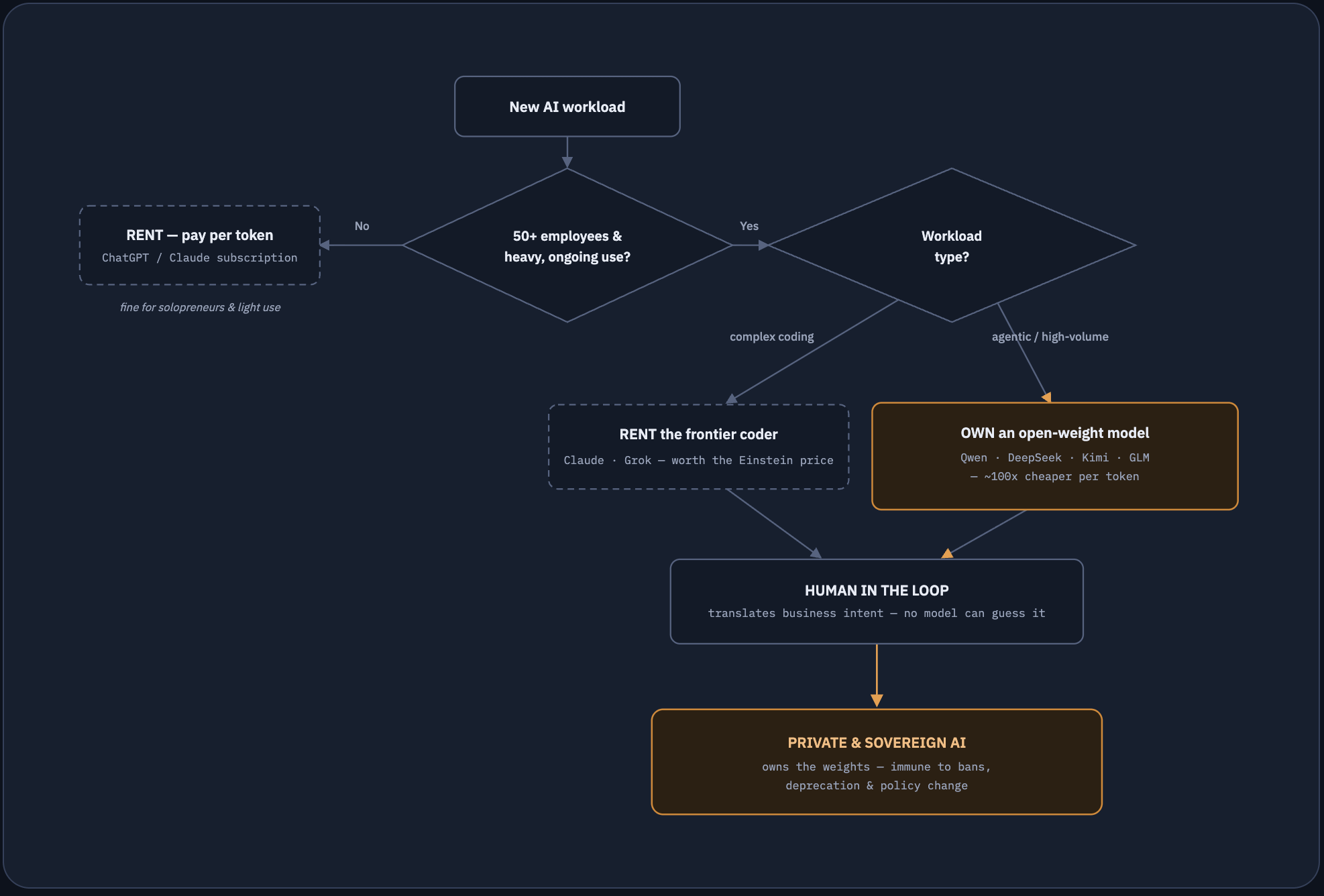
A recurring practical distinction: use the best available model for coding, and the cheapest viable model for everything else.
“It’s like bringing Einstein to your office... if you are building something that needs Einstein, and coding is complex.”
For software generation specifically, he places Claude ahead of OpenAI’s Codex and his own company’s in-development coding assistant, Quark. But for agentic workflows — research, writing, classification, orchestration — he argues that tiny open-weight models like Qwen 3.8 are close to indistinguishable from frontier models like Opus 4.6 in practice, while costing orders of magnitude less per token.
The Business Case for Private AI
The private-AI argument is framed around company size and risk exposure rather than ideology. Below roughly fifty employees, he argues, building private infrastructure is a distraction; above that threshold, renting model access starts to look like a strategic liability.
“It’s like someone who preferred to rent a Ferrari over buying a Volkswagen because he wanna appear cool. Yes, he will appear cool, but you cannot have it all the time.”
The risk isn’t hypothetical: he describes being banned outright by a commercial AI provider over a misclassification of his company’s activity, cutting off access to data and workflows built entirely on that vendor’s platform. His broader point is about vendor dependency: a company that builds its operations on a rented model has no recourse when a provider changes pricing, deprecates a model version, or revokes access — a risk he says is fundamentally different from consumer software, because it touches a company’s operational intelligence rather than its entertainment.
On the economics of self-hosting once at scale, he cites an internal example: an engineer running 280 million tokens per day of agentic (non-coding) workload against a self-hosted open-weight model, on a GPU server costing roughly $600 per month — compute cost effectively at zero beyond the fixed hardware bill.
Deterministic AI and the Role of the Human in the Loop
Despite his enthusiasm for automation, he rejects “vibe coding” — the idea that a business can be run purely by prompting an AI without a human who understands the system — as a scam premise.
“AI will never propose to you [an intent]... it will put the constitution in the repository, and it will not change it, even if you [ask new questions ten days later]... that’s against our policy. Who wrote the policy? You — but it’s an AI.”
Every private-AI deployment, in his framing, needs a dedicated human owner — a CTO or a contracted AI specialist responsible for the tool contracts, input-output relationships, and standardization layers between the model and the business logic. That role, he notes, does not need to be co-located or full-time, since remote specialists can service multiple companies simultaneously.
Rethinking Education Around Intuition and Critical Thinking
The conversation closes on education, where he argues that traditional assignments — the five-paragraph essay in particular — have been rendered obsolete by AI in the same way calculators made mental arithmetic drills obsolete. His proposed replacement is a curriculum built around what he calls the “educated guess”: human intuition sharpened by domain expertise, which he argues remains a form of intelligence current AI systems cannot replicate.
“Your guess is a very strong form of intelligence that we don’t know how to replicate... we don’t have it in the machine. This is our superpower.”
The goal, in his words, is teaching people to be human again rather than to behave like machines — since decades of institutional education optimized students for the kind of rote recall and procedural compliance that AI now performs by default.
Sovereignty as a National Strategy
The same private-versus-rented logic scales up to nation-states. He argues governments should build their own fine-tuned, sovereign AI systems on top of open-weight foundations rather than depending on commercial providers, whose models he characterizes as commercially biased despite public claims of neutrality.
“You cannot rent intelligence. That’s basic, but it’s true. Any human will not love to bring someone and tell him, ‘Now for my life I will not think anymore, you think for me.’”
He singles out the United States as notably exposed on this front — among the world’s most AI-advanced nations, yet without a government-operated foundation model independent of private commercial labs.
Technologies
The conversation moves across a wide field of proprietary and open-weight language models, spanning US, Chinese, and independent labs. For reference, the models and coding assistants discussed by name include:
ChatGPT / GPT models — OpenAI’s consumer and API-facing model line
Codex — OpenAI’s dedicated coding assistant
Claude (including Claude Opus 4.6 and Claude 4.5) — Anthropic’s model family, described as the current leader in coding quality
Claude Code — Anthropic’s AI coding tool
Grok 4.6 — xAI’s model, built on the former Cursor coding assistant following its acquisition
DeepSeek (V3 and V4) — DeepSeek’s open-weight models, credited with triggering the current open-source AI race
Qwen (including Qwen 3.8) — Alibaba Cloud’s open-weight model family
Kimi / K3 — Moonshot AI’s model line
GLM-5.3 — Zhipu AI’s model
Mimo — Xiaomi’s open-weight model
Llama — Meta’s open-weight model family, referenced generically as one of the “smaller models” now competing in the space
Quark — Quantum General Intelligence’s own coding assistant, not yet publicly released
Summary
The throughline across this discussion is a distinction between renting intelligence and owning it. Frontier proprietary models remain the strongest choice for complex software engineering, but for agentic and general business workloads, the practical gap between expensive frontier models and cheap open-weight alternatives — largely originating from Chinese labs — has narrowed dramatically. Companies above roughly fifty employees are advised to weigh the ongoing risk of vendor dependency, pricing changes, and outright access bans against the fixed cost of hosting fine-tuned, open-weight models on owned or rented GPU infrastructure. None of this removes the need for human oversight: a dedicated AI-responsible role remains essential to translate business intent into working systems, since no current model can infer what a company actually wants. And the same logic that applies to individual businesses, the discussion argues, applies to national governments — sovereignty over one’s own models is becoming as strategically important as owning any other piece of critical infrastructure.