

In today’s business world, transformation has become one of the most overused and misunderstood terms. Companies often describe everything from a website redesign to a software upgrade as “transformation.” But true transformation is much deeper than surface-level change. It reshapes how a business operates, how customers experience its products, and how leaders make decisions in a fast-changing environment. As Sridhar Ravilla explains, transformation is not about making temporary improvements. It is about creating lasting change that an organization cannot simply reverse.
Podcast
Practical Wisdom for Modern Business Change — on Apple and Spotify.
What a Transformation Executive Really Does
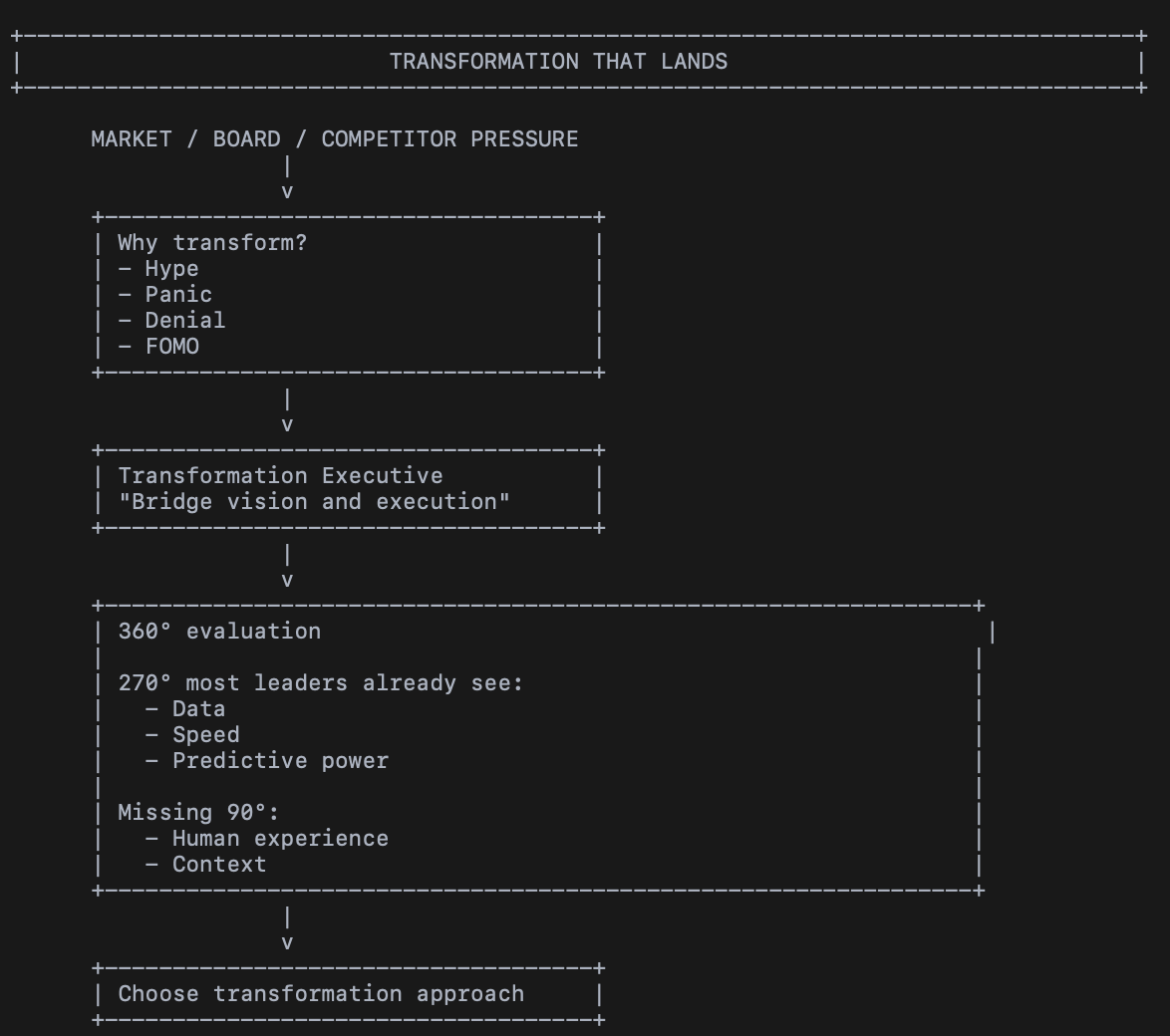
A transformation executive plays a critical role in bridging the gap between strategic vision and real-world execution. This role goes beyond managing projects or overseeing technology upgrades. It involves helping organizations navigate major shifts in systems, processes, and customer experience. According to Sridhar, a true transformation changes the way people work and the way customers interact with the business. It leaves a permanent impact, much like a major shift in the physical world changes the landscape itself.
What makes this role especially valuable is its ability to connect leadership ambition with operational reality. Boards and executive teams often have bold visions for modernization, but someone must translate those ambitions into practical decisions, measurable outcomes, and sustainable change. That is where the transformation executive becomes essential.
Why Companies Feel Pressure to Transform
Many organizations do not begin transformation from a place of clarity. Instead, they are pushed by outside pressure. Sometimes it is hype around a new technology. Sometimes it is panic that competitors are moving faster. In other cases, it is fear of missing out. Companies see their peers experimenting with AI, cloud migration, or digital modernization and feel compelled to act before fully understanding whether the move is right for them.
Sridhar points out that leaders often fall into predictable postures during these moments. Some are driven by hype and believe the latest technology will change everything. Others act from panic, afraid of becoming irrelevant if they do not move immediately. Still others respond with denial, assuming the latest trend will pass. And finally, many organizations are motivated by FOMO, simply wanting to be seen as innovative because others are doing the same. These reactions can create urgency, but not always wisdom.
Transformation Is Not About Chasing Trends
One of the biggest mistakes companies make is pursuing change for appearance rather than value. A business may decide to move from one technology stack to another, not because the shift improves outcomes, but because it sounds current or satisfies pressure from leadership, vendors, or the market. In some cases, organizations spend heavily on modernization without clearly understanding whether the current system is actually failing them.
This is where strong transformation leadership matters. A good transformation executive does not simply encourage change. They challenge assumptions. They ask whether the move creates real value for customers, improves operational efficiency, or strengthens the business in a lasting way. If the answer is no, then “transformation” may just be expensive motion rather than meaningful progress.
The Missing Piece: Human Experience and Context
Sridhar emphasizes that many leaders focus on what he calls “270-degree visibility.” They look at data, speed to market, competitors, and predictive power. These are all important. But they often miss the final 90 degrees: human experience and context. That missing piece determines whether transformation will actually succeed.
A company can invest in better systems, smarter tools, and faster processes, but if it does not understand how customers experience the product or how employees interact with the changes, the transformation remains incomplete. Human judgment, adoption, and behavior are what turn a technical rollout into a real business outcome. Without that lens, even sophisticated transformation efforts can fail to stick.
How Leaders Should Approach Transformation
The first step in any transformation is to understand both the current state and the intended future state. Leaders need clarity on what is working, what is broken, and what they are trying to achieve. That means evaluating existing systems honestly, defining measurable goals, and deciding where limited resources should go. No organization has unlimited time, money, or talent, so prioritization becomes one of the most important leadership decisions.
There are generally two broad approaches.
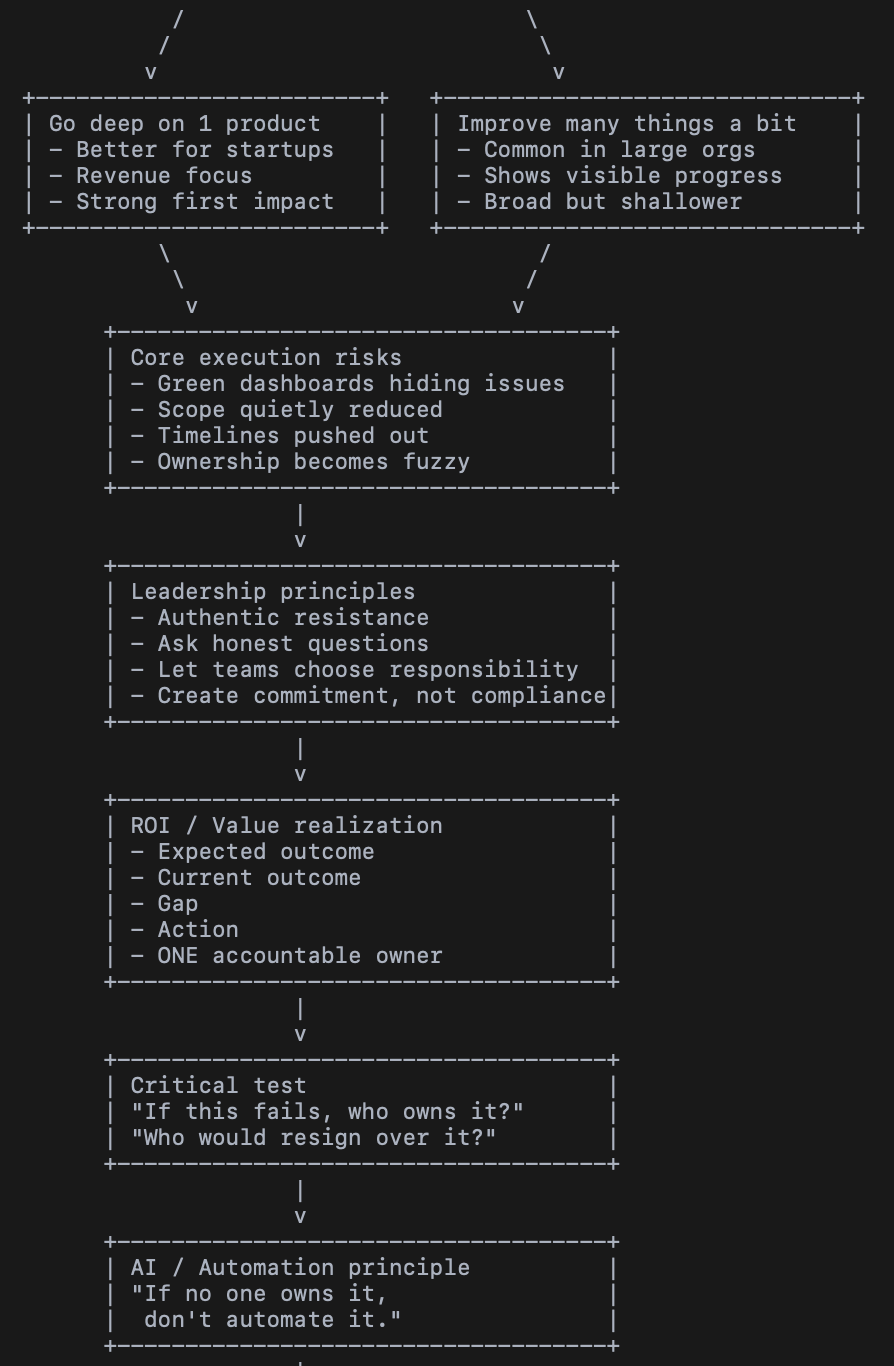
One is to go deep in one area, investing heavily to transform a single product, service, or operational function.
The other is to make shallower improvements across multiple areas, improving the overall business experience without betting everything on one part of the organization.
Each approach can work, depending on the company’s size, goals, and constraints. Large organizations often prefer spreading investment across several initiatives to show broader results, while startups or growth-stage businesses may need to focus narrowly on the one area most likely to drive survival and revenue.
Why So Many Transformations Fail
A striking theme in Sridhar’s perspective is that transformations rarely fail because of strategy alone. In many cases, the plan itself is reasonable. The real breakdown happens in execution, ownership, and leadership. Accountability becomes diffused. Risks get buried in dashboards, committees, and status updates. What looks green on paper may still be red underneath. Teams may quietly reduce scope, shift timelines, or make tradeoffs that make reports look better without actually solving the core problem.
This is why leadership must create what Sridhar calls authentic resistance. Leaders should ask hard questions without aggression. They should not accept green dashboards at face value. Instead, they should look for what changed, what was deprioritized, and who is truly accountable for closing the gap between expectation and outcome. Transformation succeeds when ownership is clear and decisions are grounded in reality rather than presentation.
The Importance of ROI and Value Realization
Transformation cannot be justified by activity alone. It must create value. Organizations often begin with strong business cases and attractive ROI projections, but those projections mean little if no one tracks whether the promised value is actually being realized over time. Sridhar argues that value realization is not a one-time exercise at the approval stage. It must be continuously measured through real-time dashboards, outcome tracking, and clearly assigned ownership.
This is especially important because many digital and AI initiatives fail to deliver meaningful business value. Success requires more than funding and enthusiasm. It requires leaders to revisit assumptions, identify gaps between expected and current outcomes, and assign one accountable owner for each initiative. Without that accountability, blame shifts to the technology, the tool, or the team that is no longer around to defend itself. With accountability, transformation becomes a disciplined effort rather than a vague aspiration.
AI, Automation, and the Role of Humans
As organizations accelerate AI adoption, another misconception emerges: that technology reduces the importance of people. Sridhar’s view is the opposite. The more powerful technology becomes, the more human judgment matters. AI can generate predictions, automate workflows, and support decisions, but it cannot own consequences. That remains a human responsibility.
This is the heart of the “humans at scale” idea. AI does not create leadership gaps; it exposes them. If ownership is weak, automation scales avoidance rather than efficiency. If no one is willing to stand behind a process when it fails, automating that process only makes the failure larger and faster. That is why transformation in the AI era must strengthen human accountability, not weaken it.
Authorship
Sridhar brings a practitioner’s voice to authorship, drawing on more than 25 years of experience in technology, telecom, and large-scale business transformation. Rather than writing from a purely theoretical lens, he writes from the perspective of someone who has worked closely with executive leadership, managed large organizations and P&Ls, and seen firsthand why many transformation efforts succeed or fail. His books reflect that real-world grounding, focusing on the intersection of strategy, execution, leadership accountability, and human judgment in an era increasingly shaped by digital change and AI.
Transformation That Lands: A practical guide to making organizational change stick by turning strategy into measurable, lasting business outcomes.
Humans at Scale: A leadership-focused look at why human judgment, ownership, and accountability matter even more in the age of AI.
AI 360: A big-picture exploration of AI’s full business impact, from systems and strategy to accountability, context, and decision-making.
Conclusion
Transformation is not a buzzword, a trend, or a technology purchase. It is a disciplined effort to create meaningful, lasting change in how a business operates and delivers value. A transformation executive helps organizations make that change real by bringing together strategy, execution, customer understanding, and human accountability.
For leaders navigating cloud migration, AI adoption, product modernization, or operational redesign, the lesson is clear: transformation works best when it is grounded in purpose, shaped by context, and owned by people who are willing to make difficult decisions. Technology can accelerate the journey, but leadership is what determines whether the transformation actually lands.

Bonus: Q & A
Here’s the crux of the conversation in a Q & A format.
Q: Who is Sridhar Ravilla?
Sridhar Ravilla is a technology and transformation leader with more than 25 years of experience in tech and telecom, focused on connecting executive vision with real-world execution.
Q: What does he mean by a “transformation executive”?
He defines a transformation executive as someone who leads deep, lasting change that reshapes systems, customer experience, and how people work, not just surface-level updates.
Q: What is true transformation according to Sridhar?
True transformation means changing current systems into something new with long-term impact, where the organization cannot simply go back to the old way.
Q: Why do companies pursue transformation?
Companies often pursue transformation because of hype, panic, denial, or fear of missing out, especially when competitors or boards are pushing for visible innovation.
Q: What is the first thing he looks at when advising a company?
He looks at the full business picture, especially the missing “final 90 degrees”: human experience and context, alongside data, speed, competition, and predictive power.
Q: How does he decide where a company should focus?
He helps leaders decide where limited resources will create the best ROI, whether by going deep into one product or making broader but lighter improvements across several areas.
Q: What approach works better: deep focus or broad improvements?
He says both can work. Larger companies often spread transformation across multiple areas to show broader results, while startups usually need to focus deeply on what drives survival and revenue.
Q: What causes most transformations to fail?
He argues that most transformations do not fail because of bad strategy, but because of weak ownership, diffused accountability, and leadership gaps during execution.
Q: What does he say about dashboards and project reporting?
He warns that dashboards may look green even when the real situation is not, because teams may change timelines, reduce scope, or make tradeoffs that hide deeper issues.
Q: What is “authentic resistance”?
It is a leadership habit of asking honest, curious questions and challenging assumptions without aggression so teams stay intellectually honest about progress and risk.
Q: What is his view on ROI and value realization?
He believes ROI should not live only in the original business case. Leaders must track expected outcomes versus actual outcomes continuously and assign one clear owner to every initiative.
Q: Why is accountability so important in transformation?
Without a named owner, failures get blamed on tools, technology, testers, or former team members. Accountability is what turns transformation into a real operating discipline.
Q: What is his view on AI and jobs?
He argues that AI does not replace the need for humans at the center. Instead, it exposes leadership, judgment, and accountability gaps that already existed.
Q: What does he say about automation?
He says automation without ownership scales avoidance, not efficiency. If nobody owns a process, automating it only makes the underlying problem bigger and faster.
Q: What books has he written?
He discusses three books: Transformation That Lands, Humans at Scale, and AI 360, each focused on transformation, leadership, accountability, and AI’s business impact.
Q: What is Transformation That Lands about?
It focuses on how to move beyond hype and make transformation stick in complex organizations so it produces measurable, lasting value.
Q: What is Humans at Scale about?
It explores why people remain essential in the AI era and how leadership must keep pace with technology to avoid a widening “fracture zone.”
Q: What is AI 360 about?
It looks at AI’s broader business impact, including systems, accountability, judgment, and the missing human and contextual dimensions leaders often overlook.
Q: What is his core message overall?
His core message is that successful transformation depends less on technology alone and more on leadership, human judgment, ownership, and disciplined execution.
Q: How do Snowpal’s products fit into this transformation conversation?
Snowpal’s products are used in the discussion as real examples of transformation choices, especially around updating user interfaces, modernizing backend APIs, enabling AI-agent access, and deciding where to focus effort for the best business impact.