With Nvidia set to report earnings shortly, investor anticipation is running high. The company sits at the center of the AI infrastructure boom, and expectations for another “blowout” quarter are widespread. But with the stock already rallying into earnings, the key question becomes: is the good news already priced in?
Disclaimer: This article is for educational and informational purposes only and does not constitute investment advice.
Podcast
AI Spending Surge: Will Nvidia Deliver Again? — on Apple and Spotify.
Stock Performance: Running Into Earnings
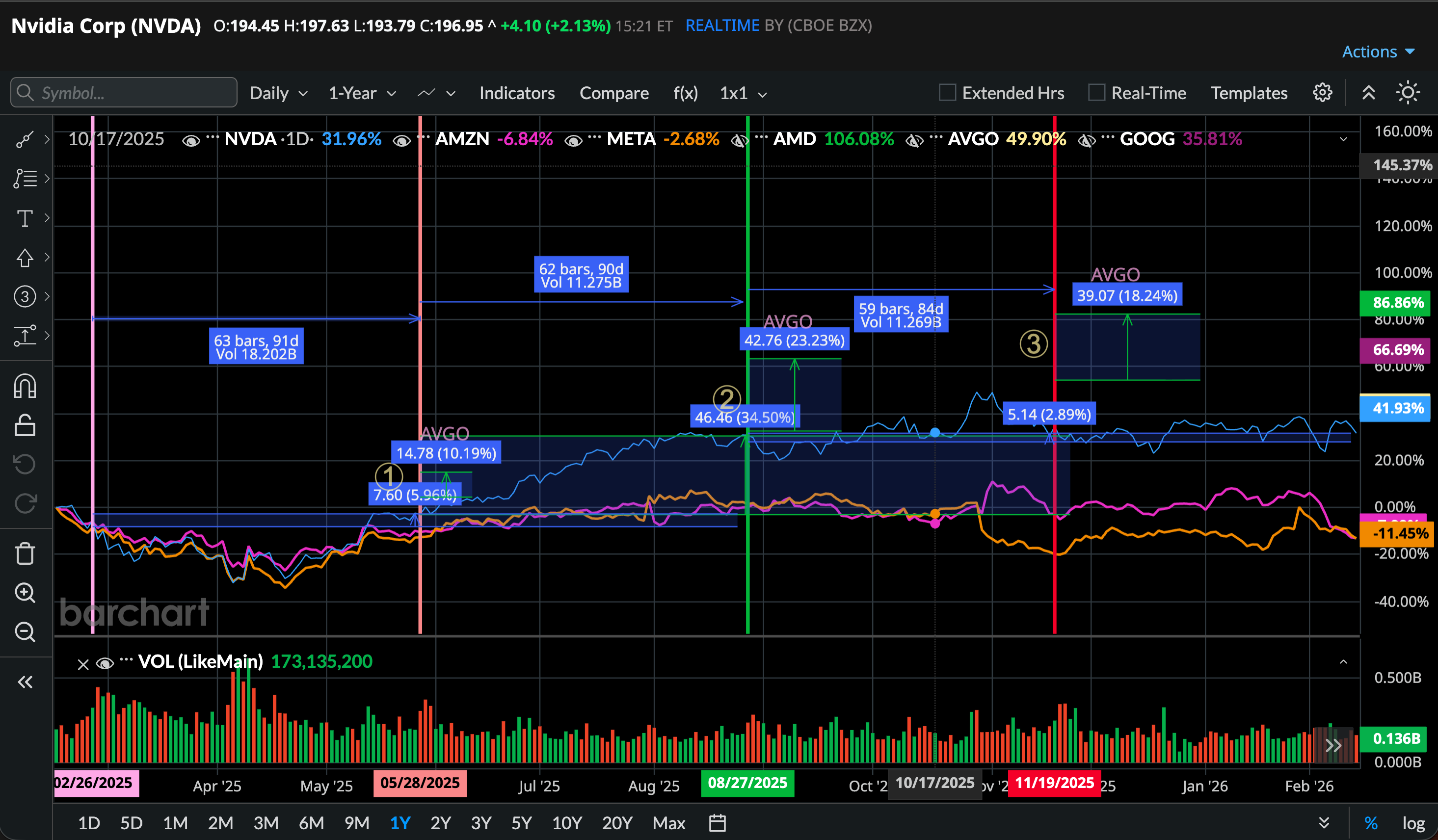
At the time of recording (February 25), Nvidia shares were trading near $197, up roughly 10% in the past week and sitting just below their prior all-time highs around $212.
Historically, Nvidia has often rallied into earnings — sometimes significantly — only to see muted or even negative short-term reactions immediately after reporting. In recent quarters:
The stock rose ~35% between two earnings cycles (May to August).
In other quarters, gains were much smaller (~2–6%).
Post-earnings reactions have included declines of 3–8%, even after strong results.
When expectations are elevated, even great numbers can trigger a “sell the news” response.
Market Expectations: Surprisingly Calm Options Pricing
Interestingly, options markets were implying minimal movement (near 0%) into earnings — an unusual signal for a company of this size and volatility.
For comparison:
Snowflake, reporting earnings the same day, had an implied move of ±12%.
Given Nvidia’s ~$4.6 trillion market cap, even a 5% move represents enormous capital flow. Yet options pricing suggests investors believe forecasts may already be tightly aligned with expectations.
The AI Spending Wave
The broader context remains extremely bullish:
Amazon reportedly planning ~$200B in CapEx.
Meta around ~$160B.
Microsoft and others contributing to total hyperscaler AI spending approaching $600B+.
Much of that capital ultimately flows toward Nvidia’s GPUs.
Revenue Concentration
However, there is a structural risk:
Top 6 customers account for ~85% of Nvidia’s revenue.
~88% of revenue now comes from the data center segment.
This level of concentration means Nvidia’s performance is heavily tied to hyperscaler spending discipline. If those companies pull back, Nvidia would feel it quickly.
Market Share Dominance
The AI chip landscape remains highly skewed:
GPUs represent ~75–80% of the AI chip market.
Nvidia controls over 90% of the GPU segment.
That implies Nvidia holds roughly two-thirds of the total AI chip market.
Competitors:
AMD gaining traction (including recent Meta partnerships).
Broadcom and Marvell competing in ASIC (application-specific) chips.
Even if Nvidia loses incremental share, the total addressable market (TAM) is projected to expand dramatically:
~$120B today.
~$300B within 4 years.
Potentially ~$1T within a decade.
An expanding market can offset moderate share erosion.
Margins: The Real Signal to Watch
Revenue growth is expected to exceed 60% year-over-year. But margins may matter more.
Annual operating margins near 62%.
Previously exceeded 70%.
Management targeting mid-70% range long term.
If margins expand again, the market reaction could be strongly positive. If margin compression continues, even strong revenue growth might not satisfy investors.
Spillover Effects: Broadcom vs. Hyperscalers
An interesting pattern:
Amazon and Meta stock prices have not shown immediate strong moves after Nvidia earnings.
Broadcom, another AI chip maker, has historically rallied 10–23% in the weeks following Nvidia earnings.
However, Broadcom often reports earnings shortly after Nvidia, so its moves may be self-driven rather than purely sympathetic.
Short-Term Outlook
Given:
10% run-up in the past week.
Elevated expectations.
Massive CapEx already publicly disclosed.
A reasonable short-term reaction range may be:
-2% to +4% immediately following earnings.
The real catalyst may not be the headline beat, but:
Guidance
Margin trajectory
Commentary on hyperscaler demand
China exposure
Product roadmap updates (GTC conference upcoming)
Big Picture
Nvidia remains:
Dominant in AI hardware.
Highly profitable.
Positioned in a rapidly expanding TAM.
Heavily dependent on hyperscaler spending.
The long-term structural thesis remains strong. The short-term price reaction depends less on performance and more on expectations versus reality.
As always, earnings season is about narrative shifts, not just numbers.