

Here’s a question worth sitting with: when was the last time anyone fundamentally rethought how a hydraulic system works?
Hydraulics — the technology that powers excavators, military vehicles, oil rigs, and factory floors — have been around since the 1800s. They work by pressurizing fluid to create force. They’re powerful. They’re proven. And according to Hiten Sonpal, CEO of RISE Robotics, they’ve hit their ceiling.
Hiten joined the Snowpal Podcast to talk about what his company is building, what he’s learned from shipping over 9 million units at iRobot, and why he raised $5.7 million from the crowd instead of from VCs. It’s a conversation worth your full attention.
Podcast
The Belt Revolution: How One MIT Startup Is Replacing Oil With Ingenuity - on Apple and Spotify.
The thing Rise Robotics actually built
Rise’s core technology is called Beltdraulic™ — and the name tells you most of what you need to know.
They took a hydraulic actuator (the cylinder that creates linear motion in heavy machinery), removed all the fluid, and replaced it with high-performance belts — the same kind used in elevators.
That swap sounds simple. The results are not.
Beltdraulic™ actuators are:
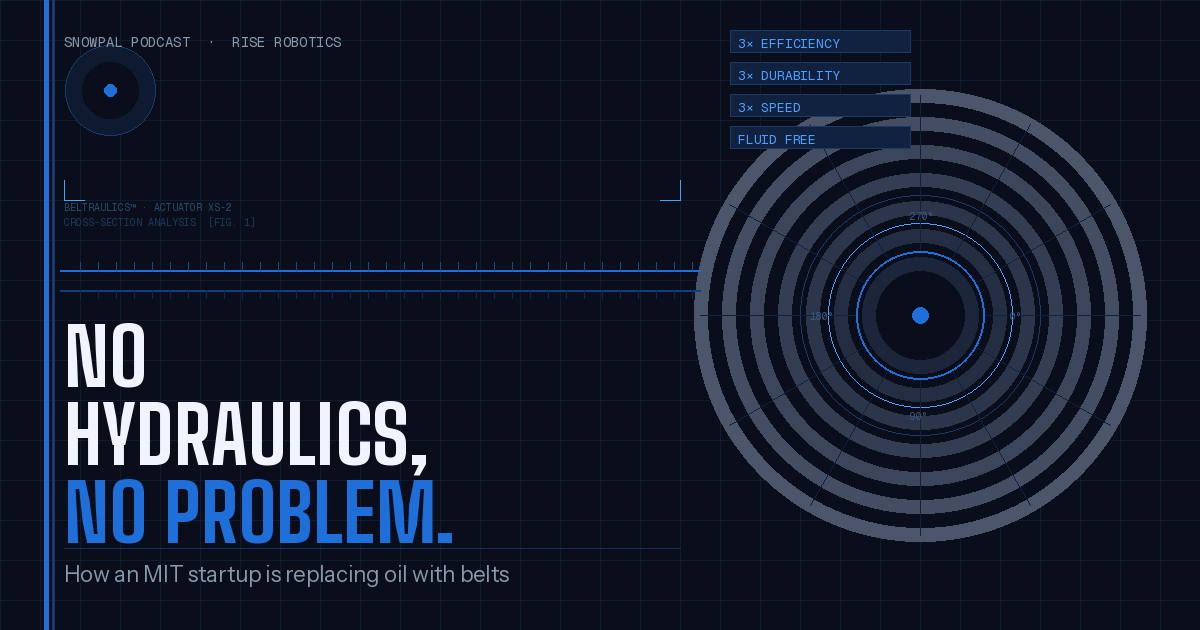
3× more efficient than hydraulics
3× faster
3× more durable
Fluid-free — no leaks, no environmental contamination, no hydraulic oil fires
AI-ready out of the box — they know their exact position, orientation, and load at all times
That last point matters more than it might seem. We’ll get back to it.
Who’s buying it
Rise has two primary customers right now: the Pentagon and the oil and gas sector.
The military angle makes intuitive sense. Soldiers working around traditional hydraulic equipment deal with diesel smoke, constant noise, and bases that eventually become environmental superfund sites from hydraulic oil leaks. Beltdraulic™ eliminates all of that. The Air Force and Army are already running programs with Rise focused on field readiness and reducing logistical complexity.
The oil and gas angle required more strategic thinking.
When Hiten joined Rise, the engineering team was excited about construction. Excavators, cranes — big, obvious applications. But construction moves slowly. The pain isn’t acute enough. Potential customers would hear the pitch and say: “Yeah, that sounds nice. Our customers aren’t really complaining though.”
Oil and gas was different.
Hydraulic systems in O&G run 24 hours a day, 7 days a week. Any downtime is expensive. Any leak is a liability. Any inefficiency compounds across years of continuous operation. Rise is now running pilots converting hydraulic natural gas pumps to belt-draulic ones — in a sector with an $11 billion addressable market, with oil pumps next on the roadmap.
“Our biggest enemy, since we don’t have any competitors, is inertia.”
— Hiten Sonpal
The lesson he took from this: don’t sell better. Find someone who’s in pain, and solve the pain.
What 9 million shipped units taught him
Before Rise Robotics, Hiten spent years at iRobot, leading teams that generated over $2 billion in revenue across 20 product lines.
The single most important thing he learned:
Every improvement you make costs exponentially more than the last one.
Whether you’re trying to cut cost, improve durability, increase speed, or extend battery life — each incremental gain takes more effort than the one before it. Start trying to improve five things at once, and you’ve built a project that won’t survive the next company reorganization.
His rule: pick three customer pain points, and only three.
Not the three coolest problems. The three problems your customer is loudest about, that no one else has solved, that you can actually ship a solution to within your runway.
For hardware companies, that runway is typically 18–24 months. For AI/SaaS, maybe 6–9. The timescale changes by industry. The principle doesn’t.
“You need to find out where your customer’s pain points are — and deliver a solution before the organization loses patience or you run out of money.”
This isn’t a compromise. It’s how you stay in the game long enough to solve the hard stuff later.
Why Beltdraulic™ and AI belong together
Here’s the AI angle that most people in the robotics space are underestimating.
Traditional hydraulic systems have what engineers call bang-bang control — you open a valve, fluid moves, something pushes. You don’t know exactly how far it moved, how much force it applied, or where it stopped without a separate sensor system. Closing that loop requires a trained human operator in the seat.
Belt-draulic actuators are different. Every actuator knows, at all times:
Its exact position
The forces it’s experiencing
Its orientation
That’s a digital twin out of the box. And a digital twin is the foundation for everything autonomous: remote operation, semi-autonomy, full autonomy, predictive maintenance.
Hiten drew a comparison to the self-driving car industry. Meaningful autonomy didn’t arrive until vehicles switched to drive-by-wire — electronic control replacing mechanical linkages. Every serious autonomous vehicle platform had to make that switch before the AI could actually take over.
The same transition is coming to heavy equipment. Beltdraulic™ is the drive-by-wire layer for excavators, forklifts, military vehicles, and oil rigs.
The data angle is equally compelling. An actuator that knows how hard it’s working can tell you when a part is being overstressed — years before it fails in the field. It can tell you if a customer is consistently lifting half their rated load (maybe they’re over-engineered and overpaying). It can generate evidence for carbon credit claims after switching away from hydraulics.
The crowdfunding twist
When Hiten joined Rise, the VC market wasn’t interested on good terms. Everyone wanted humanoid robots and AI. A deep-tech industrial hardware company didn’t fit the narrative.
But Rise had 1,500 LinkedIn followers who kept asking how they could get involved.
Hiten noticed that, and remembered something: Regulation Crowdfunding — a law passed during the Obama administration — allows startups to raise up to $5 million from the public in a 12-month window, offering real equity, not just perks.
He ran a “testing the waters” campaign to gauge interest. Within a month: $800,000 in soft commitments.
So they launched a full campaign on WeFunder, the world’s largest crowdfunding platform.
The result: $5.7 million in reservations — $700,000 more than the legal cap. Rise had to turn money away.
A few things made it work:
The terms were the same as their institutional round. Third-party ratings firm King’s Crowd gave them 4.7 out of 5 stars specifically because retail investors were getting institutional terms — something almost unheard of in crowdfunding.
The investor base is strategic, not just financial. Rise now has 2,500 investors who introduce them to customers, suppliers, and future investors. Some are active military or veterans who work with hydraulic equipment and want to see it improved. Some are climate-focused. Some are just smart retail investors who’ve realized that the best returns in companies like SpaceX were captured long before any IPO — and they want in earlier.
The minimum investment is $250. Anyone can participate.
Hiten is opening another round to accommodate the $700K that didn’t fit last year.
The bottom line
Rise Robotics isn’t trying to build a humanoid robot or solve general AI. They’re solving a specific, expensive, widespread problem that has existed for a century — with technology they can manufacture today, deploy in existing equipment, and scale through a market worth three-quarters of a trillion dollars.
The strategy is clear: go wide until you find a vertical where the pain is acute, then go deep. Focus on three things. Ship. Repeat.
If you’re a founder, there’s a product development framework here worth stealing. If you’re an investor, there’s an opportunity worth looking at seriously — especially before the next institutional round.
Q&A with Hiten Sonpal
Q: Give us a quick intro — who are you and what does Rise Robotics do?
I’m the CEO of Rise Robotics. I’ve been with the company for less than two years, brought on board by the founders to help take the company to its next stage of growth — primarily through commercialization of their technology. The company is affiliated with MIT; three out of four founders went to school there.
What we do is build a new kind of linear actuator that replaces hydraulic systems. We call our technology belt-draulics. We’ve taken the oil out of hydraulic systems and replaced it with modern belts — the same kind used by the elevator industry. By doing that, we’ve created a technology that’s three times as efficient as hydraulics, three times as fast, three times as durable, and is AI and automation-ready out of the box.
Q: Who are your customers right now?
Our biggest customers currently are the Pentagon — specifically the Air Force and the Army. We’re developing hydraulic-free solutions to help improve their readiness and reduce the logistical footprint they deal with in the field.
We recently started commercializing our technology commercially. Our first commercial sale was in the second half of last year — a pilot in the oil and gas sector, which has an $11 billion addressable market. We’re converting hydraulic natural gas pumps to belt-draulic ones, which are completely fluid-free. After that, our next step is oil pumps. Further down the line we’re looking at construction, forestry, and maritime. We have a lot of interest from heavy industry in general, but those are our two primary customers right now.
Q: Do you have competitors?
We actually have no competitors in the traditional sense. Our competitors in one way are the incumbents — companies currently making hydraulic systems — but they’ve reached the ceiling of the S-curve in terms of what can happen with fluid-based actuation.
There are also companies that make linear actuators using screw-type technology — taking a ball screw and rotating it to push forward and backward. Those companies are more likely to be our partners than our competitors. Their stroke lengths are relatively small, their speeds are slow, and the forces they can apply are limited. We have longer stroke lengths, higher speed, and higher forces. We’re very complementary to screw-type actuators. So basically, we don’t have any direct competitors in this space.
Q: What has building deep tech taught you about product development?
The key insight for me came from my time at iRobot, where teams I led generated over $2 billion in revenue and shipped over 9 million units across 20 product lines.
What I learned is that when you’re trying to improve performance in any one axis — cost, reliability, speed, durability — the effort required increases exponentially with each increment. When teams try to tackle multiple axes at once, all those exponentials stack up very quickly. At some point the problem becomes intractable.
Most large organizations reorganize every 18 months. If your project isn’t making substantial traction, it won’t survive two reorganizations. The same is true for startups — 18 months of runway means you need milestones.
So my key insight has been to help engineering teams understand they don’t have to solve everything. Pick three key problems the customer doesn’t have a solution for, and focus on delivering those. If you can solve those three things, you’ll have a market and a successful product. Think of a spider chart with all these axes — how do you squish that chart down to something tractable within a given timeframe?
Q: How do you stay focused on those three things when the world keeps changing?
The timeframe needs to be sized to the rate of change in a particular industry. In consumer electronics, 18 months is right. For pure SaaS, maybe 9 months. For AI-driven companies, even 6 months. For heavy industry, maybe 24 months.
But the core tenet still holds: can you find your customer’s pain points and deliver on them before the organization loses patience or you run out of money?
The world is changing quickly — it is possible that while you’re pursuing those three pain points, something shifts. But keeping that focused tempo means if one thing changes, you still have two to work with. If you were trying to solve ten things, a third of them shifting throws away a massive amount of work. Focusing on a few things and getting them right works across sectors, across industries, whether it’s software or hardware.
Q: How do you bring hardware innovation into legacy industries? What’s the biggest challenge?
Our biggest enemy — since we don’t have any competitors — is inertia. Legacy industries have been doing things a certain way for a very long time. Their training, their processes, their entire operation has been optimized for the technology they already have. Bringing change is very challenging.
What I’ve found works well is identifying customers who have a specific pain point that really bothers them — and going to address that pain point directly. That causes industries to move. If we show up and say ‘this is better,’ it takes a long time to get traction. But if we show up and say ‘we can solve this particular problem you’ve been living with,’ that’s different.
When I first joined Rise, the engineering team was excited about construction. It’s a large market — but it’s slow moving. Customers there would say ‘yeah, this sounds nice, but our customers aren’t really complaining.’ Oil and gas was different. Hydraulic systems there run 24/7. Any durability problem, efficiency problem, or downtime is substantial. By shifting to a customer with a real pain point, we got more traction immediately.
Q: Did you go horizontal or vertical in your market approach?
We started horizontal, which made sense when I joined. We launched our second-generation cylinder — the first standalone unit we could actually ship — at Bauma in Germany, the world’s largest construction show. We had over 200 leads from that show, across construction, agriculture, distribution, and more.
When we came back, we evaluated all of them — understanding the problems of each, where we were as a company, and which customers could meet us where we are. When we discovered the oil and gas vertical, it became very clear that going broad had been the right move to find it. Once we identified a vertical that was compelling, we could stop going broad and go deep.
So the approach was: start horizontal until you find a vertical where the pain is acute and the margins are good, then commit. We still take joint development opportunities from customers in other sectors who come to us, but when it comes to where we put our own chips — we’re going vertical.
Q: Are your products AI-native, or do they work without AI?
We are AI enablers. We don’t have AI inside the actuators, and our customers don’t need AI tools to build a drive-by-wire system using our technology.
But if they choose to add semi-autonomy, teleoperation, or full autonomy, our systems enable all of that — without depending on it. The reason is that our actuators provide precise multi-position control out of the box. You know the position of every actuator, the forces it’s experiencing, and its orientation at all times. That’s a digital twin out of the box, which is the foundation for everything autonomous.
Traditional hydraulics have what’s called bang-bang control — you open the valve, the fluid moves, and you don’t have precise feedback. You need a trained human operator in the seat to close all those loops in their head. With our technology, an AI system gets everything it needs for a digital model — and you can implement safety policies that are mathematically calculated, not statistically guessed.
Q: How does your technology relate to the autonomy transition we’re seeing in vehicles?
The analogy to autonomous vehicles is almost exact. Meaningful autonomy at scale didn’t arrive until manufacturers switched to drive-by-wire platforms. Companies like Waymo and Hyundai couldn’t truly scale autonomous systems until the vehicle’s mechanical controls were replaced with electronic, software-addressable controls.
The same transition is coming to heavy equipment. As long as excavators, forklifts, and industrial machines rely on hydraulic systems, full autonomy remains out of reach. Our technology converts those hydraulic systems into drive-by-wire systems — which is the foundational layer that any autonomous or AI control system needs.
Waymo has even revealed they use remote operators in the Philippines and the US to help get Waymos unstuck from corner cases. The only reason that’s possible is they have a full digital model of the car and its environment. With a hydraulic excavator, that kind of remote situational awareness simply doesn’t exist.
Q: What do startups typically get wrong when scaling complex technology?
The most common mistake is trying to optimize across too many dimensions at once. Teams want to cut cost AND improve reliability AND increase runtime AND improve durability — all at the same time. Each of those improvements is exponentially harder than the last, and when you stack them all together, you’ve built something that can’t be delivered in the time you have.
The discipline required is brutal prioritization. You have to help your engineering team understand that they don’t need to solve every problem — only the three that the customer is actually crying out for. And you need to be honest about your timeframe. Whether it’s 9 months or 24 months, you have a clock. The project that survives is the one that ships something real within that window.
The second mistake is not finding customers early enough. We’re a B2B company, and the instinct in deep tech is to stay in the lab until the technology is perfect. But customer pull is what actually tells you which problems are worth solving — and it’s what gives the organization a reason to keep funding you.
Q: Tell us about your crowdfunding approach — what is Regulation Crowdfunding and why did you use it?
When I joined Rise, the VC market wasn’t offering us great terms. Investors were chasing humanoid robots and AI, and our terms as a deep-tech hardware company were unattractive.
But we had 1,500 LinkedIn followers who regularly asked how they could get involved. That gave me an idea. I was advising a couple of companies that had successfully raised using Regulation Crowdfunding — a law passed during the Obama administration that allows startups to raise up to $5 million from the public over 12 months, with real equity.
We ran a ‘testing the waters’ campaign first — people could express interest without committing money. Within a month we had $800,000 of interest. So we launched a full campaign on WeFunder, which is the number one crowdfunding platform in the world. To our surprise, we ended up with $5.7 million in reservations — $700,000 more than the legal cap. We had to turn money away.
What we didn’t expect was how strategic those investors would become. We now have 2,500 investors who introduce us to customers, suppliers, and future investors. Some want to be customers themselves. It’s been extraordinary.
Q: Do investors in your crowdfunding campaign get real equity in Rise Robotics?
Yes — the process has advanced significantly over the past few years. What happens is that an LLC ends up owning a chunk of the company. All the crowdfunding investors own a piece of that LLC. So it’s very straightforward equity ownership — just structured with one layer so that our cap table doesn’t get unwieldy.
This way we have one line on the cap table representing our 2,500 investors, which institutional VCs are comfortable with for future rounds.
We can also take very small checks — the minimum investment in Rise Robotics is $250. Anyone can participate. And one of the reasons our campaign had so much traction is that the terms we offered retail investors were the same terms we offered institutional investors. The ratings firm King’s Crowd gave us 4.7 out of 5 stars specifically because of that.
Q: Who else is investing in Rise, beyond just technology enthusiasts?
We’re getting three distinct types of investors. First, there are impact investors — people in the armed services who work with hydraulic equipment and see firsthand what belt-draulics could do for soldiers. With our tech, they can stop inhaling diesel smoke, stop being around loud equipment that damages hearing, and stop dealing with hydraulic oil leaks that eventually turn military bases into environmental superfund sites. Those people invest because they believe in the mission.
Second, there are climate-focused investors who like the clean energy angle — removing fluid leaks and improving energy efficiency across heavy industry at scale.
Third, there are savvy retail investors who are starting to think like VCs. They look at our $750 billion addressable market, see that we’re disrupting something real, and recognize that companies like SpaceX are going to IPO at $1.5–2 trillion — meaning most of the money has already been made by the time a retail investor could buy in. Reg CF gives retail investors the chance to get in early, on institutional terms.
Interested in Rise Robotics? Visit riserobotics.com or explore their investor campaign at invest.riserobotics.com.
Listen to the full episode on the Snowpal Podcast.