

In this conversation, Javier Lozano Jr., a fractional CMO/CRO who’s helped B2B tech companies scale from ~$1M to $20M in revenue. As an engineering founder myself, this conversation hit close to home. Many of us believe that if we build a great product, the market will magically find us. In reality, that’s rarely how it works.
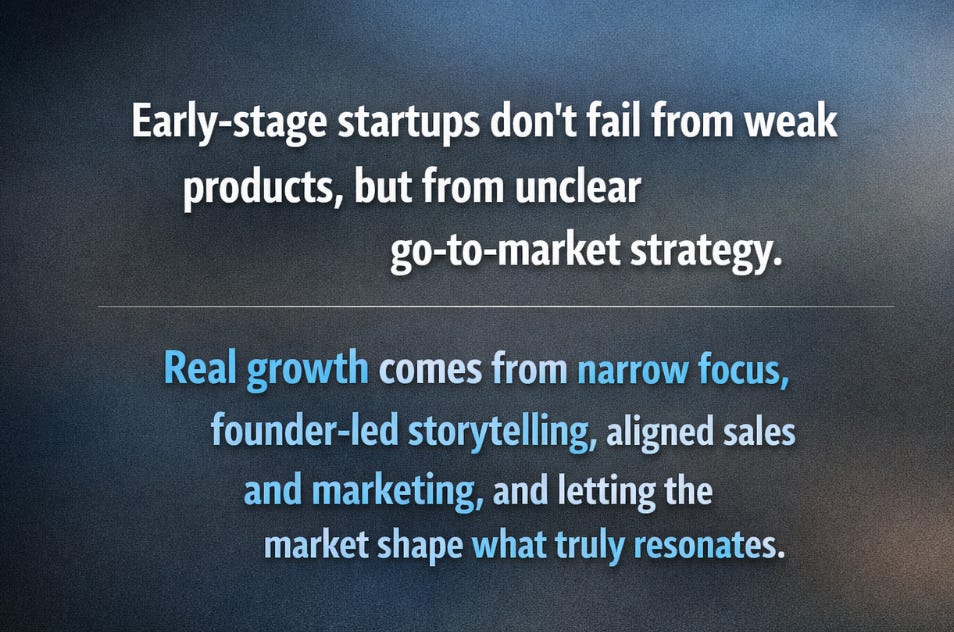
The core issue isn’t engineering or effort; it’s the lack of a clear, aligned go-to-market strategy. Before growth tactics come into play, founders need to understand their ICP, identify real buyer pain points, and align marketing, sales, and customer success around a focused narrative that differentiates them in crowded markets.
One key takeaway: founders should ship earlier, go narrower, and let the market—not internal assumptions—shape the product. Real traction comes from agitating meaningful problems, building trust through founder-led marketing, and staying patient in what is ultimately an infinite game. Growth isn’t about perfection or quick wins; it’s about consistency, clarity, and telling a story that the right customers recognize as their own.
Podcast
What Early-Stage Founders Get Wrong About Go-To-Market (And How to Fix It) — on Apple and Spotify.
Understanding the Initial Interaction
When beginning his engagements with new clients, Javier emphasizes the importance of a comprehensive go-to-market audit. This process involves assessing everything from the customer relationship management (CRM) system to the technology stack and marketing tools in use. By interviewing team members and analyzing operational metrics, Javier can identify what’s working and what isn’t. For instance, he dives into platforms like HubSpot to understand how leads are tracked and managed, akin to a doctor diagnosing a patient before prescribing treatment. This holistic approach ensures that any recommendations made are tailored to the specific needs of the company, whether they require quick fixes or strategic overhauls.
Creating a 90-Day Roadmap
Once the audit is complete, Javier collaborates with the company to develop a 90-day roadmap outlining key priorities. This structured plan focuses on the most impactful strategies that will drive growth within the designated timeframe. He cautions against the common tendency to overhaul messaging or website design too quickly, advocating instead for a focus on leveraging existing strengths before making drastic changes. For startups like Snowpal, where resources are often limited, this strategic approach can make all the difference in achieving sustainable growth.
Engaging with Engineers and Product Development
One of the most compelling discussions in the podcast revolves around when to involve a fractional CMO like Javier in the product development process. He suggests that early engagement is crucial, especially for tech founders who may be primarily focused on engineering. Understanding the competitive landscape is vital; for example, when launching a project management tool, it’s important to identify what differentiates it from established competitors like Asana or Monday.com. Javier advocates for defining a unique value proposition and building a narrative around it that resonates with potential users. This could involve testing the product with beta users who have unmet needs that existing solutions fail to address.
Finding Product-Market Fit
Javier highlights the importance of positioning and messaging in finding product-market fit. He encourages founders to think critically about how their product stands out in a crowded marketplace. Companies like Drift successfully carved their niche by focusing on marketing enablement rather than just sales conversion, showcasing the power of strategic positioning. By identifying the target audience and their specific challenges, founders can validate their product concept before launching it to the wider market.
GTM Lessons
Here are a few lessons from the discussion that every early-stage founder should hear—especially those coming from technical backgrounds.
1️⃣ Product ≠ Go-To-Market
Most startups don’t fail because the product is bad. They fail because marketing and sales aren’t aligned. Javier starts every engagement with a go-to-market audit:
CRM and pipeline hygiene
Sales + marketing alignment
Tech stack and automation
Customer lifecycle after the deal closes
You wouldn’t accept a doctor’s prescription without a diagnosis. Go-to-market should be no different.
2️⃣ “Moat” Isn’t Features — It’s Agitation
In crowded markets (think project management tools), differentiation rarely comes from features alone.
The real moat comes from:
Understanding what frustrates buyers
Agitating that pain clearly
Solving it in a way competitors don’t talk about
People don’t buy because something is “nice.” They buy because something hurts.
3️⃣ Go Narrow Before You Go Big
A common mistake: trying to sell to everyone.
The better approach?
Market to one person before marketing to a segment.
Define a tight ICP. Speak directly to that buyer. Build traction there first—then expand. Depth beats breadth early on.
4️⃣ Ship at 70% and Let the Market Decide
Founders get emotionally attached to their ideas. That’s natural—but dangerous. Ideas are rarely fully formed at launch. The market finishes them for you. Ship early. Listen closely.
Let real usage—not opinions—guide iteration.
Progress beats perfection.
5️⃣ Founder-Led Marketing Is a Superpower
In early stages, authority matters more than automation. Podcasts, LinkedIn, communities, contrarian takes—these aren’t “nice to have.” They’re often the fastest path to trust. People buy from founders they believe understand the problem.
6️⃣ This Is an Infinite Game
Building a company is not about quick wins.
It’s about:
Patience
Consistency
Playing the long game
If you’re still in the game, you’re winning.
Summary
Early-stage startups rarely fail because the product isn’t good enough. More often, they fail because the go-to-market motion is unclear, misaligned, or treated as an afterthought. As engineering founders, many of us assume that building the right thing is the hardest part—and that adoption will naturally follow. In reality, product success depends just as much on positioning, storytelling, and execution outside the codebase as it does on what’s being built.
This became especially clear in my conversation with Javier. One recurring theme stood out: before scaling, founders need clarity. Clarity on who they are building for, what pain they are truly solving, and why their solution deserves attention in an already crowded market. Features alone rarely create differentiation; meaningful differentiation comes from identifying buyer frustrations and addressing them head-on.
Another key takeaway was the importance of focus. Early-stage teams often try to go broad too quickly, hoping to appeal to multiple personas at once. Instead, the strongest growth comes from going narrow—speaking to a specific ideal customer, telling a story that resonates deeply with that audience, and earning trust before expanding outward. This applies not just to product design, but to marketing, sales, and even founder-led content.
Perhaps the hardest lesson for founders is learning to ship before everything feels perfect. Ideas are rarely fully formed at launch, and emotional attachment to early versions can slow progress. The market, not internal assumptions, is the fastest and most honest feedback loop. Shipping early, listening carefully, and iterating based on real usage is often the difference between stagnation and momentum.
At the end of the day, building a company is a long game. Growth rarely happens overnight, and consistency matters more than short-term wins. Products evolve, strategies shift, and markets change—but founders who stay patient, focused, and open to learning give themselves the best chance to keep playing the game. And in business, staying in the game is how you win.
This conversation reinforced something I’ve learned the hard way:
People remember stories more than products.
If you’re a founder struggling with growth, the answer may not be “build more features.”
It might be: tell a clearer story, to a narrower audience, with better alignment.