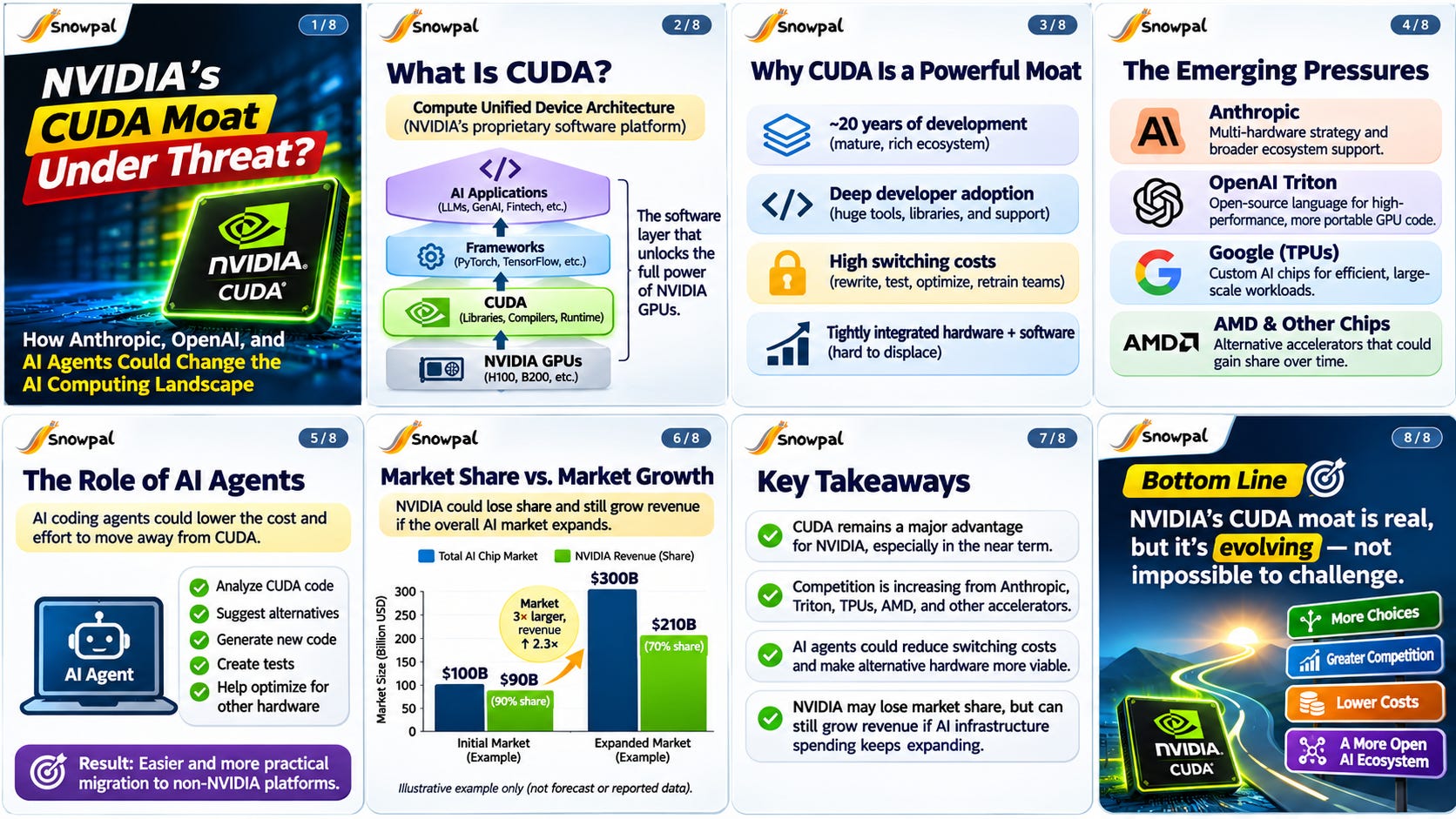
NVIDIA has become one of the most dominant companies in the artificial intelligence industry, and much of its success is attributed to its powerful GPUs. However, its competitive advantage extends well beyond semiconductor hardware. One of NVIDIA’s strongest assets is CUDA, its proprietary software ecosystem that has helped establish the company as a preferred platform for AI development. But what happens when competing chip architectures become more accessible, AI agents make software migration easier, and companies like Anthropic and OpenAI contribute to a more flexible computing environment? Could NVIDIA’s competitive moat gradually weaken, even as the broader AI industry continues expanding?
In this episode of the Snowpal Podcast, we explore CUDA from both a software engineering and investment perspective. We examine why developers and enterprises have historically found it difficult to move away from NVIDIA, how alternative chip architectures could challenge that dependency, and why declining market share would not necessarily translate into declining revenue or profitability.
Podcast
NVIDIA's Biggest Competitive Threat May Not Be Another Chip — It May Be Software — on Apple and Spotify.
NVIDIA’s CUDA: The Software Behind the Hardware
What exactly is CUDA?
CUDA stands for Compute Unified Device Architecture. It is NVIDIA’s proprietary parallel computing platform and programming model, introduced in 2006, that allows developers to use NVIDIA GPUs for general-purpose computational workloads. GPUs were originally associated primarily with graphics processing, but their ability to execute many calculations simultaneously made them particularly valuable for scientific computing, machine learning, and eventually generative AI.
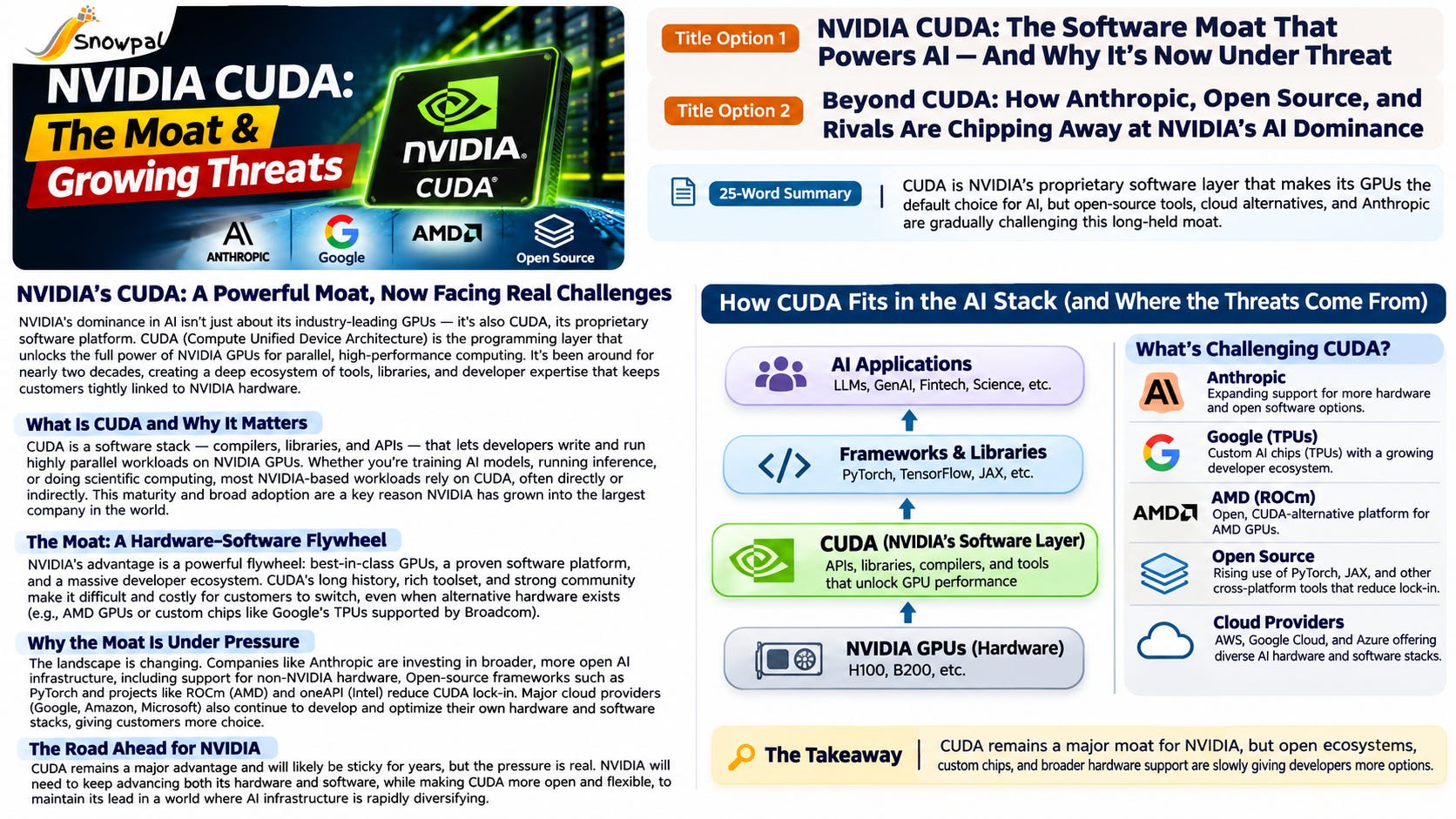
From a software engineering standpoint, CUDA provides the programming tools, libraries, compiler infrastructure, and runtime capabilities necessary to execute supported workloads efficiently on NVIDIA GPUs. Developers might write CUDA code directly, but many interact with it indirectly through machine learning frameworks such as PyTorch. When a PyTorch application runs on an NVIDIA GPU using its CUDA backend, the developer may never explicitly write a CUDA kernel, yet the underlying execution still depends on NVIDIA’s software ecosystem.
Why CUDA is such a powerful competitive moat
Building a competitive GPU is extraordinarily difficult, but producing hardware is only part of the challenge. Developers also need mature software tools, optimized libraries, debugging capabilities, documentation, and reliable integrations with the frameworks they already use. NVIDIA has spent approximately two decades developing this ecosystem, creating a substantial advantage that competitors cannot easily reproduce.
Imagine an enterprise that has invested years developing and optimizing its AI applications around NVIDIA GPUs. Its engineers understand CUDA, its infrastructure is configured for NVIDIA hardware, and its performance benchmarks have been established around that environment. Switching to another chip architecture would require more than purchasing replacement hardware. It could involve rewriting portions of the software, replacing dependencies, validating numerical behavior, benchmarking performance, and retraining engineering teams. These switching costs make NVIDIA’s ecosystem particularly difficult to displace.
Broadcom, Google, and the Rise of Alternative AI Chips
GPUs versus ASICs
Although NVIDIA dominates important segments of AI GPU computing, other companies are developing specialized processors that can perform certain AI workloads efficiently. One prominent category is the application-specific integrated circuit, or ASIC. Unlike a general-purpose GPU, an ASIC is designed around a more narrowly defined set of computational requirements, potentially delivering advantages in performance, energy efficiency, or cost for suitable workloads.
Broadcom is an important participant in this market, collaborating with major technology companies on custom semiconductor solutions. Google’s Tensor Processing Units, or TPUs, represent another approach to AI acceleration. TPUs are specialized processors designed to accelerate machine learning workloads and are supported by a software ecosystem that differs from NVIDIA’s CUDA stack.
The distinction matters because AI computing does not necessarily have to run exclusively on general-purpose NVIDIA GPUs. Certain workloads may be more economical on custom accelerators, particularly when large organizations have the resources to optimize their software around those processors.
Why cheaper chips alone may not be enough
Suppose a competing accelerator offers a compelling cost advantage over an NVIDIA GPU. An enterprise cannot automatically take its existing CUDA-dependent application and execute it unchanged on that alternative architecture. The software stack, kernel implementations, compiler support, memory management, and hardware characteristics may all differ.
This creates an interesting economic problem. Even when competing hardware is cheaper, the cost of migrating the software could exceed the potential savings. Consequently, NVIDIA’s competitive advantage comes not simply from offering powerful processors, but from making the entire computing environment difficult and expensive to replace.
Anthropic and the Possibility of Hardware Flexibility
Why multi-chip AI infrastructure matters
One of the most interesting developments discussed in the podcast is the possibility of AI workloads operating across different hardware architectures rather than remaining tied to a single semiconductor vendor. Anthropic is relevant to this conversation because its AI workloads and infrastructure relationships span multiple computing platforms.
A hardware-flexible environment could allow organizations to evaluate NVIDIA GPUs alongside alternatives such as Google’s TPUs and other custom AI accelerators. Instead of making a long-term commitment to one vendor, enterprises could select hardware based on workload requirements, cost, performance, and availability.
An important distinction is that Anthropic does not provide a universal software layer that automatically makes every CUDA application portable across all competing processors. Its multi-platform infrastructure strategy illustrates the potential for hardware diversification, while the technical work of supporting different accelerators still depends on compilers, frameworks, libraries, and engineering effort.
How AI agents could reduce migration costs
Perhaps the more significant long-term threat to NVIDIA’s software lock-in comes from AI-assisted software engineering. Historically, migrating applications between substantially different computing architectures has been expensive and time-consuming. Developers must understand the existing code, identify hardware-specific dependencies, implement alternative kernels, and validate that the migrated application behaves correctly.
AI coding agents could make portions of this process considerably easier. An agent might examine a CUDA-dependent codebase, identify hardware-specific components, propose alternative implementations, generate tests, and help developers optimize workloads for another platform. Tools such as Anthropic’s Claude could potentially assist engineers with these tasks.
This does not mean migrating a sophisticated AI workload becomes a one-click operation. Performance tuning, correctness testing, hardware availability, and operational reliability remain significant challenges. Nevertheless, if AI agents reduce the time and cost required to migrate, companies that previously considered switching impractical may begin evaluating alternatives.
The key point is that NVIDIA’s moat could weaken without competing chips necessarily becoming more powerful than NVIDIA’s GPUs. Making it easier to use alternative hardware may itself increase competition.
OpenAI’s Triton: Another Challenge to CUDA Dependency
What is Triton?
OpenAI’s Triton is an open-source programming language and compiler designed to make writing high-performance GPU kernels more accessible. It allows developers to express parallel computations at a higher level than traditional low-level CUDA programming, while still targeting efficient GPU execution.
Triton is particularly relevant for machine learning workloads where developers need specialized computational kernels. Instead of manually implementing every operation using conventional CUDA programming techniques, engineers can use Triton to express the computation and rely on its compiler infrastructure to handle portions of the optimization process.
Does Triton replace CUDA?
Not necessarily. Triton can run on NVIDIA GPUs and may still rely on NVIDIA’s underlying driver and execution infrastructure. It is therefore not accurate to describe Triton as an immediate or complete replacement for CUDA.
However, Triton can reduce developers’ dependence on writing hardware-specific CUDA code directly. With suitable compiler backends and hardware support, higher-level programming approaches may make it easier to target multiple accelerator architectures over time.
The strategic implication is important: if developers can write more portable GPU software, the relationship between applications and a particular hardware vendor may become less restrictive. NVIDIA could continue selling enormous quantities of GPUs while facing greater competition at the programming and infrastructure layers.
Could NVIDIA Lose Market Share Without Losing Revenue?
Market share and market growth are different questions
The podcast raises an important distinction between NVIDIA’s share of the AI computing market and the overall size of that market. NVIDIA may face increasing competition from custom accelerators, alternative GPU suppliers, and more portable software frameworks. Yet that does not automatically mean its revenue must decline.
Consider a hypothetical scenario in which NVIDIA controls 90% of a particular AI accelerator market worth $100 billion. Its corresponding revenue opportunity would be $90 billion. If the market subsequently expands to $300 billion but NVIDIA’s share falls to 70%, its corresponding opportunity would increase to $210 billion.
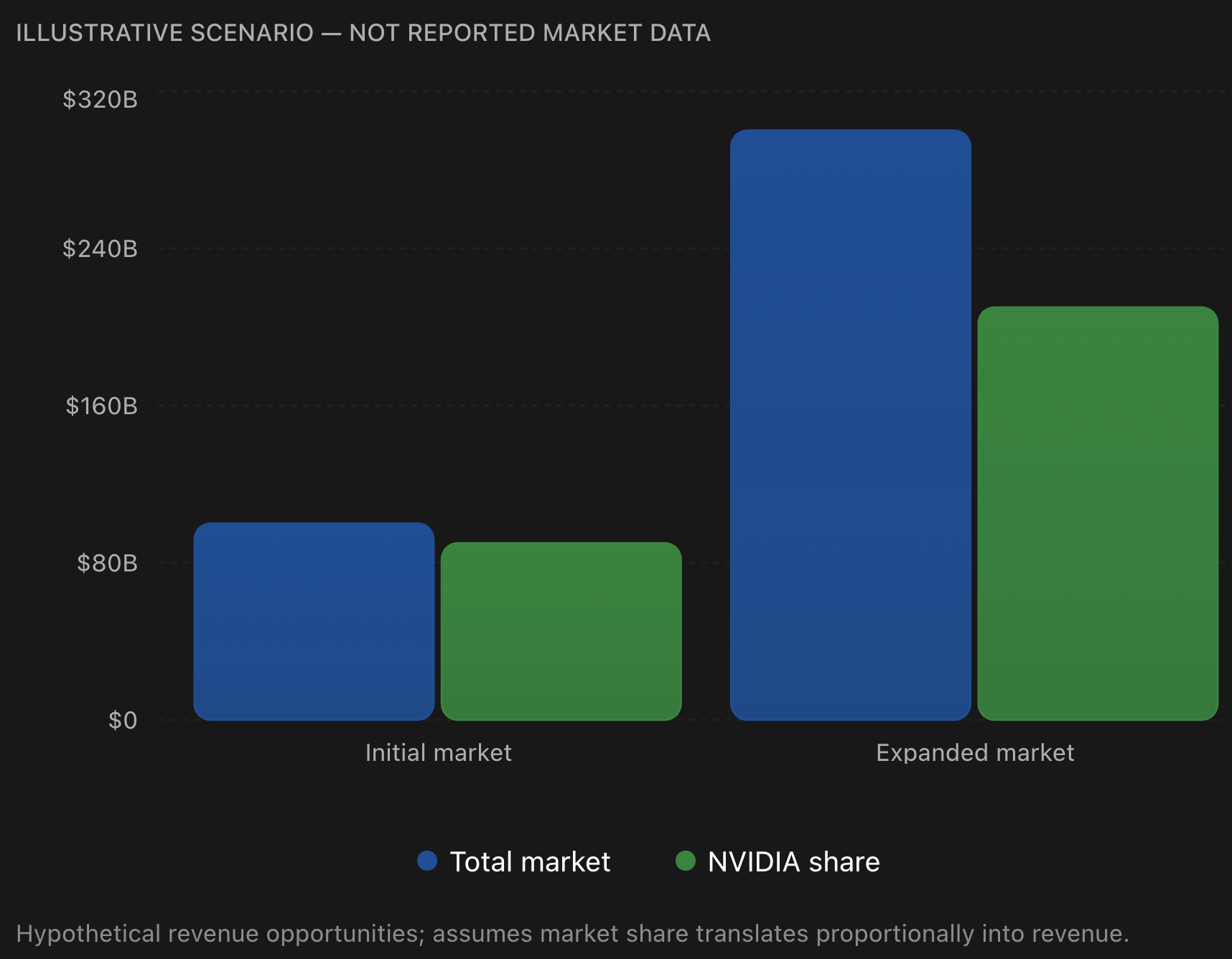
Hypothetical revenue opportunities; assumes market share translates proportionally into revenue.
Despite losing 20 percentage points of market share, NVIDIA’s corresponding revenue opportunity would have more than doubled. This illustrates why market share alone is insufficient to evaluate the company’s future financial performance.
The podcast also mentions approximate market-share figures for NVIDIA GPUs, Broadcom ASICs, and the overall AI chip market. These were explicitly pres
ented as rough estimates rather than verified industry statistics. The broader competitive argument does not depend on those particular percentages being accurate.
Why total addressable market matters
The total addressable market, commonly abbreviated TAM, represents the potential demand for products and services within a particular industry. AI infrastructure spending could continue expanding as enterprises adopt AI applications, inference workloads increase, and new computationally intensive products become commercially viable.
If that expansion is sufficiently large, NVIDIA could continue generating substantial revenue growth even while competitors capture a greater portion of incremental spending. Conversely, strong market growth does not guarantee that NVIDIA will maintain its current profit margins or valuation multiples. Pricing pressure, customer concentration, custom-chip adoption, and capital expenditure cycles could all affect its financial performance.
The Investment Perspective: Dominance Versus Competition
For investors, the central question is not simply whether NVIDIA will remain the leading AI GPU supplier. It is whether its competitive advantages will continue translating into revenue growth, attractive margins, and sustainable profitability as the industry matures.
CUDA creates meaningful switching costs, but switching costs are not permanent barriers. More capable AI development tools could lower those costs, while alternative accelerators could provide economically attractive options for selected workloads. Large technology companies also have incentives to diversify their suppliers, negotiate better prices, and reduce their dependence on any single semiconductor company.
At the same time, NVIDIA continues benefiting from its hardware performance, integrated software ecosystem, networking technologies, developer adoption, and substantial investment in research and development. Even if alternative platforms become easier to use, NVIDIA may remain the preferred option for many demanding AI workloads.
The most plausible competitive outcome is not necessarily a sudden collapse in NVIDIA’s position. It could instead be a gradual transition toward a more diversified AI computing market in which NVIDIA remains a major supplier but no longer captures the same overwhelming share of every incremental investment.
Final Thoughts: NVIDIA’s Moat May Evolve Rather Than Disappear
CUDA has been an extraordinary strategic asset for NVIDIA. By combining advanced hardware with a deeply integrated software ecosystem, the company has created barriers to entry that extend far beyond semiconductor design. But AI is also changing the economics of software development itself. If AI agents can reduce migration costs, frameworks become more portable, and alternative accelerators become increasingly capable, customers may gain choices that were previously impractical.
That does not mean NVIDIA is destined to lose its leadership position. Its revenue could continue growing even as the market becomes more competitive, particularly if demand for AI computing expands faster than its market share declines. The important distinction is between a company losing some of its exclusivity and a company losing its relevance.
For software developers, this evolution could create more flexibility and potentially lower infrastructure costs. For investors, it introduces a more nuanced question: how much of NVIDIA’s future growth depends on maintaining its current competitive dominance, and how much depends on the extraordinary expansion of the AI computing market itself?
As discussed in the podcast, the answer will become clearer as the industry evolves. What seems increasingly likely is that competition will take place not only between chips, but also between the software ecosystems that determine how those chips are used.
This article is adapted from the November 6, 2026 Snowpal Podcast transcript. The market-share and revenue examples are illustrative, and the technical discussion includes clarifications where the original recording expressed uncertainty.