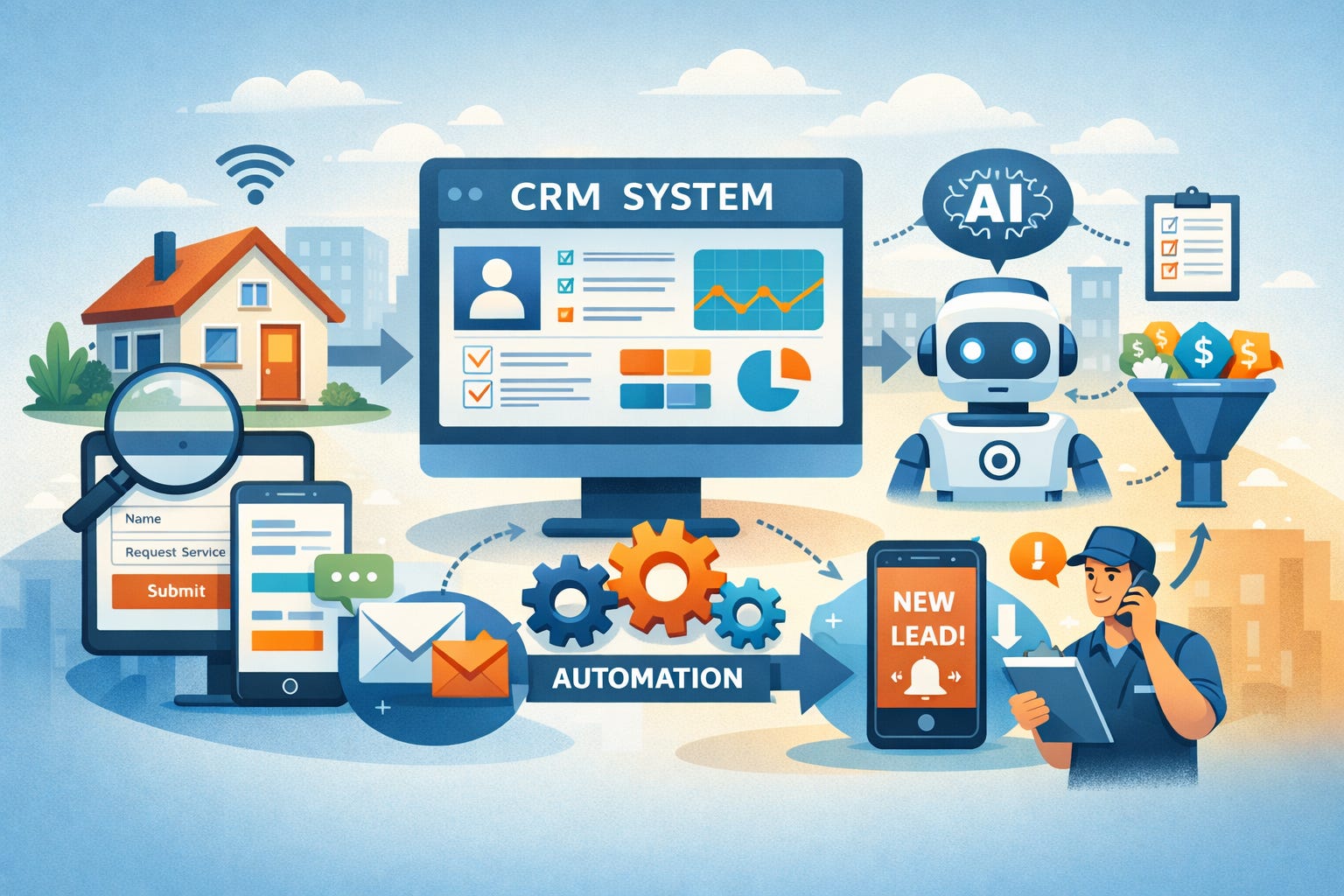
In this episode, Charles Craggett, Marketing Automation Specialist at Become The Authority, discusses how automation and AI are transforming sales and marketing for trades businesses like roofing and plumbing. He shares insights on building systems that generate leads, improve customer engagement, and increase conversions, all while maintaining control and ownership of data.
In many service industries—roofing, plumbing, electrical work, and other trades—success is often determined not only by skill but also by systems. Many contractors are excellent at their craft but struggle with the operational side of the business: marketing, managing leads, and converting inquiries into paying customers.
Modern automation and AI tools are changing this reality. By implementing better systems for marketing, customer communication, and lead management, service businesses can significantly increase sales conversions and scale their operations more efficiently. Insights from a recent conversation on the Snowpal Podcast with marketing automation expert Charles Craggett highlight how these systems are helping businesses move from disorganized operations to highly optimized growth engines.
Podcast
How Trade Businesses Can Increase Conversions with Automation and AI — on Apple and Spotify.
The Hidden Cost of Outsourced Leads
Many trade businesses rely heavily on third-party lead platforms. These platforms connect homeowners with contractors and charge businesses for each lead they receive. While this model can bring in customers, it often comes with a steep price.
Lead platforms frequently generate leads at relatively low costs and then resell them to contractors at a large markup. A lead that costs a platform $10 to acquire might be sold to a contractor for $100 or more. Over time, these expenses reduce profitability and place contractors at the mercy of external platforms that control the flow of customers.
More importantly, when companies rely entirely on external platforms, they lose control over their own marketing and brand. They cannot easily build long-term customer relationships or optimize their marketing strategies because they do not own the data or the customer journey.
Building internal marketing systems allows businesses to reclaim that control.
Why Many Trade Businesses Struggle With Systems
A common issue in the trades is the absence of structured systems for tracking leads and managing customer communication. Many businesses grow through referrals and word of mouth, which works well at smaller scales. However, as demand increases, the lack of organized processes becomes a major bottleneck.
Potential customers may submit inquiries through websites or online forms but receive responses hours later—or sometimes not at all. In service industries, delays can be extremely costly. When someone needs a plumber for a leaking pipe or a roofer during a storm, they are unlikely to wait long for a response. Instead, they will simply contact the next contractor on the list.
Even highly skilled businesses can lose significant revenue due to these delays. In many cases, the difference between a one-million-dollar company and a five-million-dollar company is not technical expertise but operational efficiency.
Bringing Marketing and Lead Generation In-House
To overcome these challenges, many service businesses are moving toward owning their marketing infrastructure rather than outsourcing it.
This typically involves building a complete digital ecosystem that includes:
A high-converting website
Search engine optimization (SEO)
Paid advertising campaigns
Customer relationship management (CRM) systems
Automated communication tools
When these components work together, businesses can generate leads at lower costs while maintaining full control over the customer journey.
Owning the marketing pipeline also allows companies to analyze performance more effectively. They can track where leads come from, how quickly they respond, and how well their processes convert inquiries into jobs.
The Importance of Fast Response Times
One of the most important factors in service sales is speed.
Research and experience show that the first company to respond to a customer inquiry often wins the job. This makes immediate follow-up critical.
Automation systems help businesses achieve this by responding to leads within minutes. When a potential customer submits a request through a website, their information is automatically captured and sent into a CRM system. From there, automated messages—often text messages—can acknowledge the inquiry and begin the conversation.
These quick responses reassure customers that their request has been received and that help is on the way. Meanwhile, the business team can prepare to follow up personally and schedule the service appointment.
This combination of automation and human interaction creates a smoother customer experience while ensuring no lead is overlooked.
Designing Websites That Convert
A service company’s website is often the first point of contact between the business and potential customers. However, many contractor websites are outdated, difficult to navigate, or poorly optimized for conversions.
Effective service websites focus on simplicity and accessibility. The primary goal is to make it easy for visitors to contact the business.
Key elements of high-converting websites include:
Clear call-to-action buttons
Simple contact forms
Prominent phone numbers
Mobile-friendly design
Fast loading speeds
Most customers searching for services today use their smartphones. If a website is difficult to navigate on a mobile device, visitors are likely to leave and contact another provider.
By simplifying the user experience and making communication effortless, businesses increase the likelihood that visitors will convert into leads.
The Continued Power of Search Engines
Search engine visibility remains one of the most powerful drivers of customer acquisition for service businesses.
When homeowners search for phrases like “roof repair near me” or “emergency plumber,” they typically select companies that appear at the top of search results. Although paid advertisements appear first on many search pages, many users skip them and click on organic search results instead.
For this reason, businesses benefit from investing in both paid and organic search strategies. When a company appears in both the paid advertisements and the organic results, it reinforces its authority and credibility.
Customers are more likely to trust businesses that dominate the search results page.
Where Artificial Intelligence Fits In
Artificial intelligence is becoming increasingly valuable in business operations, but its role in service industries is slightly different from other sectors.
Customers searching for plumbing or roofing services are generally not looking to interact with complex AI systems. Their main priority is solving a problem quickly. Most people prefer to speak with a real person who can provide clear answers and schedule service.
Because of this, AI is often most useful behind the scenes.
Automation tools powered by AI can help businesses:
Organize incoming lead data
Draft customer responses
Route inquiries to the correct team members
Schedule follow-ups and reminders
Track communication history
These capabilities improve efficiency without interfering with the human relationships that customers value.
Understanding Different Types of Customers
Another important factor in service marketing is recognizing that not every visitor is a potential customer.
Some people prefer to handle repairs themselves. They search for tutorials, read blog posts, and watch instructional videos to fix problems on their own. Others simply want a professional to solve the issue quickly.
Businesses should design their marketing strategies to focus on the second group—customers who value professional service and convenience.
Educational content such as blogs and videos can still play a useful role. These materials help establish authority and attract online traffic. However, the primary goal of a service company’s website should remain clear: convert interested visitors into scheduled appointments.
Building Scalable Systems for Growth
For many service businesses, growth is limited not by demand but by operational inefficiencies. Without organized systems, businesses struggle to manage increasing numbers of leads and customer interactions.
Automation and CRM platforms solve this problem by creating structured workflows that handle lead capture, communication, and follow-up automatically.
These systems ensure that every customer inquiry is tracked and addressed promptly. Over time, businesses can refine these workflows, optimize marketing channels, and increase their conversion rates.
Instead of reacting to incoming requests, companies operate with a predictable and scalable system for acquiring and serving customers.
The Future of Service Business Marketing
Technology will continue to reshape how service businesses attract and manage customers. Automation, AI tools, and advanced digital marketing strategies are becoming essential components of modern operations.
Contractors who adopt these systems early gain a significant advantage. They reduce marketing costs, improve response times, and provide better customer experiences.
Ultimately, success in service industries is no longer just about technical skill. It is about building systems that consistently generate and convert opportunities.
By combining strong marketing infrastructure with efficient automation tools, service businesses can transform from small local operators into scalable, high-performing organizations capable of sustained growth.
Summary
Modern service businesses are increasingly adopting digital technologies to streamline operations, improve customer response times, and increase sales conversions. Central to this transformation is the use of integrated marketing systems that combine websites, customer relationship management (CRM) platforms, automation tools, and artificial intelligence. These technologies work together to capture customer inquiries, organize lead data, and initiate immediate communication with potential customers.
A typical system begins with a website designed to collect lead information through simple forms and clear calls to action. Once a visitor submits their details, the information is automatically stored in a CRM system where it can be tracked and managed. Automation tools then trigger follow-up actions such as sending confirmation messages, requesting additional details about the service needed, or notifying the sales team to contact the customer.
Artificial intelligence enhances these systems by helping manage data flow, prioritize leads, and automate initial responses. While customers often prefer direct human interaction for service-related decisions, AI plays an important role behind the scenes by improving workflow efficiency and ensuring that inquiries are handled quickly. This combination of CRM systems, automation, and AI allows businesses to respond to leads faster, reduce operational friction, and convert more inquiries into completed jobs.