With increasing layoffs and the rapid rise of AI-assisted development, more professionals are considering entrepreneurship—especially in software. While AI tools have empowered non-engineering founders to build more independently than ever before, many still turn to managed services firms or external developers to bring their ideas to life.
If you’re planning to outsource software development—whether for a mobile app, web platform, backend system, or API—this guide outlines the critical considerations to help you avoid costly mistakes and reduce risk.
Insights inspired by a founder’s discussion on outsourcing, AI, and building responsibly.
Podcast
Building in the AI Era: A Smart Founder’s Guide to Outsourcing — on Apple and Spotify.
Section 1: Establishing Credibility and Trust
1. Verify Credibility Beyond the Portfolio
Not all portfolios reflect actual hands-on involvement.
Confirm the agency truly worked on listed projects.
Ask for references and speak directly with past clients.
Research cultural norms around accountability in the vendor’s region.
Credibility is foundational. Without it, everything else is irrelevant.
2. Evaluate Rates Realistically
Rates can range dramatically (e.g., $10/hour to $100/hour or more).
Avoid automatically choosing the lowest rate.
Compare median rates within the region.
Compare global averages for similar skill sets.
If pricing deviates too much from the norm, treat it as a red flag.
In software, you often get what you pay for.
Section 2: Structuring Your Team
3. Decide Between an Agency vs. Independent Developers
Each approach has trade-offs:
Agency Model
Single point of contact
Built-in coordination
Less management overhead
Higher risk if performance fails
Independent Contractors
Diversified risk
Potentially lower cost
Higher management complexity
Risk of finger-pointing between contributors
Choose based on your technical capability and management bandwidth.
4. Clarify Team Composition and Stability
If hiring an agency:
Interview the exact team members assigned to your project.
Confirm they will stay on your project throughout.
If hiring individuals:
Ask whether your project is their primary commitment.
Avoid developers juggling multiple gigs as secondary priorities.
Consistency is critical for delivery quality.
Section 3: Hiring and Interviewing
5. Design a Thoughtful Interview Process
Be cautious of:
Over-reliance on algorithmic coding tests
Live coding anxiety skewing results
Candidates secretly receiving assistance
Instead:
Use practical scenario-based questions
Assess communication skills relative to role
Verify authenticity during remote interviews
If remote, confirm the person answering is the actual candidate.
6. Confirm AI Fluency and Modern Development Practices
Software development has changed dramatically in recent years.
Ask:
What AI tools do you use (beyond generic chat interfaces)?
Why those tools?
What alternatives did you consider?
How has your SDLC evolved due to AI?
If their workflow hasn’t changed in two years, that’s a concern.
Section 4: Managing Scope, Time, and Budget
7. Scrutinize Turnaround Time Promises
Vendors often compete by promising:
Faster delivery
Lower costs
Be cautious:
Break work into short iterative cycles
Use weekly (or shorter) demos
Avoid unrealistic compression of timelines
Fast promises often become extended overruns.
8. Choose Between Time & Materials vs. Fixed Price
Time & Materials
Flexible
Risk of scope creep
Vendor may stretch timelines
Fixed Price
Predictable cost
Requires extremely detailed documentation
High contractual risk if requirements are ambiguous
Choose based on how clearly you can define requirements upfront.
Section 5: Code Quality and Ownership
9. Understand the Merge and Review Process
With AI generating large portions of code:
Determine what is machine-generated vs. human-written
Ensure someone independent reviews critical sections
Avoid blindly accepting “working” code
Production-ready code is not the same as demo-ready code.
10. Plan for Maintenance Early
After launch:
Who maintains the product?
Is there a retainer agreement?
What happens during production outages?
If you switch vendors later:
Will the new team understand the stack?
Is documentation complete?
Maintenance planning should begin before development starts.
Section 6: Technology and Architecture Decisions
11. Understand the Tech Stack Choices
Ask:
Why this database? (SQL, NoSQL, vector DB?)
Why this cloud provider?
Is this technology globally supported?
Is it popular where you operate?
Avoid niche or regionally isolated technologies that limit future hiring.
12. Verify Deployment Control and Dependencies
You should:
Own all cloud accounts (AWS, Azure, GCP, etc.)
Control admin access
Grant least-privilege access to vendors
Understand every external dependency
Run controlled tests:
Disable dependencies one by one
Confirm deterministic system behavior
Ensure documentation reflects actual system behavior
You—not the vendor—must retain operational control.
Section 7: Legal and Risk Protection
13. Evaluate Legal Feasibility Across Borders
Contracts help—but:
Laws vary by country
Enforcing contracts internationally is costly and complex
Protect yourself through:
Milestone-based payments
Escrow arrangements
Code ownership clauses
Clear IP agreements
Practical safeguards matter more than theoretical legal recourse.
Section 8: The AI Era Advantage
14. Leverage AI as a Non-Engineering Founder
Today’s AI tools:
Enable rapid prototyping
Assist in code reviews
Help understand architecture
Reduce dependency on full engineering teams
Even if outsourcing, educate yourself enough to:
Ask informed questions
Review outputs critically
Maintain strategic control
This is the best time in history to be a non-technical founder building software.
Conclusion
Outsourcing software development is not inherently risky—but unmanaged outsourcing is.
Before signing a contract, ensure you:
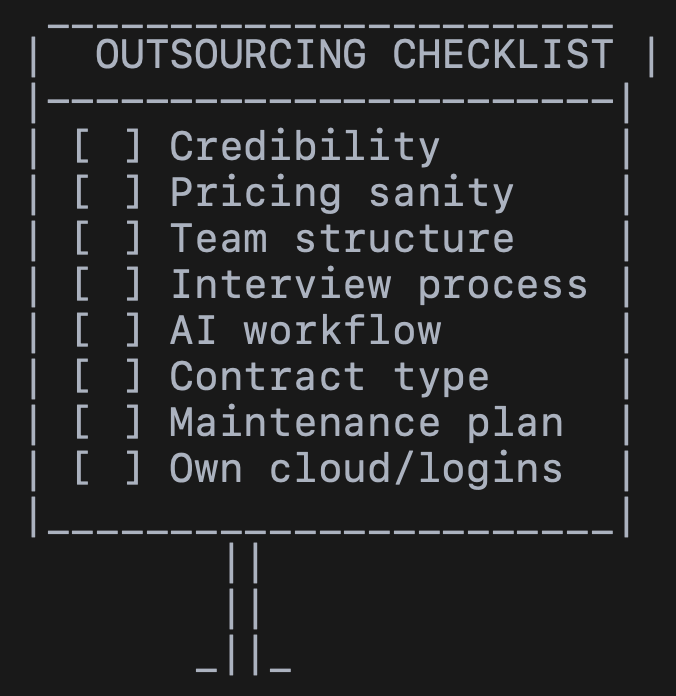
Validate credibilityUnderstand pricing benchmarksChoose the right team structureImplement a strong hiring processDemand AI-aware workflowsStructure contracts wiselyRetain technical and operational controlPlan maintenance before launch
When done thoughtfully, managed services can accelerate innovation. When done carelessly, they can drain time, money, and momentum.
Approach outsourcing as a strategic partnership—not just a transaction.