

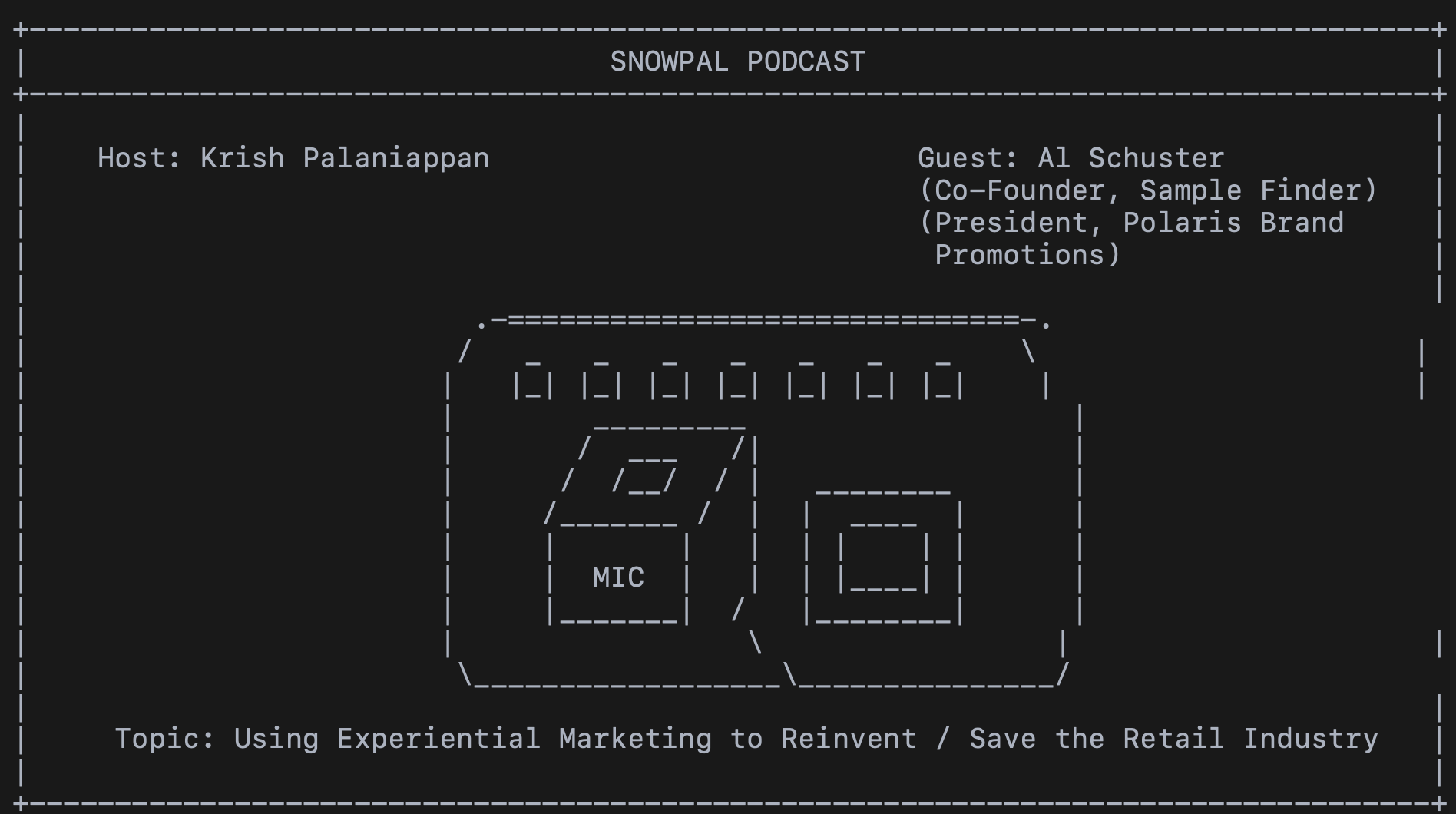
In a recent episode of the Snowpal Podcast, Krish sat down with Al Schuster, Co-Founder of Sample Finder and President of Polaris Brand Promotions, to discuss a timely and pressing topic: using experiential marketing to save the retail industry.
Krish, a product leader and technology entrepreneur, guided the conversation through retail disruption, digital transformation, and the future of in-store engagement. Al brought firsthand industry insight from nearly a decade of building experiential brand activations across brick-and-mortar environments. Together, they explored how technology and human-centered experiences can coexist to reshape the future of retail.
Podcast
Reinventing Retail Through Experiential Marketing — on Apple and Spotify.
The Retail Crossroads: Convenience vs. Experience
Retail is at a defining moment. E-commerce has reshaped consumer behavior in profound ways. Groceries arrive at doorsteps, apparel is ordered with one click, and AI tools allow consumers to visualize products in their homes before making a purchase. The friction of shopping has nearly disappeared. Yet in that same shift, something else has quietly eroded: discovery, sensory engagement, human interaction, and brand storytelling. As discussed in the Snowpal Podcast conversation with Al Schuster , the future of retail may not be about competing with e-commerce on convenience but about doubling down on experience. If shopping continues to move online, the central question becomes what role physical retail spaces will play in the future.
The Core Problem: Declining Foot Traffic and Discovery
Experiential marketing agencies like the one behind Sample Finder have historically relied on in-store foot traffic to introduce new brands to consumers . Weekend demos drove discovery, natural store traffic ensured sampling, and shoppers encountered new products organically. As consumers shift online, foot traffic declines, sampling opportunities shrink, and emerging brands lose key discovery channels. Shelf competition becomes algorithmic instead of physical. Just as few people scroll beyond the first page of search results, online marketplaces prioritize top listings and paid placements, limiting exposure for smaller brands . The result is reduced consumer choice and fewer pathways for innovation to reach shoppers.
The Strategic Shift: From Transaction Spaces to Experience Hubs
Schuster argues that retail must evolve from transaction spaces into experiential engagement spaces . Rather than asking why consumers would come to stores, retailers should ask what stores can offer that the internet cannot. E-commerce cannot replicate taste, smell, texture, spontaneous discovery, real-time human interaction, or the collective energy of a shared environment. Despite streaming platforms, people still attend sports games and concerts. Despite digital media, they seek festivals and live events. Experience remains irreplaceable.
The Sample Finder Model: Technology Supporting Physical Retail
Instead of competing with technology, Sample Finder uses it to enhance brick-and-mortar retail . The mobile app surfaces nearby experiential events such as in-store demos and pop-up activations, prioritizing proximity and timing rather than paid ranking. Users can check in, earn points, write reviews, enter contests, and discover new brands. The approach gamifies physical engagement, transforming retail visits into intentional, rewarding experiences rather than passive errands.
Applicability Across Retail Segments
Experiential marketing is not limited to low-cost sampling. In consumer packaged goods, small product samples such as snacks or beverages drive trial and conversion. In mid-ticket retail, boutique stores can host exclusive events, designer meet-and-greets, or limited-time promotions that deepen emotional connection. In high-ticket categories such as automotive or luxury goods, experiential marketing becomes about immersion and education. Test drives, demonstrations, and in-person consultations create memories that digital ads cannot replicate.
Economic Implications of Experiential Retail
The broader economic implications are significant . If brick-and-mortar retail collapses, commercial real estate vacancies increase, local economies weaken, and community gathering spaces diminish. The infrastructure already exists. The choice is whether to let it deteriorate, repurpose it entirely, or transform it into experience-driven environments. Experiential retail offers a path to preserve physical commerce while acknowledging digital growth.
AI, Automation, and the Human Element
AI is reshaping industries, including retail and software development . It can automate marketing, personalize recommendations, and optimize logistics. Yet experiential marketing depends on human energy, emotion, and trust. The likely future is hybrid: AI enhances operational efficiency, while humans deliver authentic engagement and sensory experiences. Technology should amplify human interaction, not eliminate it.
Consumer Motivation: Why Would They Come Back?
Consumers will not drive to stores merely to transact. However, they may visit for curated events, gamified rewards, exclusive experiences, and social interaction. The incentive does not need to be extravagant; it must be meaningful. Even a simple product sample gains value when paired with discovery, engagement, and community. Experience compounds perceived value.
The Hybrid Future of Retail
Retail’s future may separate routine transactions from discovery. Routine purchases may continue shifting online, while discovery, engagement, and brand immersion occur in physical experiential spaces. Stores could evolve into demo hubs, event venues, and community gathering centers rather than purely transactional environments. The traditional browsing model may shrink, but retail itself does not have to disappear. It must evolve.
Conclusion: Retail Wins by Being Memorable
Retail will not survive by competing solely on speed or price. E-commerce dominates convenience. Physical retail’s competitive advantage lies in experience. By leveraging technology to drive in-person engagement, experiential marketing provides a framework for revitalizing brick-and-mortar spaces. Retail’s next chapter will belong to brands and retailers that prioritize memorability over mere transaction.