

Krish Palaniappan opened the conversation by framing a reality many engineering founders quietly experience: building great software no longer guarantees discovery. As a product-focused technologist, he described how teams obsess over features, architecture, and scalability—only to realize after launch that visibility is an entirely different discipline. His questions weren’t theoretical; they came from lived experience. Why doesn’t technically superior software automatically surface in search? When did marketing become both art and science? And at what point should engineering teams start thinking about discoverability instead of treating it as an afterthought?
Jimi Gibson, VP of Brand Communications at Thrive Agency, responded from the vantage point of two decades in digital marketing, explaining that the rules of visibility have fundamentally shifted. Traditional SEO, he noted, focused on ranking pages, but the AI era evaluates trust, authority, and structured answers. Businesses are no longer competing just for keywords; they are competing to become the verified entity an AI system chooses to cite. Throughout the discussion, Jimi unpacked how Answer Engine Optimization, structured content, and visible expertise are redefining how companies get found—and why engineering-led organizations must adapt sooner rather than later.
Podcast
Trust, Structure, and Authority: Winning in AI-Powered Search — on Apple and Spotify.
The Fundamental Shift: Pages to Answers
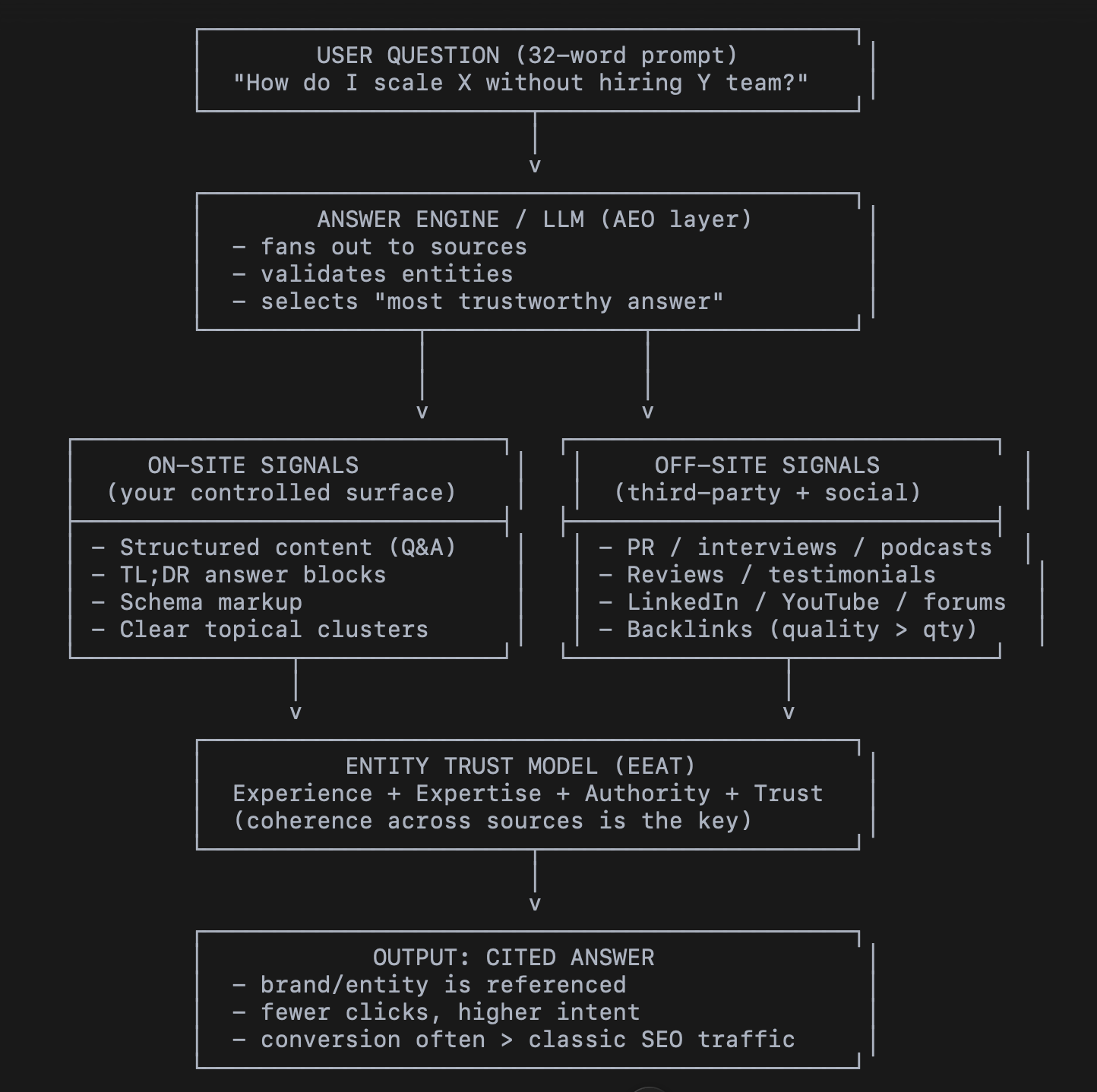
Traditional SEO focused on helping individual web pages rank for keywords. The objective was visibility in search results through backlinks, domain authority, technical optimization, and keyword strategy. Answer Engine Optimization (AEO), however, operates differently. AI systems don’t simply rank pages—they retrieve answers and verify entities. As outlined in How to Optimize for Answer Engine Visibility , AEO prioritizes content that directly answers user questions in a structured, machine-readable way. The shift is subtle but powerful: instead of optimizing for rankings, businesses must optimize for being cited as the trusted answer.
Engineers Build Features. Customers Search for Outcomes
Engineering teams often focus on features, architecture, and performance. Customers, however, search for relief. They don’t ask for “clean backend abstractions”; they ask how to scale without hiring more engineers or how to simplify complexity. AI systems respond to outcome-driven queries. If your messaging centers on what you built rather than the transformation you enable, you may never surface as the authoritative answer. The product matters—but positioning determines discoverability.
Structure Is No Longer Optional
AI systems depend on clarity. Clear headings, concise answers, FAQ-style formatting, and schema markup dramatically improve retrieval . Long, unstructured paragraphs make it harder for AI to parse and extract meaning. A practical shift is to begin content with a direct question and a clear, 60–80 word answer before expanding. Structured content is not cosmetic—it is strategic infrastructure for visibility.
Authority Is Attached to People
Experience, expertise, authoritativeness, and trustworthiness (EEAT) increasingly determine whether AI systems surface your content. Anonymous corporate messaging is weaker than content tied to identifiable subject matter experts. A visible founder or executive who consistently publishes, speaks, and engages strengthens brand credibility. AI systems evaluate coherence across platforms; consistency signals trust.
Focus Beats Breadth
Trying to speak about everything dilutes authority. AI systems look for thematic coherence. Publishing deeply around three to five core themes across multiple formats—blog, video, podcast, social—signals expertise far more effectively than scattered topics. Depth creates clarity; clarity creates trust.
Trust Signals Matter More Than Impressions
Likes and shares carry less weight than consistency and credibility. Testimonials, case studies, third-party mentions, schema markup, and consistent business information reinforce legitimacy . AI systems evaluate sentiment and cross-reference data across platforms. Trust is cumulative and structural.
Marketing and Engineering Converge
Engineering is rooted in logic and measurement. Modern marketing blends quantitative analysis with narrative framing. The overlap is significant: A/B testing, behavioral tracking, funnel optimization, and performance metrics are engineering-adjacent disciplines. The gap often lies in translating technical capability into human benefit. Early collaboration between engineering and marketing prevents misalignment and strengthens both product and messaging.
Start Earlier Than You Think
Marketing should not begin after the product is complete. Early strategic discussions clarify audience, positioning, and prioritization. Waiting until launch often leads to technically sound products that lack discoverable messaging. Marketing insight can inform product decisions—not just promote them.
AI Tools Amplify, Not Replace, Strategy
AI can accelerate production and assist with content generation, but output quality depends on strategic input. Without clarity, tools generate generic content that lacks differentiation. Expertise guides tools; tools do not replace expertise. Organizations that rely solely on automation risk surface-level visibility without depth.
The Real Question: Are You Relevant?
Even perfect marketing cannot sustain a product that no longer meets market needs. Businesses must continually evaluate relevance, focus, and adaptation speed. Visibility amplifies value—but it cannot manufacture it.
Final Reflection
Modern marketing, particularly in the context of Answer Engine Optimization (AEO), functions as a structured data and signal orchestration system rather than a purely promotional activity. Instead of optimizing for keyword density and backlink volume alone, the objective is to design content architectures that AI systems can parse, validate, and retrieve with confidence. This requires implementing schema markup, consistent entity definitions (e.g., NAP consistency), clearly structured Q&A formats, and semantically coherent topic clustering across platforms.
Additionally, marketing now depends on reinforcing trust signals—named subject matter experts, authoritative citations, consistent brand metadata, and cross-platform coherence—to satisfy AI evaluation models that prioritize experience, expertise, authoritativeness, and trustworthiness (EEAT). In this framework, marketing becomes an integration layer between technical infrastructure, behavioral analytics, and entity credibility modeling, ensuring that a business is not just indexed, but algorithmically recognized as the most reliable answer.
The conversation made one reality clear: building is not enough. In the era of AI-powered discovery, companies must be structurally clear, thematically focused, and consistently credible. Engineering builds capability. Answer Engine Optimization ensures that capability is found.
Q & A: Answer Engine Optimization and AI Visibility
1. What is Answer Engine Optimization (AEO)?
Answer Engine Optimization is the practice of structuring content so AI systems can directly retrieve and cite it as the best answer to a user’s question. Instead of focusing only on keyword rankings, AEO prioritizes clarity, structure, and trust signals that help AI models verify authority.
2. How is AEO different from traditional SEO?
Traditional SEO optimizes pages for search engine rankings using keywords, backlinks, and technical site health. AEO focuses on becoming the trusted entity that AI systems select when generating direct answers. The goal shifts from “ranking” to “being cited.”
3. Why is structured content important for AI visibility?
AI systems parse structured content more efficiently. Clear headings, concise answers, FAQ formats, and schema markup help models extract meaning quickly and accurately. Unstructured long-form text reduces retrieval accuracy.
4. What does AI look for when deciding which content to cite?
AI systems evaluate experience, expertise, authoritativeness, and trustworthiness (EEAT). They assess consistency across platforms, named subject matter experts, third-party mentions, reviews, and coherent topical focus.
5. Should companies focus on more topics or fewer?
Fewer, deeper topics are more effective. Publishing consistently around three to five core themes builds topical authority. Spreading content across too many unrelated subjects weakens perceived expertise.
6. Do backlinks still matter in the AI era?
Yes, but quality matters more than quantity. Relevant, authoritative backlinks reinforce credibility. AI systems evaluate contextual relevance and trust rather than simply counting links.
7. How should content be structured for AEO?
Start with a direct question and provide a concise 60–80 word answer. Follow with expanded explanation. Use subheadings, bullet points where appropriate, and schema markup to improve machine readability.
8. Are social media signals relevant to AI visibility?
Yes. While traditional search engines placed limited weight on social engagement, AI systems evaluate broader signals across platforms. Consistent messaging and visible expertise strengthen credibility.
9. Can AI tools replace marketing strategy?
AI tools can accelerate production and assist with drafting, but strategy requires human judgment. Without clear positioning and thematic focus, AI-generated content often becomes generic and ineffective.
10. When should a company begin thinking about AEO?
As early as possible. Marketing strategy should inform product positioning during development, not after launch. Early clarity around audience and outcomes improves both product-market fit and discoverability.