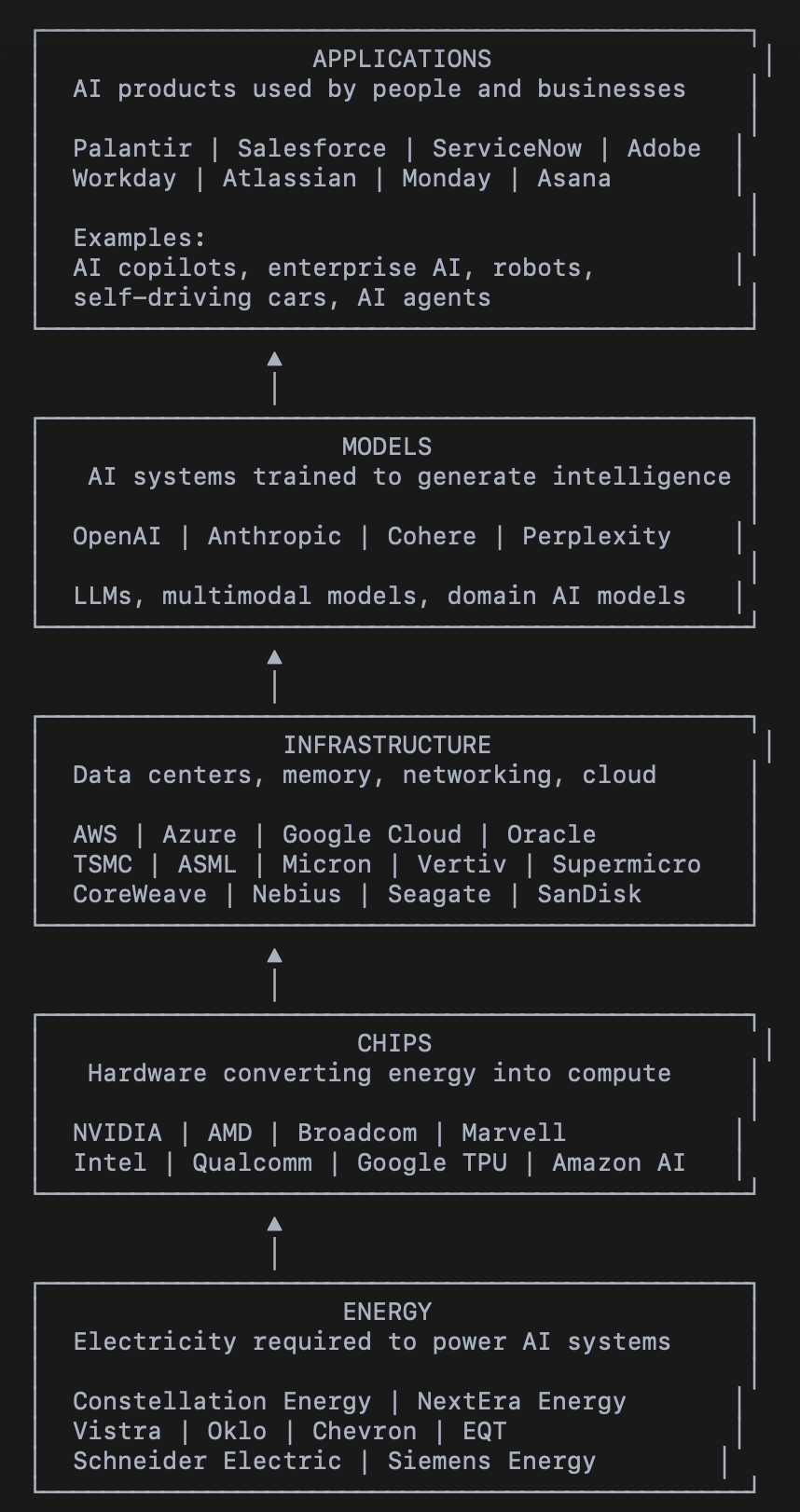
Artificial intelligence is often discussed through visible products such as chatbots, copilots, or autonomous systems. However, the AI economy is built on a deeper industrial stack. NVIDIA CEO Jensen Huang described this structure as “AI’s Five-Layer Cake,” where multiple industries combine to power modern AI systems.
The five layers are:
Energy → Chips → Infrastructure → Models → Applications
Each layer depends on the one below it. Electricity powers compute hardware, hardware runs in data centers, data centers train models, and models power applications used by businesses and consumers.
Podcast
The AI Five-Layer Stack: Understanding the Full AI Ecosystem — on Apple and Spotify.
Layer 1: Energy – The Foundation of AI
Energy is the base of the AI stack because every AI computation ultimately consumes electricity. Training large language models and running inference workloads requires enormous data centers packed with GPUs, networking systems, cooling infrastructure, and storage devices. Regions with strong power infrastructure—such as Northern Virginia, one of the world’s largest data center hubs—are seeing rapid growth in AI data center construction.
Intelligence generated in real time requires power generated in real time. Every AI token produced corresponds to electrical activity inside data center hardware. The scale of power consumption is staggering. A 1-gigawatt AI data center can consume electricity comparable to roughly one million U.S. homes. As AI adoption accelerates, electricity demand from data centers is rising rapidly, pushing governments and companies to rethink energy infrastructure.
This demand is driving renewed investment in:
Nuclear power
Renewable energy
Natural gas generation
Grid modernization
Energy storage systems
Companies in the Energy Layer
Nuclear and Power Generation
Constellation Energy (CEG)
Oklo (OKLO)
Nano Nuclear Energy (NNE)
Vistra (VST)
Renewable Energy Producers
NextEra Energy (NEE)
Natural Gas and Energy Producers
Chevron (CVX)
EQT Corporation (EQT)
Williams Companies (WMB)
Energy Infrastructure and Grid Systems
Schneider Electric (SU.PA)
Siemens Energy (ENR.DE)
Fluence Energy (FLNC)
MasTec (MTZ)
These companies represent the industrial backbone that powers the entire AI economy.
Layer 2: Chips – Converting Energy into Computation
The second layer of the AI stack consists of semiconductor chips that convert electricity into computational power. AI workloads require processors optimized for parallel computation. GPUs dominate the AI market because they can run thousands of simultaneous operations needed for neural network training.
According to the discussion:
Approximately 75% of AI chips are GPUs
Around 90% of those GPUs are produced by NVIDIA
This means roughly two-thirds of all AI chips sold globally are NVIDIA GPUs. The rest of the AI chip market consists largely of ASIC chips (Application-Specific Integrated Circuits) designed for specialized AI workloads. Companies such as Broadcom and Marvell design these chips. Another emerging trend is hyperscalers building their own AI chips to reduce reliance on external vendors. Companies like Google and Amazon design custom AI accelerators used within their cloud infrastructure.
Companies in the Chips Layer
GPU Manufacturers
NVIDIA (NVDA)
AMD (AMD)
ASIC Chip Designers
Broadcom (AVGO)
Marvell Technology (MRVL)
Semiconductor Competitors
Intel (INTC)
Qualcomm (QCOM)
Custom AI Chip Developers
Alphabet / Google (GOOGL) – Tensor Processing Units
Amazon (AMZN) – Trainium and Inferentia
These companies design the processors that transform electricity into the massive computational workloads required for AI systems.
Layer 3: Infrastructure – Data Centers and AI Computing Platforms
Above chips sits the infrastructure layer, which includes the systems required to run AI workloads at global scale. Data centers require specialized engineering to support thousands of GPUs operating simultaneously. Companies must manage heat dissipation, power distribution, networking bandwidth, and massive datasets.
AI infrastructure consists of:
Data centers
Cloud computing platforms
High-speed networking
Storage and memory systems
Cooling and power management technology
One of the most important companies in this layer is Taiwan Semiconductor Manufacturing Company (TSMC). The transcript notes that approximately 90–95% of advanced AI chips are manufactured by TSMC, making it one of the most critical companies in the global semiconductor supply chain. Another essential company is ASML, which builds the lithography machines used to manufacture advanced semiconductors. Memory technology is also crucial. AI workloads require extremely high-bandwidth memory systems, driving growth for companies producing DRAM and storage solutions. Cloud providers form another major part of this layer. Companies increasingly train and deploy AI models through hyperscale cloud infrastructure rather than building their own data centers.
Companies in the Infrastructure Layer
Semiconductor Manufacturing
Taiwan Semiconductor Manufacturing Company (TSM)
ASML Holding (ASML)
Memory and Storage
Micron Technology (MU)
Seagate Technology (STX)
SanDisk (SNDK)
Cloud Infrastructure Providers
Amazon Web Services (AMZN)
Microsoft Azure (MSFT)
Google Cloud (GOOGL)
Oracle Cloud (ORCL)
Data Center Infrastructure
Vertiv (VRT)
Super Micro Computer (SMCI)
AI Infrastructure Providers
CoreWeave (CRWV)
Nebius Group (NBIS)
Additional Infrastructure and AI Systems Companies
Groq
Cerebras Systems
Pure Storage (PSTG)
Databricks
Snowflake (SNOW)
These companies build the physical and cloud environments required to train and run AI models.
Layer 4: Models – Creating AI Intelligence
The fourth layer consists of AI model developers. These organizations train large language models and other machine learning systems that generate intelligence. AI models are trained using massive datasets and enormous computing resources. Once trained, they can perform tasks such as:
natural language understanding
code generation
scientific research analysis
robotics control
autonomous driving
The transcript identifies OpenAI and Anthropic as two of the most influential companies in this layer. These companies receive significant investment from large technology firms that provide cloud infrastructure and compute resources for training large models.
Companies in the Models Layer
AI Model Developers
OpenAI
Anthropic
Enterprise AI Model Platforms
Cohere
AI Search and LLM Platforms
Perplexity
Strategic Investors Supporting Model Development
Microsoft (MSFT)
Amazon (AMZN)
Alphabet / Google (GOOGL)
NVIDIA (NVDA)
These companies develop the algorithms and neural networks that power modern AI systems.
Layer 5: Applications – Delivering AI to End Users
The top layer of the AI stack consists of applications—the products that businesses and consumers interact with directly. AI applications embed models into real-world software and devices. These products turn raw AI capabilities into practical tools used across industries.
Examples include:
AI copilots for productivity software
enterprise analytics platforms
AI-powered search engines
autonomous vehicles
humanoid robots
The transcript notes that a self-driving car is essentially an AI application embodied in a machine, while a humanoid robot represents an AI application embodied in a robotic body. Many traditional SaaS companies are integrating AI features into their platforms, while new companies are building AI-native software from the ground up.
Companies in the Applications Layer
Enterprise AI Platforms
Palantir (PLTR)
ServiceNow (NOW)
Enterprise SaaS Platforms
Salesforce (CRM)
Workday (WDAY)
Atlassian (TEAM)
Monday.com (MNDY)
Asana (ASAN)
AI-Enabled Software Platforms
Adobe (ADBE)
C3.ai (AI)
AI-Native Platforms
Perplexity
Cohere
These companies deliver AI functionality to businesses and consumers through software and intelligent systems.
Conclusion
The AI ecosystem operates as a stacked industrial system rather than a single technology sector.
Energy companies generate the electricity that powers AI systems. Semiconductor companies design chips that convert that power into computational work. Infrastructure providers run massive data centers and cloud platforms where AI models are trained. Model developers create the intelligence itself. Finally, application companies deliver that intelligence to end users.
In simple terms:
Energy companies such as Constellation Energy (CEG) and NextEra Energy (NEE) power the system.
Chip companies like NVIDIA (NVDA), AMD (AMD), and Broadcom (AVGO) convert that power into AI computation.
Infrastructure companies including TSMC (TSM), ASML (ASML), AWS (AMZN), Microsoft Azure (MSFT), and Vertiv (VRT) run the hardware and cloud platforms where AI workloads operate.
Model developers such as OpenAI and Anthropic build the AI systems that perform reasoning and language understanding.
Application companies like Palantir (PLTR), ServiceNow (NOW), Salesforce (CRM), and Adobe (ADBE) deliver AI capabilities to businesses and consumers.
Together, these five layers form the complete AI economy, spanning energy, semiconductors, cloud infrastructure, machine learning research, and enterprise software.