

In this episode, Krish sits down with Kathy Baldwin, Founder and CEO of Finally Business Infrastructure, for a deeply practical conversation on what it really takes to scale a business. Kathy brings decades of experience in sales, systems thinking, and customer psychology, working closely with founder-led businesses to transform the knowledge in their heads into structured, scalable processes.
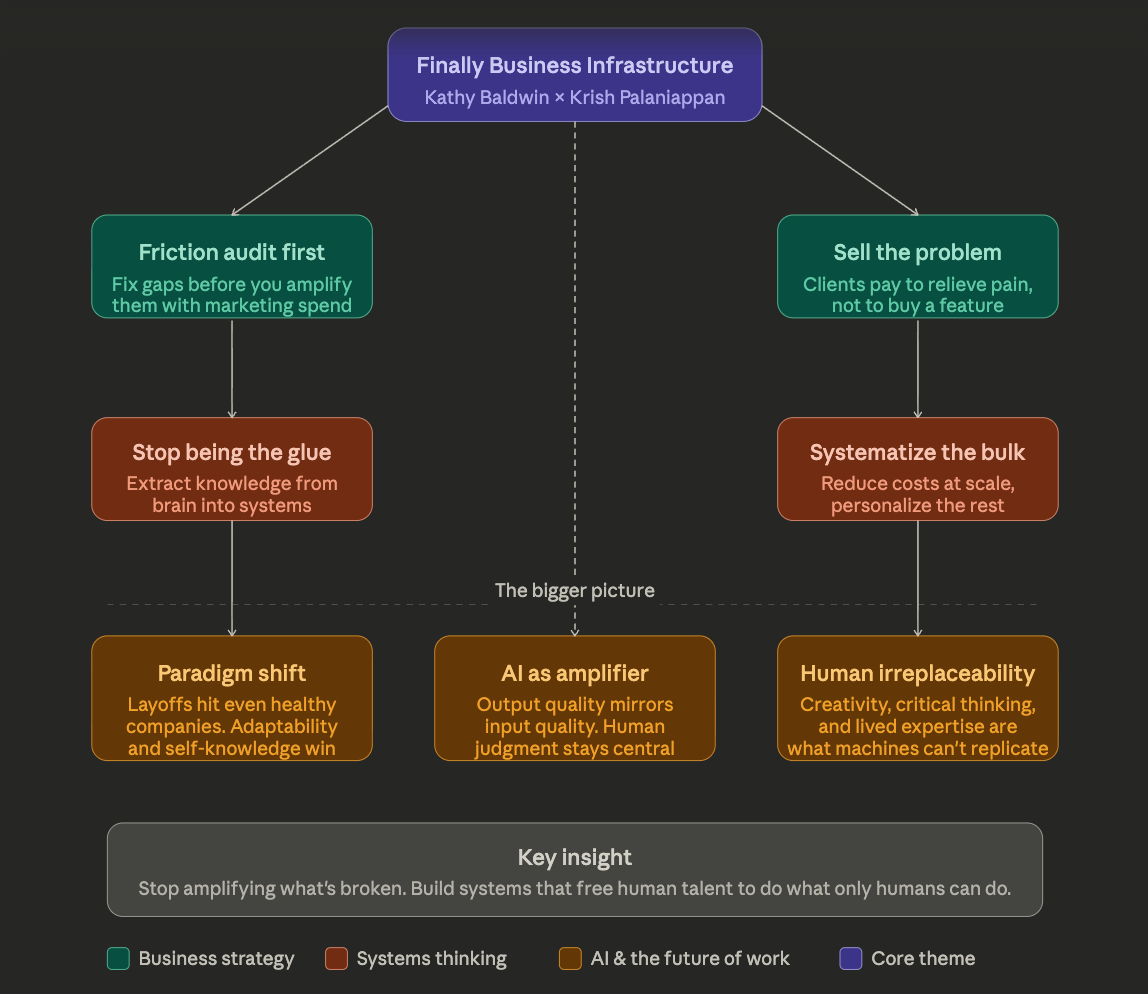
The discussion cuts through common misconceptions around growth, marketing, and technology, emphasizing a core principle: businesses must fix internal friction before attempting to scale externally. Drawing from real-world examples and candid exchanges, Kathy highlights how founders often become the “glue” in their organizations—and why that becomes a bottleneck. Together, they explore how aligning messaging with customer problems, clarifying expectations, and building process-driven systems can create sustainable growth.
This conversation is especially relevant for founders, operators, and product leaders navigating today’s rapidly evolving landscape shaped by automation and AI.
Podcast
Fix Systems First Before Scaling Marketing and AI Growth — on Apple (Part I, Part II) and Spotify.
Fix the System Before You Amplify It
One of the most critical mistakes founders make is pouring time, energy, and money into marketing before addressing the underlying inefficiencies in their business. As discussed in the conversation, amplifying a broken system does not solve problems—it magnifies them. When marketing efforts increase visibility, they also increase exposure to friction, gaps, and inconsistencies that already exist. The result is not growth, but chaos at scale. Before investing in outreach, advertising, or automation, founders must ensure that what they are amplifying is actually worth amplifying.
The Founder as the Bottleneck
Many founder-led businesses are built on deep expertise, often developed in a specific domain such as engineering, product development, or consulting. However, expertise in one area does not translate into mastery across all business functions. In corporate environments, specialized departments handle sales, marketing, customer success, and operations. When founders step out on their own, they unknowingly inherit all of these roles. Over time, they become the “glue” holding everything together—filling gaps manually, compensating for missing processes, and bridging communication breakdowns. While this may work in early stages, it fundamentally limits scalability. A business cannot grow efficiently if it depends entirely on the founder’s constant intervention.
The Illusion of Knowing Versus Doing
A subtle but pervasive challenge is the gap between awareness and execution. Founders often understand, at least conceptually, that they need better sales processes, clearer messaging, and defined systems. However, knowing this does not automatically translate into implementation. Muscle memory, habits, and day-to-day pressures push them back into reactive behaviors—focusing on product features instead of customer problems, or jumping into tactics without strategic alignment. This disconnect is not due to incompetence but to the complexity of running a business where multiple unknowns compete for attention simultaneously.
Shifting From Solutions to Problems
One of the most powerful shifts founders can make is moving from a solution-centric mindset to a problem-centric one. Businesses naturally fall in love with their products—their features, capabilities, and technical sophistication. However, customers do not buy solutions; they buy relief from pain. A restaurant owner, for example, is not looking to “build software”—they are trying to serve customers better, increase orders, and replicate in-person experiences digitally. When founders focus on the customer’s starting point—their frustrations, constraints, and goals—they position their offering as a bridge rather than a product. This reframing is essential for effective communication, positioning, and conversion.
Conducting a Friction Audit
Before scaling any business activity, founders must conduct what can be described as a “friction audit.” This involves analyzing the entire customer journey—from initial awareness to final delivery—through the customer’s perspective. Where do prospects lose interest? Where does confusion arise? Where are expectations misaligned? Every point of friction represents a leak in the system. Without addressing these leaks, additional traffic or leads will simply flow through and be lost. The goal is to create a seamless, intuitive experience that moves customers forward without unnecessary resistance.
The Role of Expectations in Delivery
A significant portion of business breakdowns stems from mismatched expectations. When what is promised differs from what is delivered, dissatisfaction is inevitable—even if the product itself is high quality. Clear documentation, defined processes, and explicit communication are essential to ensure alignment between provider and customer. This reduces scope creep, eliminates ambiguity, and creates a predictable experience. In many cases, customers do not require perfection—they require consistency and clarity. Delivering exactly what was promised, in the way it was promised, builds trust and long-term loyalty.
Qualification: Not Everyone Is Your Customer
Another key insight is the importance of qualification. While it may be tempting to assume a large addressable market, not everyone is a viable customer at any given time. Some prospects lack urgency, others lack budget, and some simply do not align with the offering. Effective systems filter and qualify leads early, ensuring that time and resources are focused on those most likely to convert. This requires understanding not just who your customers are, but when they are ready to act. Without this clarity, businesses waste effort chasing unqualified opportunities.
Tools Do Not Replace Strategy
Modern tools, including AI, automation platforms, and sales software, have dramatically lowered barriers to entry. Founders can now build, market, and scale faster than ever before. However, tools are not a substitute for strategy. A tool applied to a broken system will only accelerate dysfunction. The effectiveness of any tool depends on how well it is integrated into a coherent process. Rather than searching for a single “all-in-one” solution, successful founders assemble ecosystems of tools that align with their workflows and objectives. The focus remains on process design, not tool selection.
AI as an Amplifier, Not a Fix
Artificial intelligence represents a powerful force in modern business, but it is not a cure-all. AI excels at amplifying existing systems—whether they are efficient or flawed. If a sales process is unclear or a customer journey is fragmented, AI will scale those issues just as effectively as it scales successes. Therefore, foundational clarity must precede technological adoption. Businesses that invest in AI without first addressing structural weaknesses risk accelerating their own inefficiencies.
Building Systems That Scale
Ultimately, sustainable growth comes from transforming implicit knowledge into explicit systems. Founders must externalize what exists in their heads—documenting processes, defining workflows, and creating repeatable structures. This shift reduces dependency on individuals and enables consistent execution. When systems are well-designed, they not only support growth but also enhance the customer experience, making it easier for clients to engage, buy, and succeed.
Conclusion
The path to scalable growth is not paved with more marketing, more tools, or more activity. It begins with clarity—understanding the customer, identifying friction, aligning expectations, and building systems that work independently of constant human intervention. Only after these foundations are in place does amplification make sense. At that point, marketing, automation, and AI become powerful accelerators rather than sources of compounded problems.
Q & A
1. Why shouldn’t businesses invest in marketing too early?
Marketing amplifies whatever already exists. If your systems have gaps or inefficiencies, you’ll scale problems instead of results.
2. What is a “friction audit”?
It’s a systematic review of the customer journey to identify where prospects get confused, drop off, or experience delays.
3. What role do founders often play unintentionally?
Founders often become the “glue,” manually filling gaps between systems instead of building processes that run independently.
4. Why is being the “glue” a problem?
It limits scalability because growth becomes dependent on the founder’s time, attention, and ability to manage everything.
5. What is the difference between knowing and executing?
Founders may understand what needs to be done but struggle to consistently implement it due to habits and operational pressure.
6. What is a common messaging mistake founders make?
They focus on features and solutions rather than clearly articulating the customer’s problem and desired outcome.
7. Why should businesses focus on customer problems first?
Customers engage when they feel understood; framing around their pain points makes your solution more relevant and compelling.
8. What causes most client dissatisfaction?
Misaligned expectations—when what is delivered doesn’t match what the customer thought they were buying.
9. How can businesses reduce scope creep?
By clearly defining deliverables, documenting processes, and ensuring both sides agree on expectations before execution begins.
10. What does “qualified lead” mean?
A prospect who not only fits your target profile but also has the urgency, budget, and readiness to make a decision.
11. Why isn’t everyone a potential customer?
Because timing, need, budget, and priorities vary—targeting everyone leads to wasted effort and poor conversion.
12. Are tools enough to fix business problems?
No. Tools are enablers, but without a clear process, they can create more complexity rather than solving issues.
13. What is the risk of relying too much on tools?
You may automate broken workflows, making inefficiencies faster and harder to detect instead of eliminating them.
14. How does AI impact business systems?
AI accelerates execution, but it mirrors your system quality—strong systems improve, weak systems deteriorate faster.
15. What is the foundation of scalable growth?
Well-defined processes, clear messaging aligned to customer needs, qualified leads, and systems that reduce dependency on individuals.