In this episode, Robby Cobbs, CEO of TechMySchool and Tech Plan Genie, discusses the transformative role of AI in education, the challenges faced by modern educational systems, and the importance of soft skills. Krish & Robby explore the evolving landscape of college education, parental guidance, and the cultural perspectives on learning. Robby shares insights from his experiences in education and emphasizes the need for adaptability in an ever-changing world.
For more than a century, education followed a familiar script: attend school, listen carefully, memorize information, earn good grades, graduate, and secure a stable job. That pathway shaped generations of students and defined the role of educators as primary sources of knowledge.
Today, that script is breaking.
Artificial intelligence, shifting labor markets, rising tuition costs, and changing student needs have placed education at a historic inflection point. For students and educators alike, the question is no longer “How do we do school better?”—it is “What is school actually for now?”
Podcast
Rethinking Learning in the Age of AI — on Apple and Spotify.
From Knowledge Transfer to Skill Development
For students, information is no longer scarce. AI tools can summarize textbooks, write essays, generate code, and explain complex ideas instantly. This reality changes what learning means.
The most valuable skills students can develop today include:
Critical thinking (asking better questions, not just answering them)
Problem framing (defining what actually needs to be solved)
Creativity and synthesis (connecting ideas across disciplines)
Communication and collaboration
Adaptability and learning how to learn
Memorization alone is no longer a competitive advantage. Students who thrive will be those who can use knowledge—ethically, creatively, and contextually.
The Educator’s Role Is Evolving, Not Disappearing
For educators, AI is not the enemy—it is a catalyst forcing long-overdue change.
The traditional “sage on the stage” model struggles in a world where students can fact-check and generate content instantly. The emerging role of the educator is closer to:
Facilitator of learning
Designer of meaningful experiences
Coach for thinking, not compliance
Guide for ethical and responsible AI use
This shift is uncomfortable. It requires educators to rethink assessments, classroom activities, and even authority. But it also restores something powerful: human judgment, mentorship, and connection—things AI cannot replace.
Rethinking Assessment in an AI World
If a student can generate a polished essay in seconds, then the problem is not the student—it’s the assignment.
Meaningful assessment today focuses on:
Process over output
Reflection over regurgitation
Projects over papers
Real-world application over abstract recall
Students should be asked to:
Explain how they arrived at an answer
Defend decisions verbally
Work collaboratively on authentic problems
Apply concepts to real situations that matter to them
AI doesn’t eliminate rigor—it demands better rigor.
College, Careers, and Honest Conversations
Students are increasingly asking hard questions:
Is college worth the cost?
Will this degree lead to meaningful work?
What happens if AI automates my field?
There is no single right answer—but there is a need for honesty.
College still offers value:
Exposure to diverse ideas and people
Personal growth and independence
Networks that often last a lifetime
But it is no longer the only—or always the best—path. Educators and institutions must normalize:
Trade schools and apprenticeships
Early work experience
Entrepreneurship
Lifelong, modular learning instead of one-time credentials
Success should not be defined by prestige alone, but by alignment between skills, interests, and opportunity.
Equity, Access, and the Responsibility of Education
One of the greatest risks of the AI era is widening inequality.
Students with access to guidance, mentors, and informed educators are far better positioned to navigate change. Those without that support risk being left behind—not because of ability, but because of exposure.
This places a profound responsibility on educators and institutions:
To educate parents as well as students
To teach AI literacy, not just AI avoidance
To emphasize transferable skills over narrow test performance
To value students as whole humans, not just academic profiles
Education has always been a ladder. The challenge now is ensuring that ladder still reaches everyone.
What Students and Educators Can Do Now
For students:
Learn how AI works—and how to use it responsibly
Build skills that travel across industries
Seek experiences, not just credentials
Reflect often on what energizes you, not just what pays
For educators:
Redesign learning around thinking, not compliance
Embrace AI as a teaching tool, not just a policy problem
Advocate for flexibility and innovation in curriculum
Model curiosity and lifelong learning
The Future Is Unwritten—but It Is Human
Despite the uncertainty, one truth remains: education is not obsolete—it is more important than ever.
But its purpose has shifted. It is no longer about producing perfect answers. It is about developing resilient, thoughtful, ethical humans who can navigate a world that changes faster than any syllabus.
Students don’t need less education.
Educators don’t need less relevance.
They need a new foundation—one built for the future, not the past.
Summary
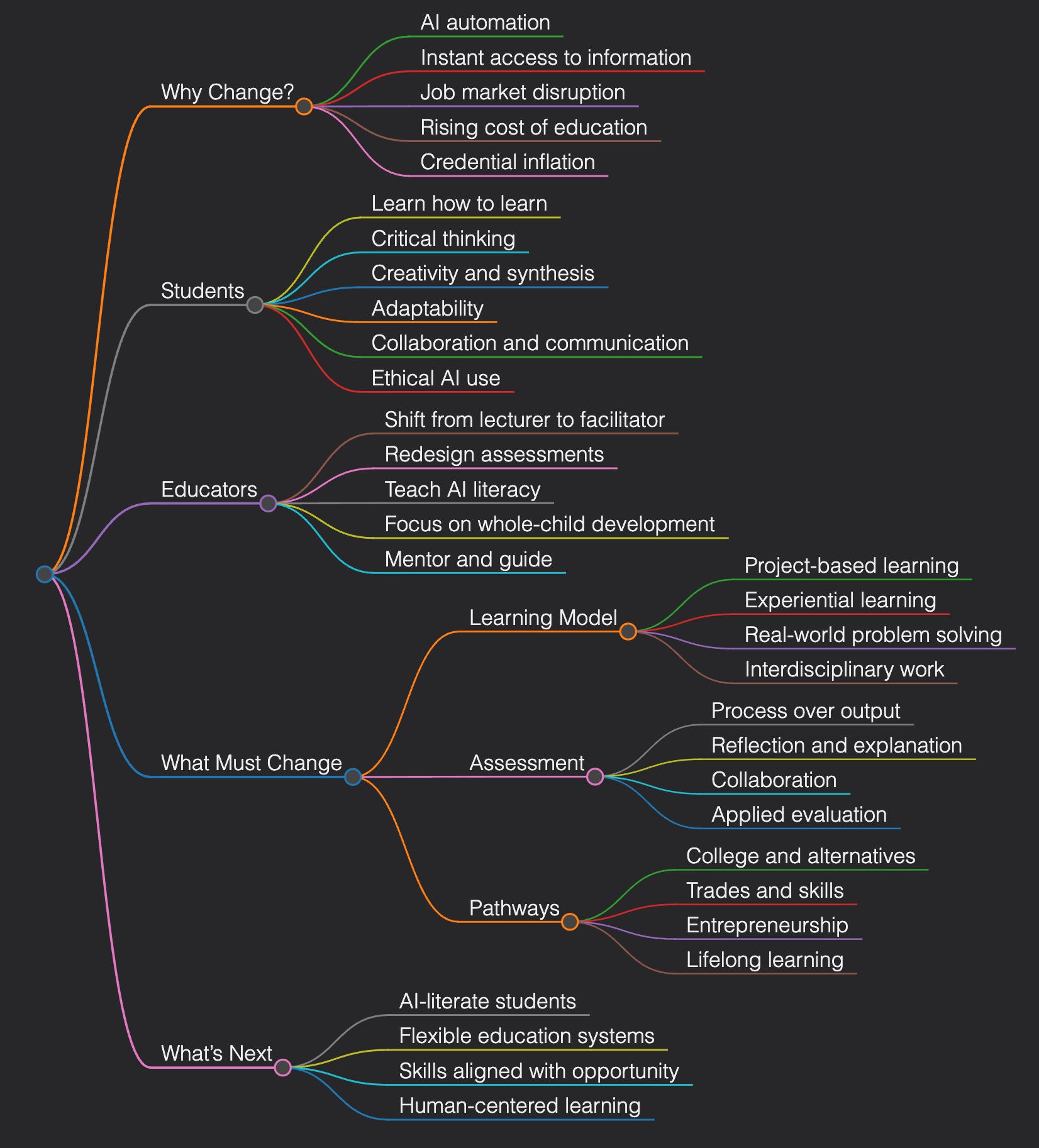
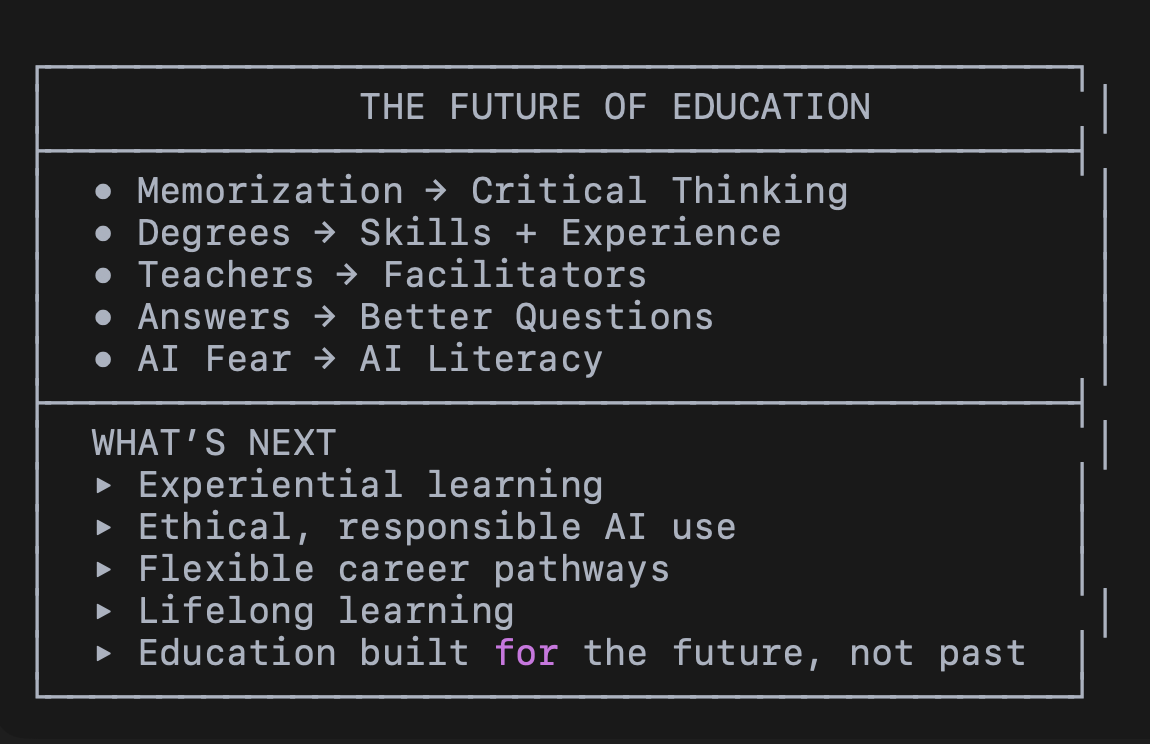
Education is undergoing a fundamental shift as artificial intelligence reduces the value of memorization and elevates the importance of critical thinking, creativity, adaptability, and human judgment. Students are no longer just expected to absorb information, but to question it, apply it, and use technology responsibly to solve real-world problems. Educators, in turn, must move from content delivery to facilitation, redesigning assessments and learning experiences to emphasize process, reflection, collaboration, and ethical decision-making. What’s next is a broader transformation of the education system toward experiential learning, AI literacy, flexible and non-linear career pathways, and stronger support structures that help students—regardless of background—navigate uncertainty and align their skills, interests, and values with a rapidly changing economy.