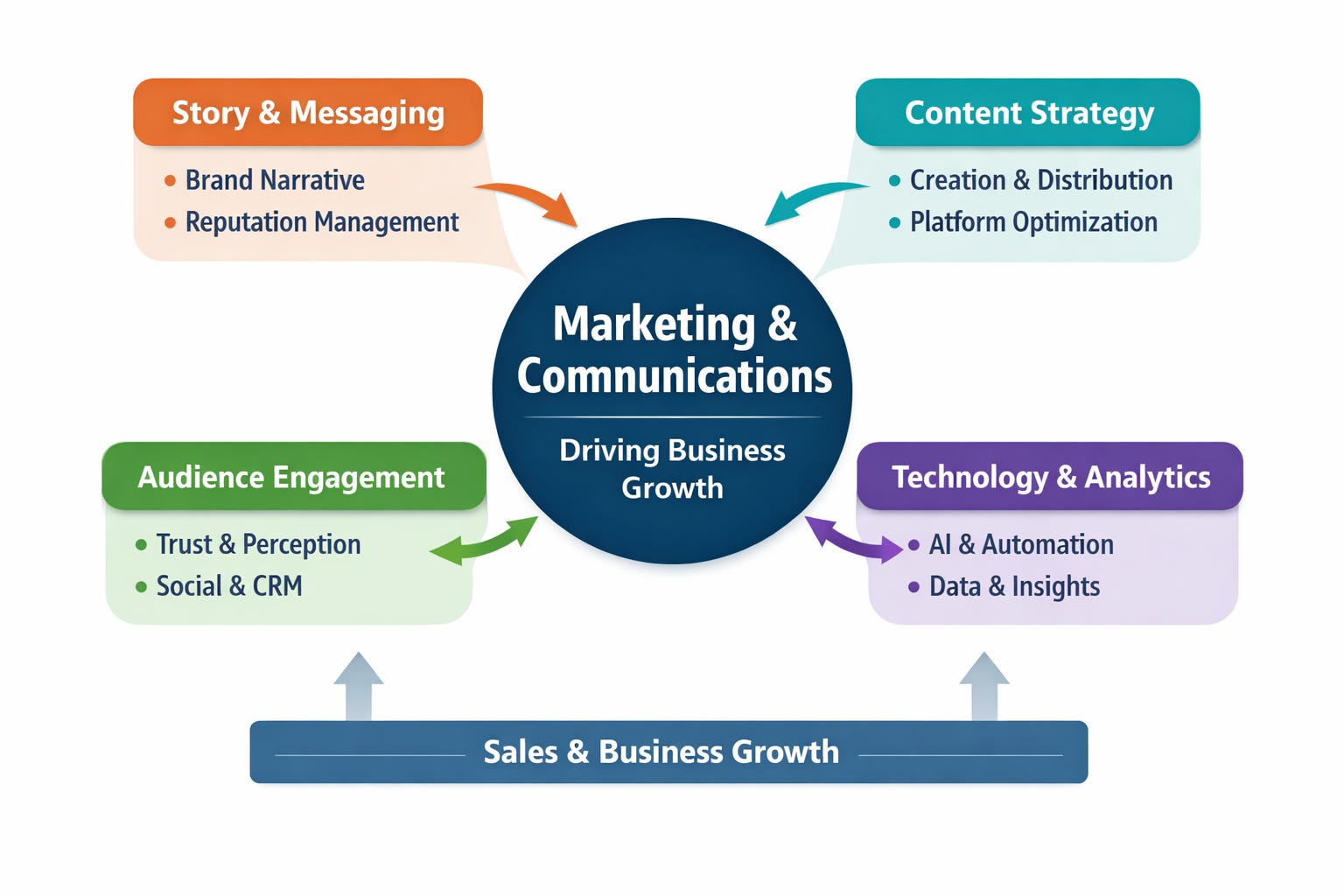
In this episode, Joshua Altman, Managing Director at Beltway Media, shares insights on the role of chief communications officers, effective content strategies, platform selection, and the impact of AI on communication practices for startups and established companies alike.
Podcast
The Strategic Role of Marketing and Communications in Modern Businesses — on Apple and Spotify.
Introduction: Building a Great Product Is Not Enough
In B2B companies, founders often begin with the belief that the hardest problem is building the product itself. For engineering-led businesses, this assumption is understandable. Reliability, scalability, security, and performance are all difficult problems. But once a product is launched, another challenge emerges: making sure the right buyers understand it, trust it, and see why it matters to their business.
That is where marketing and communications become essential. In B2B, growth rarely happens because a product simply exists. It happens because a company can clearly explain its value, consistently communicate its story, and build confidence with decision-makers over time. Communications is not separate from growth; it is part of the infrastructure that makes growth possible.
Marketing vs. Communications in a B2B Context
In a B2B company, marketing is often associated with lead generation, pipeline growth, and demand creation. Communications, however, plays a broader and more foundational role. It shapes how the company is perceived internally and externally, how its value proposition is understood, and how trust is built with customers, prospects, investors, partners, and employees.
This distinction matters because B2B buying is rarely impulsive. Buyers are evaluating risk, fit, credibility, and long-term value. Communications supports sales and marketing by giving them the messaging, positioning, and trust foundation they need to be effective. In that sense, communication is not just a support function; it is part of the architecture of the business itself.
Why Communications Matters in B2B Companies
For B2B companies, communications matters because the audience is often harder to win. Buyers are more selective, sales cycles are longer, and multiple stakeholders may be involved in a single decision. A business buyer may need to justify a purchase internally, compare alternatives, and return to your company several times before taking action.
That means your messaging must do more than attract attention. It has to reduce uncertainty. It has to explain what the product does, why it matters, and why your company is credible. It also has to remain consistent across the website, product materials, demos, sales conversations, onboarding, leadership updates, and customer-facing content. When that consistency is missing, friction appears. When it is present, the business becomes easier to understand and easier to trust.
Storytelling as a B2B Growth Tool
Storytelling is sometimes dismissed in B2B because it sounds too soft or consumer-oriented. In reality, it is one of the most practical tools a B2B company has. A good story helps a prospect understand what problem exists, why it matters, and how the company solves it. It also makes the company more memorable in markets where many offerings sound similar.
A useful B2B story is not fiction or hype. It is a structured way of connecting product capabilities to customer pain points and business outcomes. The strongest companies move from raw facts to a narrative, and from narrative to a recognizable brand. That process makes their product easier to explain, easier to remember, and easier to sell. This is especially important in software and services, where the product may be intangible and the value may not be obvious at first glance.
Content as a Trust Engine, Not Just a Traffic Engine
In B2B, content should not be viewed only as a traffic play. Its deeper role is to build familiarity and trust over repeated interactions. Buyers may encounter a company through a LinkedIn post, a founder interview, a webinar clip, a podcast appearance, a case study, or an email. Each piece of content acts as a touchpoint that helps the audience understand the company a little better.
This makes content especially valuable for B2B firms with complex offerings. A project management platform, a workflow tool, a consulting service, or an enterprise software product may all require explanation before a sale can happen. Content helps educate the market before the first sales call and reinforces confidence after the call. In that sense, content is not separate from sales; it supports the sales process by preparing the buyer to engage.
Technologies Powering B2B Marketing and Communications
Technology plays a central role in modern B2B communications because it enables companies to create, distribute, measure, and refine messaging at scale. Customer relationship management systems help teams organize leads, track buyer interactions, and personalize outreach. Marketing automation platforms make it possible to nurture prospects over time through segmented email journeys, event follow-ups, and product education sequences. Analytics tools help teams understand which messages, channels, and formats are contributing to awareness, engagement, and conversion.
AI tools are increasingly important in this stack, particularly for research, drafting, analysis, and workflow acceleration. But in B2B, technology works best when it supports strategy rather than replacing it. The tool can speed up execution, but it cannot decide what story should be told, how a category should be framed, or where credibility must be built. That still depends on judgment. For that reason, the most effective B2B companies use technology to amplify expertise, not substitute for it.
The Most Effective B2B Channels
For many B2B companies, the most effective channels are not the loudest or most viral ones. They are the channels where business buyers already spend time and where trust can be built steadily. LinkedIn is especially valuable because it is designed around professional identity, industry context, and business relevance. Facebook can also matter more than many B2B teams expect, especially for small businesses and operators making purchasing decisions. Email remains highly effective when the list is targeted, permission-based, and filled with useful content rather than noise.
This mix reflects a practical B2B reality: not every platform needs to be treated equally. Companies should focus on the places where their buyers actually pay attention and where the message can be repeated over time. A narrow but relevant audience is often far more valuable than broad reach without intent.
LinkedIn as a Core B2B Platform
Among B2B channels, LinkedIn stands out because it is well suited for thought leadership, company updates, industry commentary, and product education. It is not necessarily where the sale closes, but it is often where credibility begins. Buyers may not purchase directly from a post, but they may remember a company, follow its page, engage with its content, or respond to outreach more positively after repeated exposure.
For B2B teams, the most effective LinkedIn content often includes videos, carousels, and posts that clearly explain useful ideas. Timing and frequency matter, but not as much as substance and consistency. The goal is not simply to post often; it is to stay present with material that helps the audience understand the business and its expertise. Over time, that repeated exposure supports the longer, multi-touch nature of B2B buying.
Building a High-Quality B2B Email List
Email remains one of the most durable B2B communication channels because it gives companies direct access to an audience they own. But its value depends on list quality. A smaller opt-in list of relevant prospects is more valuable than a larger list of disinterested contacts. In B2B, the strongest email lists are built through product signups, demo requests, waitlists, webinars, downloadable resources, and cross-channel invitations from places like LinkedIn.
This matters because B2B communication is cumulative. The email list becomes a place where the company can continue educating, nurturing, and reinforcing trust over time. It is not just for promotions. It is for sustaining the conversation after the first point of contact.
Product Messaging Must Match Product Reality
One of the most important communications principles in B2B is alignment between what is promised and what the product actually delivers. If messaging overstates capability, buyers notice quickly. In software, this can be especially damaging because expectations are formed before the demo, before onboarding, and before expansion discussions.
That is why effective B2B communications must be grounded in the product itself. Teams need to understand how the product is experienced, whether the narrative matches the actual workflow, and whether customers interpret the value the same way the company intends. Good communication does not decorate the product; it clarifies it. When messaging and product experience align, the result is trust. When they diverge, the result is confusion.
Internal Communications Also Matter in B2B
B2B companies often think of communications as something customer-facing, but internal communication is just as important. Sales enablement, product roadmap updates, team alignment, all-hands meetings, and policy communication all influence how consistently the company presents itself. If internal teams are unclear about priorities, language, or direction, that confusion eventually reaches customers.
For growing B2B firms, internal communication becomes especially important because multiple functions must work together to support the buyer journey. Product, engineering, sales, customer success, and leadership all need a shared understanding of what the company stands for and how it talks about its work. Strong internal communication makes strong external communication possible.
The 50/50 Reality in B2B Growth
A hard truth for many B2B founders is that building the product is only part of the job. A substantial share of effort must go toward communicating the value of what has been built. In practice, this can mean that a surprisingly large amount of business energy needs to go into marketing, communications, and growth, not just product development.
This does not mean engineering becomes less important. It means the company must balance creation with communication. A strong product without visibility struggles to grow. A clear story without a strong product also fails. B2B success depends on doing both well enough, and doing them together.
Conclusion
For B2B companies, marketing and communications are not optional finishing layers added after the product is built. They are strategic functions that help the market understand the product, trust the company, and move toward a buying decision. The companies that perform best are often not just the ones with strong offerings, but the ones that explain those offerings clearly, repeatedly, and credibly.
In B2B, communication is what turns capability into comprehension and comprehension into trust. That is why it matters so much.