In this episode, Jeremy Barker, founder and CEO of Murphy Door, shares his incredible journey from being a firefighter to building a successful business specializing in hidden doors. He discusses the challenges he faced in his entrepreneurial journey, the lessons learned from failures, and the importance of passion and customer experience in business. Jeremy emphasizes the role of AI in shaping the future of business and offers valuable insights for aspiring entrepreneurs.
In this engaging conversation, Jeremy Barker discusses the innovative software solutions transforming the door assembly process and the importance of user experience in catering to high-end customers. He emphasizes the need for customization and the role of customer feedback in improving products and services. The discussion also explores the impact of AI on business operations and the future of retail, highlighting the necessity for personalized shopping experiences. Jeremy shares insights on bridging the gap between developers and customers, the flaws of traditional review platforms, and the evolving landscape of engineering in the age of AI.
Jeremy Barker’s entrepreneurial journey doesn’t follow the polished arc often found in startup lore. There’s no Ivy League pedigree, no venture-backed launch, and no neatly drawn five-year plan. Instead, there’s bankruptcy, living out of a truck, returning to public service as a firefighter, and eventually building one of the most distinctive consumer brands in America: Murphy Door, the nation’s leading hidden door and secret room company .
In a candid conversation, Barker shared how curiosity, resilience, and an almost stubborn refusal to follow conventional paths shaped both his career and his philosophy of building businesses.
Podcast
How Grit Built a Category-Defining Brand — on Apple and Spotify.
Takeaways
Barker’s story offers a few clear takeaways:
You don’t need perfect data to start—just conviction.
Failure is survivable, but avoidance isn’t.
Money won’t sustain you; meaning will.
Education matters—but experience compounds faster.
To learn more, read on. Listen. Watch.
Early Exposure to Extremes
Barker’s relationship with money began at both ends of the spectrum. As a child, he experienced affluence—his father was a senior executive at a major brokerage firm. That comfort vanished overnight after the 1987 market crash, forcing the family into financial hardship. The whiplash left a lasting impression.
While his father worked in finance, Barker’s mother embodied hustle. She cut hair, made porcelain dolls, sculpted art, and sold whatever she could. Watching her grind planted an early seed: value is created by doing, not by credentials.
The First Win—and the First Fall
At just 18, Barker stumbled into his first real business. After helping a neighbor build a storage shed, he noticed a simple but widespread flaw: wooden shed doors warped over time. His solution—a metal reinforcement frame—seems obvious in hindsight, but at the time it didn’t exist at scale.
He patented the design and built a shed manufacturing business that grew to $20 million in annual revenue before he turned 21 .
But success came faster than operational maturity. Barker didn’t understand accounting, cash flow, payroll taxes, or regulatory compliance. When winter slowed sales and liabilities stacked up, the business collapsed. He filed for bankruptcy in his early twenties.
What followed was even harder: a year living out of his pickup truck, showering at truck stops, and confronting the reality of failure head-on.
Learning the Hard Way
Rather than breaking him, that year reshaped Barker’s approach to life and business. He describes it as a period of forced self-reflection—no distractions, no safety nets, just accountability.
He eventually returned to construction, rebuilt his confidence, and launched another business that reached $30 million in revenue—only to be wiped out by the 2008 financial crisis when banks failed to pay what they owed. A second bankruptcy followed .
This time, the emotional damage was less severe. Barker had learned that failure wasn’t fatal—it was instructional.
Firefighting and the Birth of Murphy Door
Seeking stability, Barker returned to firefighting. The job provided health insurance and a steady paycheck, but it didn’t cover the mortgage. He worked multiple side jobs to make ends meet.
In 2012, while building a small home theater in his basement for his kids, Barker had a simple idea: what if the entrance itself was part of the experience? He imagined a hidden door disguised as furniture—something playful, secret, and unforgettable.
When he searched for products like it, he found almost nothing.
That absence became the opportunity.
Barker began designing specialized hardware to support pivoting, concealed doors and launched Murphy Door—initially selling only the hardware online. The first year brought in just $30,000, but margins were strong, and demand was real .
Soon, customers asked for complete doors. Barker learned cabinetry, standardized designs, and sold directly online—often before products physically existed. Early buyers trusted nothing more than a rudimentary website and Barker’s promise.
Scaling Without a Safety Net
Murphy Door’s growth followed a steep curve:
Year 1: $30,000
Year 2: $150,000
Year 3: $1.1 million
Year 5: Nearly $5 million
All while Barker was still working full-time as a firefighter .
Today, Murphy Door produces one unit every six minutes, serves more than 150,000 customers worldwide, and has generated over a billion social media views. The company has won national awards, including “Best Indoor Product of the Year” from the National Association of Home Builders—beating Fortune 500 brands in the process .
A Philosophy Built on Experience
Barker is unapologetic about his skepticism of formal business education. He believes structure often limits creativity and that many professionals become trapped by “golden handcuffs”—high salaries that discourage risk.
For Barker, motivation has never been money.
The real reward, he says, is watching someone open a hidden door for the first time: the surprise, the joy, the childlike wonder. That emotional reaction is the fuel that keeps him building.
He applies the same thinking to hiring and technology. When Murphy Door posted identical wage listings for factory workers and junior software roles, the software job received more than 300 applications, while the factory role received just three. His response wasn’t to chase trends—it was to rebalance value where it was being overlooked .
How Product Differentiation, Direct Sales, and Operational Systems Drove Scalable Growth
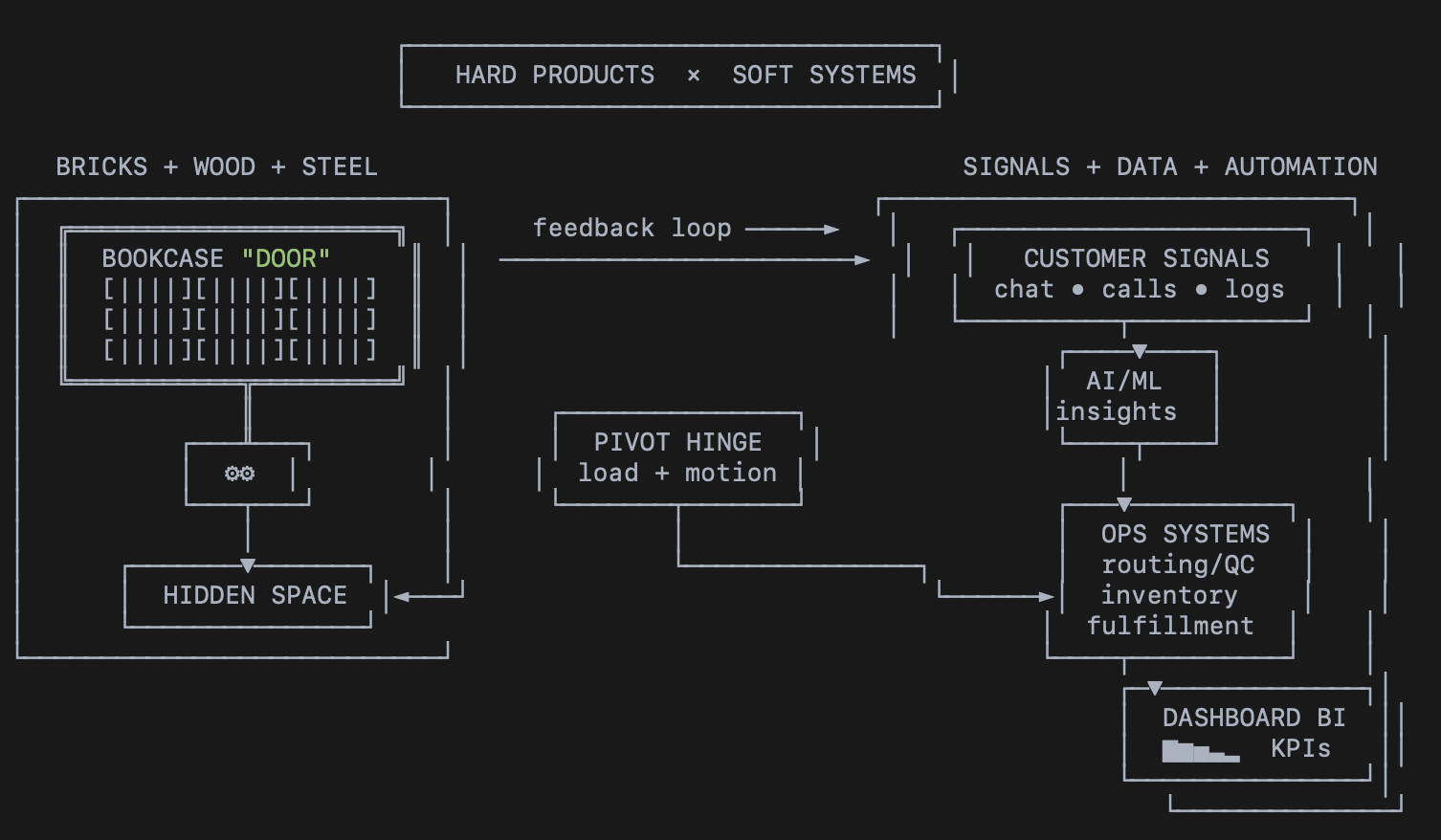
The business was built by identifying an unmet niche rather than optimizing within an existing category. The product focused on hidden, load-bearing doors integrated into cabinetry and walls, requiring custom hardware design, patentable hinge systems, and standardized manufacturing constraints to enable scale. Early go-to-market relied entirely on direct-to-consumer e-commerce, pre-selling high-ticket physical products with minimal brand trust, no showrooms, and limited prior validation. Growth was driven by rapid iteration from live customer feedback, vertical integration of manufacturing, and a shift from selling components (hardware) to complete systems (finished doors), increasing both margins and defensibility.
Operationally, the company scaled by systematizing design SKUs, logistics classifications, and production workflows while maintaining customization at the edge. Data collection emphasized real customer conversations and post-install feedback over third-party review platforms, informing product improvements and conversion optimization. Technology investments focused on internal tooling, automation, and selective software development rather than heavy headcount, allowing revenue growth to outpace organizational complexity. The result was a capital-efficient, category-creating business that scaled through product differentiation, operational discipline, and tight feedback loops rather than traditional enterprise sales or credential-driven execution.
Technologies
On the software side, technology was used to compress feedback loops and operational complexity rather than inflate headcount. Direct-to-consumer e-commerce captured high-intent customer data, while real-time sales conversations and post-install insights informed product, pricing, and conversion optimization. Internal tools and selective automation replaced manual coordination across design, production, logistics, and support. By prioritizing systems, data flow, and automation over surface-level digital features, the business scaled a complex physical product with the efficiency, adaptability, and learning velocity typically associated with high-performing software companies.
Lessons for Founders
Start with a real gap, not a crowded market. Category creation beats incremental differentiation when the problem is genuinely unmet.
Think in systems, not products. Scalability comes from standardization, modularity, and repeatable processes—even for physical goods.
Customer conversations outperform reviews and surveys. Direct, live feedback creates faster learning loops than third-party platforms.
Validate demand before perfecting execution. Early traction matters more than polish; iteration beats overplanning.
Money isn’t a durable motivator. Long-term resilience comes from purpose, ownership, and pride in what you’re building.
Operational discipline is a growth lever. Logistics, tooling, and workflow design can be bigger advantages than marketing spend.
From living in a truck to building secret rooms in homes around the world, Jeremy Barker’s journey is proof that unconventional paths can lead to extraordinary outcomes—if you’re willing to keep walking when the road disappears.