In this episode, April Palmer (Instagram: @hotmessboss) discusses her expertise in cloud cost containment and her role as a fractional chief growth officer. She emphasizes the importance of balancing engineering speed with cost management, the challenges of communication between finance and engineering teams, and the impact of AI on business growth. April shares insights on vendor lock-in, multi-cloud strategies, and the necessity of understanding market opportunities. She also provides valuable advice for startups and entrepreneurs, highlighting the need for clear communication and the importance of slowing down to ensure sustainable growth.
Podcast
Growth Without Chaos: Lessons from the Frontlines of Tech — on Apple and Spotify.
The Hidden Risk in Your Infrastructure
What if your cloud bill isn’t the real problem? Or worse—what if it is, but not for the reason you think? Most tech founders assume their biggest risk is building the wrong product. Sometimes the real threat hides in a line item buried in AWS, quietly compounding every month while engineering builds at full throttle. In a recent Snowpal Podcast conversation, April Palmer—fractional Chief Growth Officer and cloud cost strategist at Duckbill—offered clarity without jargon . What emerged wasn’t just a cost discussion, but a deeper lesson in alignment and growth.
The Myth of the Negotiated Discount
Imagine you’re building fast, shipping constantly, scaling infrastructure, and iterating without pause. Then the cloud bill spikes. Leadership panics. Finance demands cuts. Someone suggests negotiating with AWS. Problem solved? Not usually.
For many companies spending under $500k per month, discounts often underdeliver. Enterprise support fees offset savings, and commercial terms are largely standardized. Real savings often come from fundamentals: turning off unused resources, right-sizing instances, improving tagging, and aligning infrastructure to business goals. Cost containment is less about bargaining power and more about operational awareness.
The Real Problem: Organizational Misalignment
The hardest cloud challenge isn’t technical—it’s human. Finance wants lower costs. Engineering wants performance. Sales wants growth. Leadership wants all three immediately. When these groups don’t align, cloud costs become a symptom of a deeper disconnect.
Optimization requires collaboration—what’s often called FinOps—where finance, engineering, and procurement speak a shared language.
The objective isn’t slashing costs blindly; it’s right-sizing spend to match strategy. A zero cloud bill means zero business. The goal is sustainability, not austerity.
AI: Intentional Tool or Expensive Distraction?
AI has amplified both opportunity and confusion. Companies rush to “implement AI” without validating the problem it solves. Automation promises efficiency, but AI cannot interpret your fundraising timeline, product roadmap, or market nuance. It augments human judgment; it doesn’t replace it. The companies succeeding with AI are not the loudest adopters—they’re the most intentional ones. They validate use cases before implementation and measure impact against strategy.
The Growth Question: Bigger Market or Better Insight?
Consider two startups. One has an exceptional product and team but a narrow market. The other has an average product in a large market. Which do you grow? The instinct might favor scale, but growth often starts with discovery. Founders frequently underestimate their true addressable market because they haven’t explored adjacent use cases or conducted deep customer discovery.
Slowing down at the beginning—measuring twice—can accelerate growth later.
Clear positioning sharpens messaging. Sharp messaging accelerates sales. Accelerated sales compound into scale.
The Founder’s Emotional Equation
Founders don’t just build products—they build identity around them. They sacrifice time, capital, and stability. So when feedback challenges the strategy, it feels personal. Growth requires separating identity from iteration.
A strong growth partner helps founders evaluate ideas without equating critique with rejection.
Not every founder is ready for that distinction, but those who are move faster in the long run.
Education, Risk, and the New Workforce
The conversation extended to education and career paths in a shifting economy. With automation reshaping white-collar roles and tuition costs rising, intentionality matters more than tradition. Community colleges, employer-sponsored tuition, and early real-world experience may provide stronger leverage than defaulting to expensive four-year pathways. The theme remains consistent: slow down, assess the landscape, and make strategic moves.
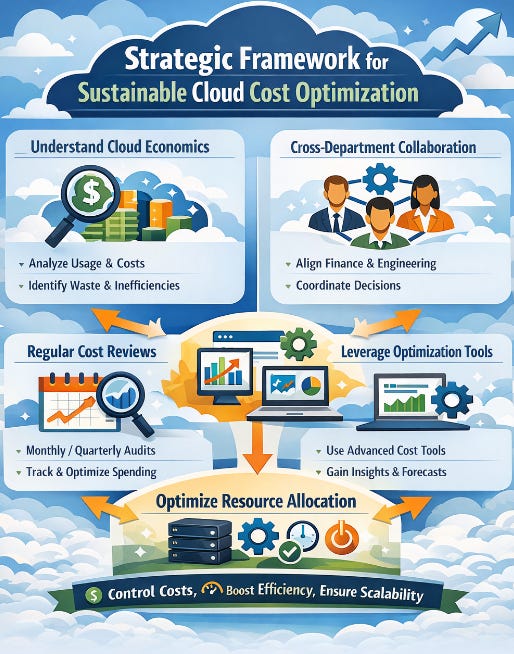
Strategic Framework for Sustainable Cloud Cost Optimization
Effective cloud cost optimization begins with a clear understanding of cloud economics and usage patterns. Organizations must analyze actual consumption before pursuing discounts, ensuring that spending aligns with workload requirements. This includes identifying underutilized or over provisioned resources, consolidating services where possible, and implementing consistent tagging to enable accurate cost allocation and accountability. Without proper visibility into usage data, untracked resources and poor allocation practices can significantly inflate costs. Regular, structured cost reviews—conducted monthly or quarterly—help detect inefficiencies early, with many teams uncovering 10–20% savings simply through disciplined analysis of billing and utilization reports rather than relying on year-end assessments.
Sustainable cost control also requires cross-functional collaboration between finance, engineering, and procurement to align budget constraints with architectural decisions. A siloed approach often results in misaligned priorities, inefficient provisioning, and missed optimization opportunities. Leveraging specialized cloud cost management platforms can provide deeper visibility and analytics beyond native provider tools, enabling proactive governance and forecasting.
Continuous optimization of resource allocation—resizing instances, eliminating idle assets, and automating shutdown policies—ensures that organizations pay only for what they actively use.
Together, financial visibility, operational discipline, tooling, and cross-department governance form a repeatable framework for controlling cloud spend while maintaining performance and scalability.
Final Insight
Your cloud bill isn’t just a financial issue—it’s a reflection of alignment, clarity, and growth strategy. AI is powerful, but context determines value. Speed without discovery creates expensive chaos. Sustainable growth begins with understanding before scaling. And often, the most impactful growth leaders are not center stage—they’re quietly helping others win from behind the scenes.
What if we generated some Golang code to reflect this conversation…
package main

import "fmt"

type Startup struct {
	Product           string
	CloudBillHigh     bool
	UnusedResources   bool
	NeedsRightSizing  bool
	PoorTagging       bool
	AlignedWithGoals  bool
	TAMSmall          bool
	ProblemDefined    bool
	AISupportsGoal    bool
	FounderIdentityIsProduct bool
}

func DiagnoseCloudCost(s Startup) string {
	if s.CloudBillHigh {
		// Look for fundamentals first
		if s.UnusedResources || s.NeedsRightSizing || s.PoorTagging {
			return "Operational Inefficiency"
		}
		// If fundamentals are fine but costs still feel “wrong,” it’s usually alignment
		if !s.AlignedWithGoals {
			return "Alignment Problem"
		}
	}
	return "No Immediate Issue"
}

func AlignOrganization(financeAligned, engineeringAligned, salesAligned bool) string {
	if !(financeAligned && engineeringAligned && salesAligned) {
		FinOpsConversation()
		defineSharedGoals()
		mapCostToGrowth()
	}
	return "Aligned"
}

func FinOpsConversation() {
	// Placeholder: facilitate finance + engineering + procurement discussion
}

func defineSharedGoals() {
	// Placeholder: set measurable shared outcomes (cost, performance, growth)
}

func mapCostToGrowth() {
	// Placeholder: tie spend to roadmap + revenue outcomes
}

func EvaluateAIUse(problemDefined, aiSupportsGoal bool) string {
	if !problemDefined {
		return "Do Not Implement AI"
	}
	if aiSupportsGoal {
		return "Implement Intentionally"
	}
	return "Reassess AI Use Case"
}

func GrowthStrategy(product string, tamSmall bool) string {
	DeepCustomerDiscovery()

	if tamSmall {
		exploreAdjacentMarkets()
		validateNewUseCases()
	}

	sharpenPositioning()
	accelerateSales()

	return "Scale"
}

func DeepCustomerDiscovery() {
	// Placeholder: interviews, jobs-to-be-done, pain validation, willingness-to-pay
}

func exploreAdjacentMarkets() {
	// Placeholder: neighboring segments, alternative buyers, new workflows
}

func validateNewUseCases() {
	// Placeholder: prototype + test value hypotheses
}

func sharpenPositioning() {
	// Placeholder: problem -> promise -> proof
}

func accelerateSales() {
	// Placeholder: messaging -> pipeline -> conversion loops
}

func FounderFeedback(founderIdentityIsProduct bool) string {
	if founderIdentityIsProduct {
		separateEgoFromIteration()
	}
	acceptFeedback()
	iterateStrategy()
	return "Faster Growth"
}

func separateEgoFromIteration() {
	// Placeholder: frame critique as product iteration, not personal judgment
}

func acceptFeedback() {
	// Placeholder: create feedback channels and review cadence
}

func iterateStrategy() {
	// Placeholder: adjust positioning, ICP, pricing, and GTM motions
}

func UseAIAsAmplifier(humanInsight string) string {
	// Placeholder: AI helps structure, document, and operationalize
	structured := generateStructuredOutput(humanInsight)
	docs := accelerateDocumentation(structured)
	return supportExecution(docs)
}

func generateStructuredOutput(input string) string {
	return "Structured Strategy: " + input
}

func accelerateDocumentation(input string) string {
	return "Docs: " + input
}

func supportExecution(input string) string {
	return "Execution Plan: " + input
}

func main() {
	startup := Startup{
		Product:                "Snowpal-style SaaS",
		CloudBillHigh:          true,
		UnusedResources:        true,
		NeedsRightSizing:       true,
		PoorTagging:            false,
		AlignedWithGoals:       false,
		TAMSmall:               true,
		ProblemDefined:         true,
		AISupportsGoal:         true,
		FounderIdentityIsProduct: true,
	}

	alignmentStatus := AlignOrganization(false, true, false)
	costDiagnosis := DiagnoseCloudCost(startup)
	aiDecision := EvaluateAIUse(startup.ProblemDefined, startup.AISupportsGoal)
	growthResult := GrowthStrategy(startup.Product, startup.TAMSmall)
	founderState := FounderFeedback(startup.FounderIdentityIsProduct)

	fmt.Println("Alignment:", alignmentStatus)
	fmt.Println("Cloud Cost Diagnosis:", costDiagnosis)
	fmt.Println("AI Decision:", aiDecision)
	fmt.Println("Growth Result:", growthResult)
	fmt.Println("Founder State:", founderState)
	fmt.Println(`"Measure Twice, Scale Once"`)
}