

In this episode, Michael Nappi, Chief Product and Engineering Officer at ScienceLogic, shares insights into AI Ops, its role in modern IT management, and how it helps large enterprises and MSPs streamline their infrastructure monitoring and management. Discover how AI-driven automation and observability are transforming IT operations.
Podcast
AIOps: Turning Data into Action — on Apple and Spotify.
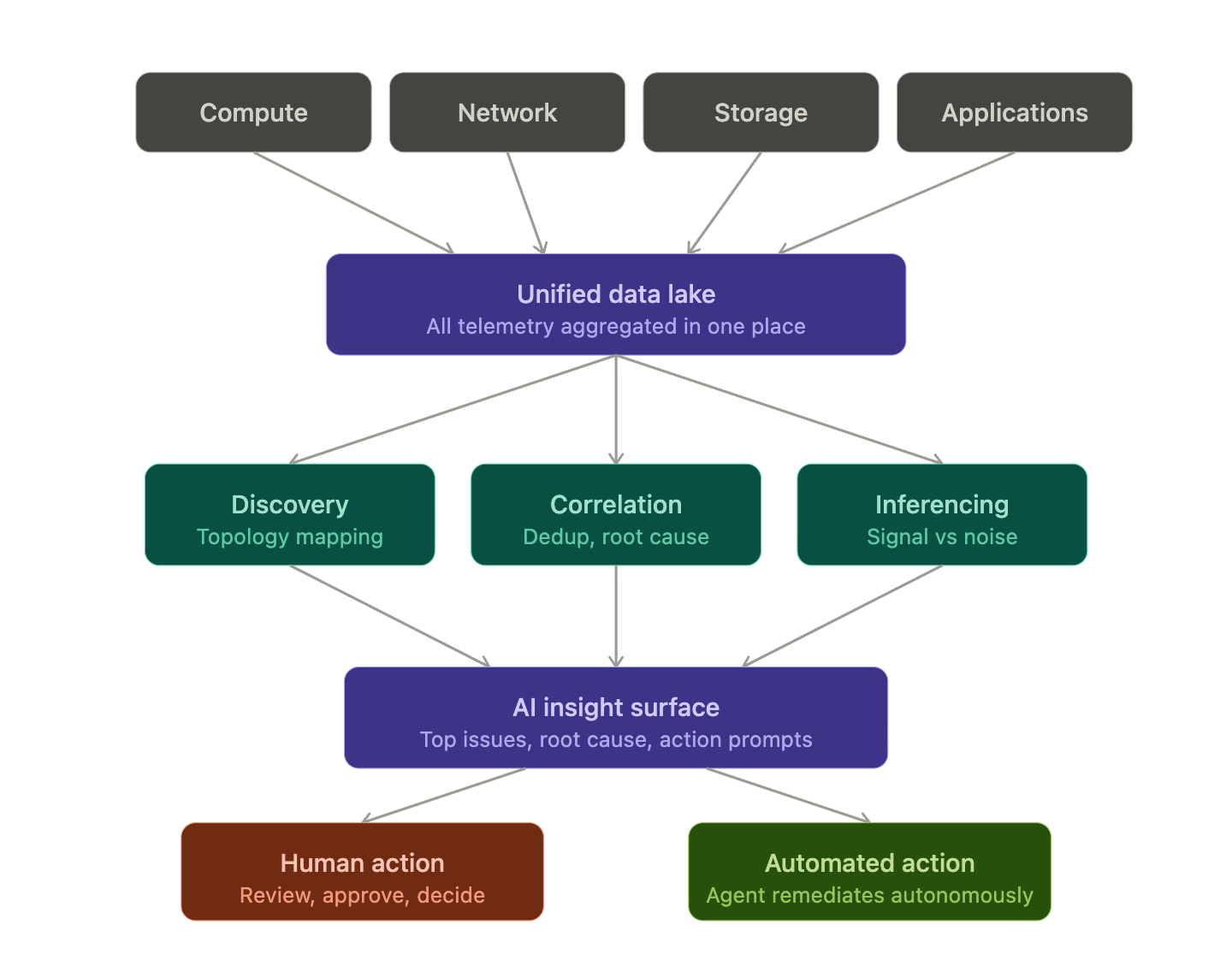
The AIOps Pipeline Diagram
Raw telemetry from across a hybrid IT estate flows into a unified data lake, where AI reasons over it to surface only what matters — routing each insight to either a human engineer or an autonomous remediation agent.
Q & A with Michael Nappi
1. What is AIOps and how does it differ from traditional IT operations?
AIOps extends traditional IT operations by applying AI/ML techniques to large volumes of telemetry data (metrics, logs, events, traces) generated across complex IT environments. While traditional IT ops relies on rule-based monitoring and manual intervention, AIOps enables automated correlation, noise reduction, anomaly detection, and actionable insights, helping teams understand system behavior and respond faster.
2. What core problem does IT operations aim to solve?
IT operations ensures that an organization’s compute, storage, and networking infrastructure runs reliably, efficiently, and continuously delivers services to the business. This includes maintaining uptime, performance, and availability while minimizing disruptions.
3. Who are the primary customers of AIOps platforms like ScienceLogic?
The primary customers are large enterprises, global 2000 organizations, government agencies (including DoD and civilian sectors), and MSPs. These customers typically operate large-scale, hybrid, and distributed IT environments requiring centralized visibility and control.
4. What role do MSPs play in this ecosystem?
MSPs manage IT infrastructure on behalf of other businesses, providing services like monitoring, incident detection, and remediation. They abstract operational complexity for their clients and are accountable for maintaining service availability and performance.
5. What value does ScienceLogic provide to MSPs and enterprises?
ScienceLogic provides a unified observability and operations platform that discovers infrastructure, aggregates telemetry, correlates signals, identifies issues, and enables both guided and automated remediation, effectively replacing multiple fragmented tools with a single system.
6. How does infrastructure discovery work in such platforms?
The platform detects all assets within an IT environment (anything with an IP address), including servers, network devices, applications, and services, using protocols like SNMP, SSH, APIs, and others. This creates a comprehensive, real-time inventory of the IT estate.
7. What are collectors and why are they used?
Collectors are lightweight Linux-based agents deployed within a customer’s environment that gather telemetry data locally and forward it to the central platform. They act as edge caches, improve resiliency, support secure communication behind firewalls, and enable operation in restricted or air-gapped environments.
8. Why not collect all data directly from the cloud without collectors?
Collectors provide architectural benefits such as reduced latency, improved reliability via store-and-forward mechanisms, compliance with security constraints (e.g., firewalls, air-gapped systems), and efficient data filtering before transmission, which is especially important in sensitive or distributed environments.
9. What types of data are collected and analyzed?
The platform ingests metrics, logs, events, and traces from infrastructure and applications. This telemetry may originate from cloud services (e.g., AWS CloudTrail), APIs, or system-level monitoring and is normalized and correlated for analysis.
10. How does the platform handle noisy or high-volume data?
It uses filtering, sampling, and intelligent ingestion strategies to avoid overwhelming the system with unnecessary data, focusing instead on meaningful signals that contribute to actionable insights.
11. Is the platform cloud-agnostic and how does it support multi-cloud environments?
Yes, it is fully cloud-agnostic, capable of monitoring workloads across AWS, Azure, GCP, on-prem systems, and virtualized environments, providing a unified “single pane of glass” view across all environments.
12. How is the platform deployed and hosted?
It can be deployed on-premises, hosted by ScienceLogic as a SaaS offering, or deployed within a customer’s or MSP’s cloud environment. The architecture is flexible to support various operational and compliance needs.
13. How does onboarding work for MSPs and their customers?
ScienceLogic provisions and configures the platform for MSPs in a SaaS environment. MSPs then onboard their customers into a multi-tenant system by deploying collectors, configuring integrations, and assigning user roles.
14. How does the platform model services instead of just infrastructure?
It maps underlying infrastructure components (servers, databases, APIs, etc.) to business services, enabling visibility into service health, performance, and risk. This allows teams to understand not just system status but business impact.
15. How does AIOps enable proactive rather than reactive operations?
By analyzing trends and patterns in telemetry data, the platform can detect early warning signs of degradation, predict potential failures, and alert teams before issues impact services, enabling proactive remediation instead of reactive firefighting.