

The stock market has experienced a brutal selloff, with technology and semiconductor companies taking some of the hardest hits. Following the U.S. midterm elections, investors are increasingly concerned about the possibility of tighter artificial intelligence regulations, restrictions on data center development, and the implications for companies investing billions of dollars in AI infrastructure. But does this mean the AI revolution is coming to an end, or are markets reacting too aggressively to political uncertainty?
In this episode of the Snowpal Podcast, I explore the recent market downturn, the potential consequences of increased AI regulation, the financial implications for semiconductor manufacturers and hyperscalers, and why I believe AI development is unlikely to come to a standstill despite political headwinds.
Podcast
The AI Gold Rush Meets Washington: Why Tech Stocks Are Falling and What Comes Next — on Apple and Spotify.
The Market Selloff: Technology Stocks Take a Beating
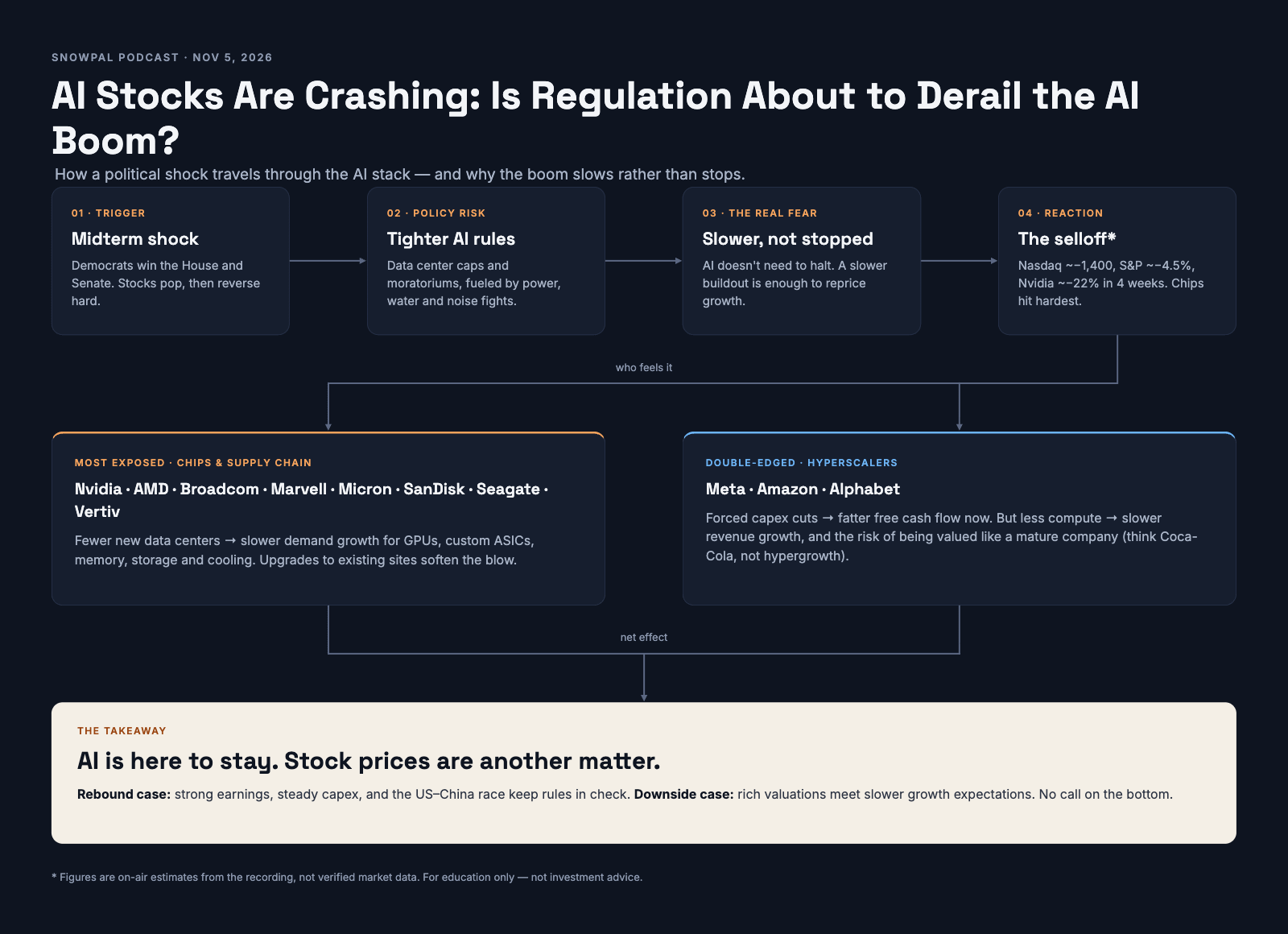
The market reaction following the midterm elections has been dramatic. After initially responding positively to the election results, stocks reversed direction, producing what felt like a bloodbath across major indexes. During the podcast, I estimated that the Nasdaq had fallen approximately 1,400 points, the Dow had declined more than 1,000 points, and the S&P 500 had dropped approximately 4.5%. These figures were estimates discussed during the recording rather than independently verified market data.
The semiconductor sector has been particularly vulnerable. Nvidia, AMD, Broadcom, Micron, SanDisk, and other companies associated with AI infrastructure have experienced substantial selling pressure. The immediate question is whether investors are reacting to a genuine deterioration in business fundamentals or simply reassessing the pace at which AI infrastructure spending can continue under a potentially more restrictive regulatory environment.
Semiconductor stocks face significant selling pressure
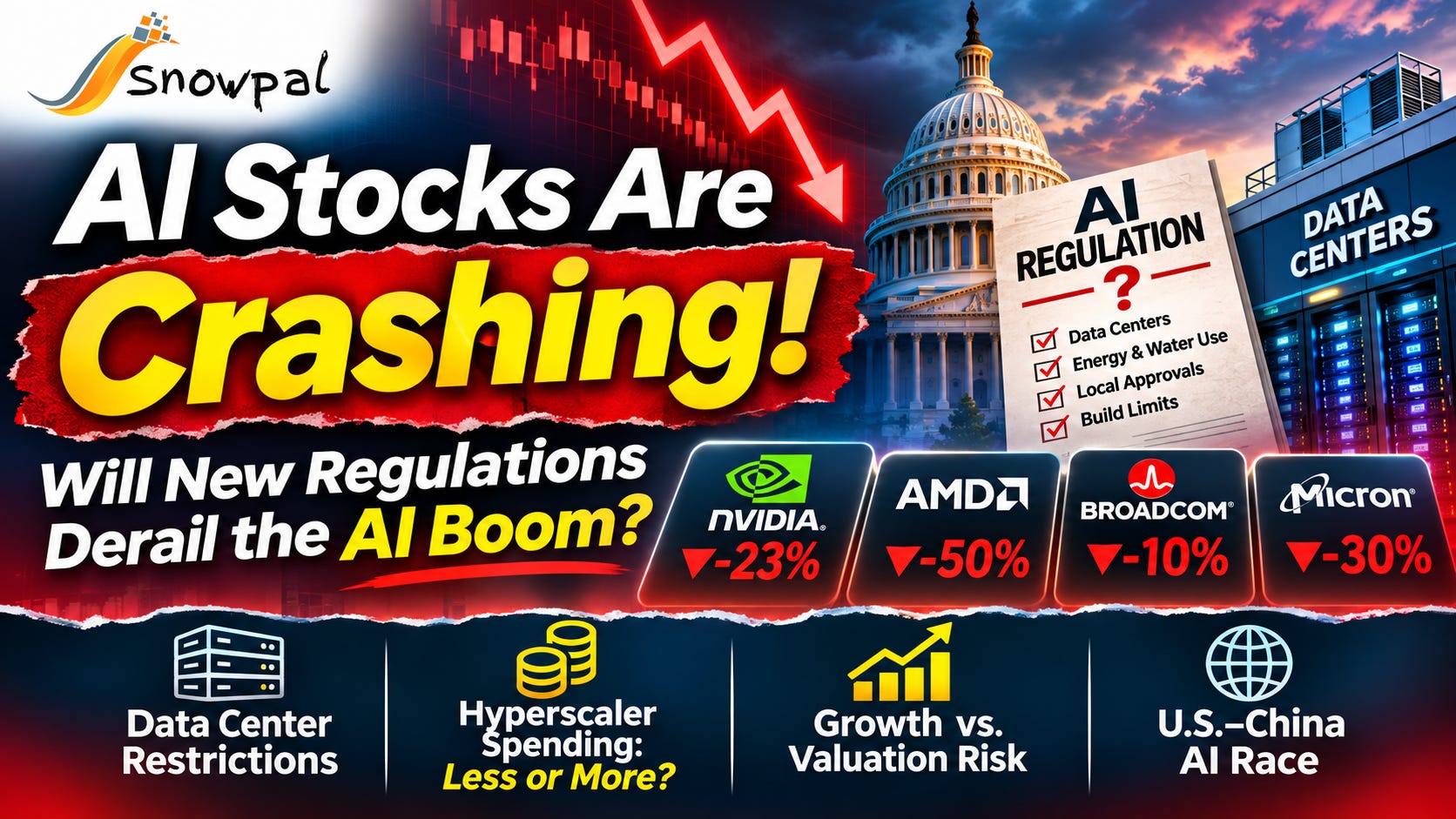
Several companies stood out during the discussion. Nvidia was estimated to have declined approximately 22–23% over the preceding four weeks, while Micron had fallen below $700 after trading near $1,000 around its previous earnings announcement. SanDisk, which had approached $2,000 earlier in the year, was trading below $1,000, while Broadcom had declined nearly 10% and fallen below $300.
These numbers were recalled from memory during the podcast and should be treated as approximate rather than verified historical prices. Nevertheless, the broader observation is that companies closely associated with AI infrastructure have experienced considerable volatility. Amazon appeared to be a relative exception during the session, having maintained stronger momentum following its recent earnings announcement.
A hypothetical AI portfolio loses approximately 50%
To illustrate the magnitude of the correction, I discussed a paper-trading portfolio tracking approximately ten companies associated with AI infrastructure. Over roughly four to five weeks, that hypothetical portfolio had declined approximately 50%. The portfolio was not funded with actual capital, but its performance demonstrated how quickly losses can accumulate when highly correlated technology stocks experience simultaneous corrections.
This raises an important distinction: a company can continue growing its revenue and expanding its business while its stock price declines significantly. Market valuations reflect expectations about future growth, not merely the financial results companies have already delivered.
Political Changes and the Prospect of More AI Regulation
The podcast discusses the Democratic victories in the House and Senate during the midterm elections and the possibility that the incoming Congress will pursue additional AI-related regulation. The concern is not necessarily that artificial intelligence development will be prohibited, but that restrictions could increase the cost, complexity, and time required to expand AI infrastructure.
There is a reasonable argument for regulation. AI development raises legitimate questions about energy consumption, environmental impact, public safety, and the effects of increasingly powerful technologies on employment and society. At the same time, excessive restrictions could slow investment, reduce competitiveness, and discourage companies from developing infrastructure in the United States.
Why the pace of AI development matters more than an outright shutdown
The stock market does not require AI development to stop entirely before repricing AI-related companies. Even a relatively modest reduction in expected growth can have significant consequences for businesses whose valuations depend on years of rapid expansion. If investors previously expected data center capacity to increase at an extraordinary pace but begin anticipating a slower expansion, semiconductor manufacturers and infrastructure suppliers could experience substantial valuation adjustments.
This is especially important because stock prices often incorporate expectations well beyond the next quarter or fiscal year. A company can remain profitable, continue selling products, and report growing revenue while still disappointing investors who had anticipated substantially faster growth.
Data Centers: The Center of the AI Regulation Debate
Data centers are among the most visible and controversial components of the AI infrastructure boom. As technology companies build increasingly powerful computing facilities, communities are beginning to question the environmental and economic consequences of these developments.
I live in Loudoun County, Virginia, an area with a substantial concentration of data centers. Many residents work in technology and benefit directly or indirectly from the growth of AI, yet they may understandably oppose having enormous computing facilities constructed near their homes.
Electricity, water consumption, and noise pollution
The concerns surrounding data center expansion extend beyond their physical appearance. Large facilities consume substantial electricity, may require considerable water for cooling, and can contribute to local infrastructure costs. Noise is another important consideration, particularly where cooling equipment, backup generators, or gas turbines operate near residential neighborhoods.
Facilities that cannot obtain sufficient electricity from the existing grid may require alternative power arrangements, potentially introducing additional environmental and noise concerns. These issues help explain why local communities and policymakers may support restrictions on new development even when they recognize the economic importance of AI.
Could restrictions slow new data center construction?
The podcast raises the possibility of additional controls on the number of data centers permitted in certain counties and states, as well as more stringent requirements governing their construction and operation. It also references potential moratoriums in Texas as an example of the broader regulatory uncertainty facing the industry.
The underlying economic relationship is straightforward: if fewer data centers are constructed, demand for the equipment required to build and operate those facilities could grow more slowly. That includes processors, memory, storage, cooling systems, electrical infrastructure, and other components.
However, fewer new facilities would not automatically translate into an equivalent reduction in equipment demand. Existing data centers could still be upgraded, and companies could continue investing in more efficient and powerful computing systems.
Nvidia and AMD: Why AI Chipmakers Are Particularly Exposed
Semiconductor manufacturers have become some of the most prominent beneficiaries of the AI investment cycle. Their growth is closely associated with the willingness of major technology companies to continue purchasing enormous quantities of computing hardware.
Nvidia’s dependence on data center demand
Nvidia is central to the AI infrastructure ecosystem because its GPUs are widely used to train and run increasingly sophisticated AI models. During the podcast, I estimated that approximately 90% of Nvidia’s revenue could be associated with data centers and that quarterly revenue might be approaching $100 billion. Both figures were explicitly presented as estimates from memory, not verified financial results.
The broader concern is that Nvidia’s growth expectations depend heavily on continued demand for AI computing capacity. If regulatory restrictions slow infrastructure expansion, investors may begin questioning whether the company can sustain the extraordinary growth rates reflected in its valuation.
Even if Nvidia continues generating substantial revenue and profits, a slowdown relative to expectations could produce meaningful stock-price volatility.
AMD’s growing exposure to AI infrastructure
AMD faces a similar challenge, although its business includes several revenue streams beyond data centers. During the discussion, I estimated AMD’s quarterly revenue at approximately $13–14 billion, with roughly 60% potentially associated with data centers. These were also unverified estimates made during the recording.
AMD operates across data center computing, gaming, and other semiconductor markets, but its growth narrative is increasingly connected to the expansion of AI workloads. If the construction of new computing facilities slows, demand for its data center products could be affected.
The distinction between Nvidia and AMD is important because investors must consider not only the size of each company’s AI opportunity but also the degree to which its valuation already assumes continued success.
Broadcom, Micron, SanDisk, Seagate, and Vertiv: The Wider AI Supply Chain
AI infrastructure requires far more than GPUs. The expansion of data centers supports an extensive ecosystem of semiconductor designers, memory manufacturers, storage providers, networking specialists, and cooling equipment companies. This creates a chain of dependencies in which changes to hyperscaler spending can influence numerous businesses simultaneously.
Broadcom and Marvell: Custom chips and AI connectivity
Broadcom and Marvell occupy important positions in the semiconductor ecosystem, particularly through custom silicon and related technologies. Broadcom’s application-specific integrated circuits, or ASICs, represent an alternative approach to AI computing hardware compared with general-purpose GPUs.
The podcast emphasizes that the United States has substantial strength in this area, with companies such as Nvidia, Broadcom, and Marvell contributing to its semiconductor leadership. However, if hyperscalers reduce or delay infrastructure investments, companies supplying custom AI chips and associated technologies may also face changing demand expectations.
Micron, SanDisk, and Seagate: Memory and storage demand
AI systems require enormous amounts of memory and storage capacity. Micron, SanDisk, and Seagate were discussed as companies potentially affected by a slowdown in data center development. Although these businesses operate in different segments of the memory and storage markets, they share exposure to the broader expansion of digital infrastructure.
A reduction in anticipated data center construction could moderate future demand growth for certain products. Nevertheless, AI workloads may continue requiring increasing amounts of memory and storage even if the number of newly constructed facilities grows more slowly.
Vertiv: Cooling infrastructure and the AI buildout
Vertiv represents another important part of the AI infrastructure supply chain. Powerful computing systems generate substantial heat, creating demand for specialized cooling and thermal management equipment.
As data center computing density increases, efficient cooling becomes increasingly important. If infrastructure projects are postponed or canceled, suppliers such as Vertiv could experience changes in expected orders. Conversely, continued upgrades to existing facilities and increasing computing density could sustain demand even under a more restrictive construction environment.
Hyperscalers: Could Lower AI Spending Actually Be Good News?
One of the more interesting questions discussed in the podcast is whether restrictions on AI infrastructure investment could benefit the companies currently spending the most money.
Meta, Amazon, and Alphabet have committed substantial resources to AI-related capital expenditure. Investors have frequently expressed concerns about the scale of these investments and the uncertainty surrounding their eventual financial returns.
If regulations force these companies to spend less on infrastructure, the immediate financial consequences could be positive in certain respects.
Reduced capital expenditure could improve free cash flow
Capital expenditure represents money invested in assets such as servers, networking equipment, computing infrastructure, and data centers. When companies increase these investments substantially, their free cash flow can decline even while their underlying operations remain highly profitable.
If Meta, Amazon, or Alphabet were required to reduce capital expenditure, they could retain more cash in the short term. This could improve reported free cash flow, provide greater financial flexibility, and potentially reduce investor concerns about the cost of the AI expansion.
From this perspective, lower spending is not necessarily bad news for hyperscalers. In fact, it could make their near-term financial statements appear more attractive.
The problem: Lower spending could also limit revenue growth
The other side of the argument is that AI infrastructure investments are intended to support future revenue growth, product development, and competitive advantages. Companies are not spending billions of dollars simply because they have excess cash. They expect those investments to generate economic benefits.
Meta, for example, requires substantial computing capacity to develop and deploy increasingly sophisticated AI products. The podcast references its Muse application as an example of a product associated with significant computing requirements.
If regulations prevent companies from expanding their infrastructure at the desired pace, their ability to launch new products, improve existing services, or scale AI capabilities could become constrained. That could ultimately limit future revenue growth.
The tradeoff is therefore between improved short-term free cash flow and potentially weaker long-term growth opportunities.
Growth Stocks Versus Mature Businesses: Why Valuation Matters
One of the most consequential risks for hyperscalers is not necessarily declining revenue but a change in how investors classify their businesses.
Companies expected to deliver substantial earnings growth often command higher valuation multiples than businesses operating in mature industries. Investors are willing to pay more for future earnings when they believe those earnings will increase rapidly over time.
What happens when a growth company begins to mature?
Suppose investors begin believing that a major technology company can no longer expand its AI capabilities as quickly as previously expected. Even if the company remains profitable and continues increasing earnings per share, the market may no longer assign it the same valuation premium.
During the podcast, I compared this possibility with mature consumer businesses such as Coca-Cola and Pepsi. The comparison was not intended to suggest that hyperscalers would become identical to beverage companies, but rather to illustrate how different growth expectations can influence valuation.
A business generating steady earnings growth may still be an excellent company, yet its stock could perform poorly if investors previously priced it for extraordinary expansion.
Why better free cash flow does not guarantee a higher stock price
A reduction in capital expenditure could improve free cash flow while simultaneously weakening expectations for future revenue growth. Investors would then have to decide which development matters more.
This explains why a forced reduction in AI spending might not produce an immediate rally in Meta, Amazon, or Alphabet. The market could reward stronger cash generation, penalize slower growth, or respond differently depending on the company’s valuation and competitive position.
The outcome would depend on how effectively each company converts its existing AI investments into measurable financial returns.
The United States, China, and the Global AI Race
Beyond financial markets, AI development has become an important component of international technological competition. The podcast argues that policymakers must consider the consequences of slowing domestic AI development while competing nations continue investing aggressively.
China is particularly relevant because it has substantial ambitions in artificial intelligence, semiconductor development, and advanced computing infrastructure.
Can the United States afford to slow AI investment?
The United States benefits from a powerful technology ecosystem that includes Nvidia, Broadcom, Marvell, and major hyperscalers such as Amazon, Alphabet, Microsoft, and Meta. These companies collectively contribute to the country’s capabilities in semiconductor design, computing infrastructure, software, and AI development.
Excessively restrictive policies could create opportunities for international competitors if they substantially reduce the pace of American technological progress. This does not mean regulation should be abandoned, but it does suggest that policymakers face a difficult balancing act between managing risks and preserving competitiveness.
Why AI development is unlikely to stop
My expectation is that AI development will continue despite additional regulation. The technology has already become deeply integrated into business operations, software development, and a growing range of industries.
There may be delays, higher compliance costs, and changes in the pace of infrastructure construction. However, the economic incentives to improve AI systems remain substantial, and the international competition to develop more powerful technologies provides another reason for continued investment.
The more realistic question is how quickly AI will advance and which companies will benefit most from the next phase of development.
AI and Employment: The Transformation Is Already Underway
As someone working in technology and running a software startup, I have seen how AI is changing expectations around productivity and staffing. The podcast discusses the possibility that work previously requiring ten employees might, in some circumstances, be accomplished by a much smaller team using AI-powered tools.
The example of reducing a ten-person team to three was intended to illustrate the potential scale of productivity changes, not to establish a universal employment ratio.
Fewer resources may be needed to accomplish the same work
AI can automate repetitive tasks, accelerate software development, assist with research, and improve the efficiency of numerous business processes. This creates opportunities for smaller teams to accomplish work that previously required larger organizations.
At the same time, the effects will vary considerably across industries and occupations. Some roles may shrink, others may evolve, and entirely new categories of employment may emerge as the technology develops.
What seems increasingly difficult to dismiss is that AI has already moved beyond being merely an experimental technology. Businesses are actively incorporating it into their operations, and its influence on productivity is likely to remain an important economic consideration.
Is the AI Selloff an Overreaction or the Beginning of a Larger Correction?
The market’s recent decline raises an obvious question: are investors responding rationally to a meaningful change in future growth expectations, or is the selloff primarily a knee-jerk reaction to political uncertainty?
Both explanations may contain some truth. Regulation could affect infrastructure expansion and investment economics, but the extent of those effects remains uncertain. Political outcomes do not automatically translate into immediate restrictions, and proposed policies may be modified, delayed, or never implemented.
Why a market rebound remains possible
If investors conclude that AI infrastructure investment will continue at a healthy pace, confidence in semiconductor and technology companies could recover. Strong earnings, sustained hyperscaler capital expenditure, and evidence of increasing AI adoption could support that reassessment.
The international competition surrounding AI may also limit how aggressively policymakers pursue restrictions that could weaken domestic technology companies.
However, the possibility of a rebound does not establish that current stock prices represent a bottom.
Why further downside remains possible
Even companies with excellent long-term prospects can experience substantial corrections when valuations are elevated or earnings expectations change. If investors anticipate slower growth, reduced infrastructure spending, or weaker returns on AI investments, stock prices could continue declining.
The podcast does not attempt to identify an exact market bottom. Instead, it recognizes that prices could be approaching attractive levels while acknowledging that additional downside remains possible.
This uncertainty is particularly important for investors considering semiconductor companies whose valuations are closely connected to the continuation of the AI infrastructure expansion.
The Next Two Years: Politics, Regulation, and Technological Progress
With the next presidential election approximately two years away, the political environment could remain an important source of uncertainty for technology investors. Legislative proposals, regulatory changes, and debates over data center development may continue influencing market sentiment.
Nevertheless, technological advancement and political decision-making do not always move at the same pace. Companies can continue innovating while governments debate regulatory frameworks, and the competitive incentives driving AI development are unlikely to disappear simply because the political environment becomes less favorable.
The central question for investors is whether the next two years will bring restrictions severe enough to materially alter the financial outlook for AI-related businesses, or whether the market is currently assigning too much importance to an uncertain regulatory future.
Final Thoughts: AI Is Here to Stay, but Stock Prices Are Another Matter
My central argument is that artificial intelligence is unlikely to disappear or become irrelevant because of increased regulation. The technology is already influencing software development, corporate productivity, infrastructure investment, and international competition. Those forces are powerful enough that continued development appears more likely than a complete reversal.
However, believing in the long-term future of AI is not the same as believing that every AI-related stock is attractively valued. Nvidia, AMD, Broadcom, Micron, SanDisk, Seagate, Vertiv, and the hyperscalers operate in different segments of the ecosystem, and their financial performance could respond differently to changes in infrastructure investment.
Regulation may slow certain projects without stopping the broader AI expansion. Reduced capital expenditure could improve hyperscaler free cash flow while creating challenges for semiconductor suppliers. More importantly, even modest changes in expected growth could produce substantial stock-market volatility.
The recent selloff may ultimately prove to be an overreaction, or it may represent an adjustment to more realistic growth expectations. We cannot know that with certainty today. What remains clear is that the intersection of AI, politics, infrastructure, and financial markets will be one of the most important developments to watch over the next several years.
Disclaimer: This article reflects the opinions, estimates, and predictions discussed in the podcast recorded on November 5, 2026. Market figures and company financial estimates mentioned in the recording have not been independently verified. The content is intended for educational and informational purposes and does not constitute financial or investment advice.