For decades, the conversation around global outsourcing has revolved around two places: India and the Philippines.
On a recent episode of the Snowpal Podcast, Krish Palaniappan sat down with Gerard Holland, a chartered accountant turned tech entrepreneur and founder of Talent Match Africa (TMA), to make the case for a “next frontier” that most Western businesses have barely considered: Africa.
Podcast
Africa, AI, and the Future of Global Talent — on Apple and Spotify.
Introduction
Holland, who lives in Melbourne, Australia, but runs operations out of Johannesburg, Durban, Cape Town, Nairobi, and Addis Ababa, didn’t set out to build an Africa-focused talent company. His path started in international education, building an internship placement platform that he took from Australia to the UK and Canada. Everything changed in 2020, when he was introduced to the continent through Zondwa Mandela, a grandson of Nelson and Winnie Mandela.
“I’d never been to Africa, but it definitely ignited something inside of me, an interest and that entrepreneurial flair, you could call it,” Holland recalled. He flew into Ethiopia first, then Rwanda, Kenya, and South Africa. What he found didn’t match his expectations at all: “I was completely blown away by the talent that is on the continent, the level of English proficiency, the tech capability, education levels, the infrastructure that’s happening in Africa. It wasn’t what I expected in my head.”
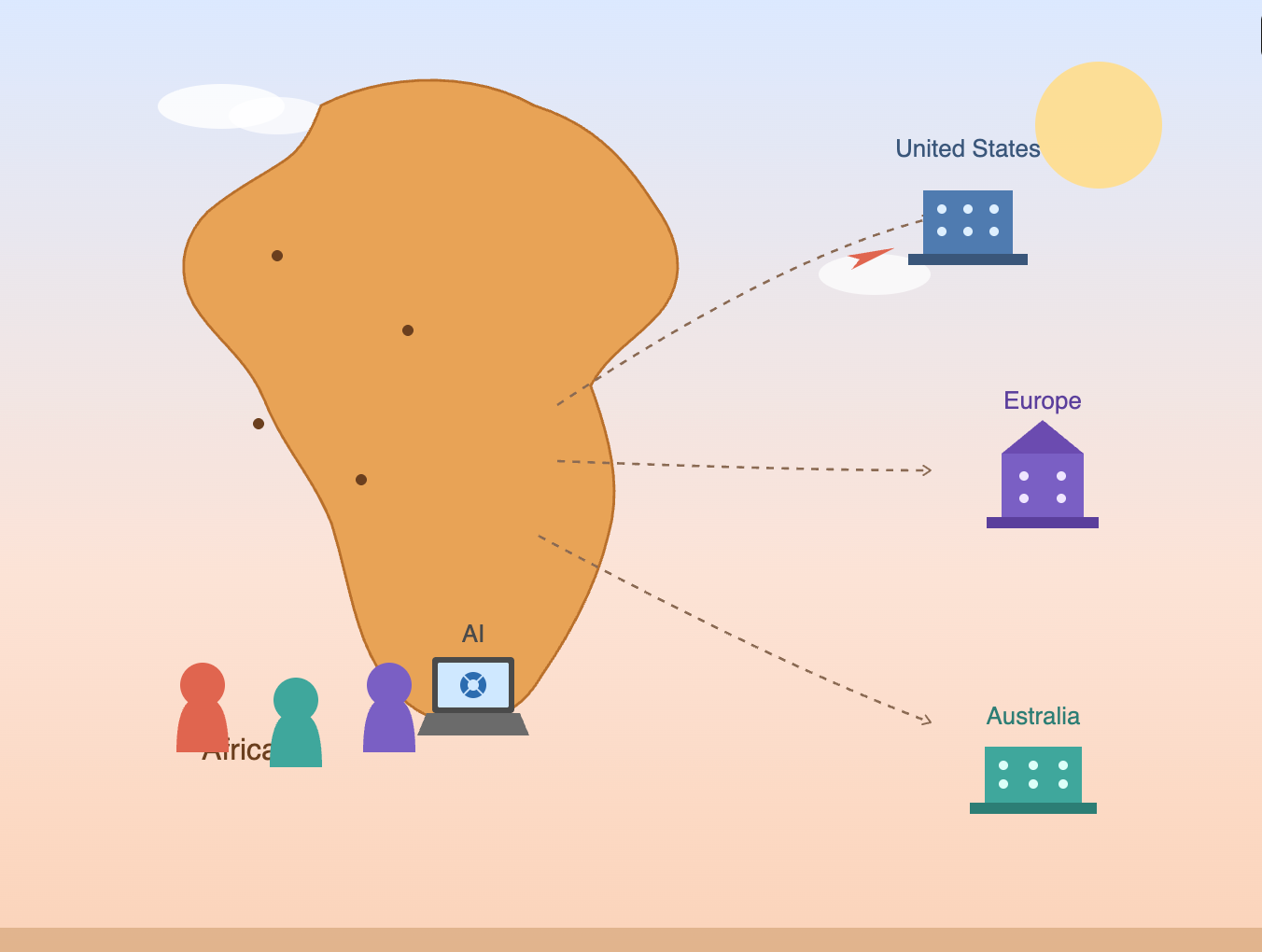
Talent Match Africa was born from that trip. Today the company places people in tech, finance and accounting, sales support, customer service, legal support, logistics, and operations roles with companies across the US, Australia, Canada, the UK, France, and China — and increasingly, in AI-related work.
The Demographic Case for Africa
Holland’s pitch for Africa starts with numbers most business leaders haven’t encountered. By 2035, every second person entering the global workforce will live on the African continent. By 2050, the continent’s population is projected to reach two billion. The driver is age: the average age in Africa is 19, compared to the 40s in the US and 72 in Monaco. That young population is now flooding into the workforce, backed by millions of university graduates every year.
Crucially, that talent pool is largely untapped. “India has become very congested and saturated,” Holland said. “The US went in the 70s and 80s and helped India become this tech powerhouse. But now it’s very saturated because everyone’s there. Whereas people haven’t quite worked out yet that there’s amazing talent in Africa. So you don’t have that competitive pressure. Price becomes more favorable, access to really good talent.”
He also pointed to a retention advantage Africa currently holds over the Philippines, where job-hopping has become endemic. “You don’t have people moving around as much... We’re not having those issues in Africa. Not yet anyway. We’re probably five years away from when that may become a problem.”
“Africa Is Not One Country”
Palaniappan pushed back with an obvious question: Africa is a continent of more than fifty countries, spanning enormous cultural and linguistic differences. Isn’t that a barrier for companies trying to figure out where — and how — to hire?
Holland pointed to a book that shapes his own thinking: Africa Is Not One Country. “A lot of people do sometimes think about Africa as being a country, when it’s like saying Europe is a country,” he said. “People in Germany are very different to people in France. And they’re next to each other.” A company that wants French-speaking talent needs to look at specific regions; language, accent, and business culture all vary sharply from country to country.
Accents, in particular, have become a bigger consideration than Holland expected. “I’m finding more and more that accent is even more important, particularly for a lot of USA companies. I’ll often get calls from businesses saying, ‘Look, Gerard, we really want people, but just so you know, we need really neutral accents.’ Where if they’re talking to clients, we don’t want people to know that they’re from another country — Americans want to deal with Americans.” South African, Kenyan, and Nigerian accents are all distinct, he noted, and clients increasingly specify which they’re comfortable with.
For companies looking to enter the continent, Holland recommends South Africa as an entry point: “It’s probably the most westernized of a lot of the countries in Africa. So a lot of businesses will get a foothold in South Africa and then they might work up into different parts of the continent.”
The Affordability Equation — And Why It’s Shifting
Palaniappan asked Holland directly whether Africa’s core value proposition, like India’s before it, ultimately comes down to cost. Holland didn’t dodge the question.
“India has become a lot more expensive now,” he said. “Eight, nine years ago, India was still very, very affordable. With all the demand on talent, people know what they’re worth and they can ask to be paid more, which then costs go up.” He described clients who saw quarterly price increases of 15% just to keep pace with local wage inflation. Africa, by contrast, is earlier in that cycle — global demand hasn’t yet driven up local wages the way it has in India, though Holland noted that large employers like Google and Amazon are already establishing a presence on the continent.
He also pointed to a cultural shift in how openly companies discuss offshoring. “Pre-COVID, it was almost like businesses when they talked about offshoring, it was a bit taboo... Now, post-COVID, people are like, ‘Yeah, I’ve had 20 people in Bangalore for 10 years.’” Rising costs of living in the US, UK, and Australia have made the math increasingly unavoidable for businesses trying to stay profitable: “If you can get someone doing the exact same job, but it costs 70% less, then businesses are saying, well, I’m going to do that.”
Underlying all of it, in Holland’s view, is a shift in trust that COVID accelerated. “What COVID made everyone appreciate... is that I can trust my people working remotely to do their job if we’re tracking the outcomes of what they do. If I’m in Boston and I’ve got a team member in Boston that’s working from home anyway, well why can’t I have a team member in Johannesburg or Bangalore doing the same work?”
The AI Question: Does Cheaper Labor Even Matter Anymore?
The most pointed exchange of the conversation came when Palaniappan raised what he called playing “devil’s advocate.” If AI is allowing companies to do the same work with a fraction of the headcount — he cited an example of a company that reportedly went from 52 employees to eight — does the whole premise of chasing cheaper labor abroad start to break down? If you only need eight people, why not just hire eight people locally?
Holland’s answer was refreshingly candid about the uncertainty in the room. “I don’t think anyone has the answer yet. Every business I speak to now has a different perspective on it.” He described playing golf with a business owner who’d cut his team from 22 to 12 while becoming more profitable than ever, driven by AI efficiency — and, in the same breath, other businesses that tried to cut headcount with AI and had to reverse course and rehire because “the AI wasn’t the efficiency they thought they would get.”
Holland laid out two divergent futures he sees as plausible. On one end: mass unemployment. “We actually need way, way less people across the entire economy, and we end up at 25, 30 percent unemployment globally. That’s a pretty drastic position. It’s not impossible. I think it’s a low probability, but it’s not impossible... The USA cannot possibly survive with more than 20 percent unemployment. The country will implode on itself.”
On the other end is a more optimistic scenario, and it’s the one Holland is building his business around: AI as an equalizer for the developing world. “If we can have people that are based in South Africa, Kenya, Philippines, Colombia — doesn’t matter — and you upskill them with the latest tools... they can perform at two to three times higher than what they otherwise would have three years ago. And then all of a sudden you can have lower-cost resources doing the same work but at a higher level than previously possible.” For a business owner, he added, “this is amazing — I can get people that are much more affordable, doing work at a really high level because they’re using AI tools.”
He offered a concrete example: a client in Toronto had built out 20-25 AI agents running parts of their business, with the CEO and CFO each managing some directly. But agents need constant supervision. “You have to actually manage them. They break, something’s not working, you need to fine-tune it... it’s not a ‘you do it once, you leave it there, and happy days, you go sit on a beach while your business makes all this money.’” TMA now has two people in Johannesburg dedicated to managing that client’s AI agents — a role that didn’t exist a few years ago.
He also shared a striking data point from a French airline-software client: “Of their thousand engineers, no one writes code anymore. Literally no one writes a line of code. They’re all reviewing code. They’re all on their phones watching the code build.” That shift, Holland argued, is changing the profile of the talent companies need — not less experienced people, but more experienced ones who can supervise AI output. “So rather than getting very early-stage grads who don’t have the experience yet, it’s actually targeting the people who do have a lot of experience... We can go and target the top 10 percent. It’s harder to do in India now because the top 10 percent are getting paid a lot of money. We don’t have that saturation in these markets at the minute.”
Summing up the uncertainty, Holland offered one of the conversation’s sharper lines: “There’s this saying that you’ve probably heard — AI won’t take your job, but someone using AI will take your job.”
Beyond the Bottom Line: Culture, Trust, and Why Remote-Only Failed
Palaniappan raised a challenge that goes beyond skill or price: the fatigue that comes with building trust across cultural and geographic distance. Holland admitted TMA learned this the hard way. “When we first took the business into Africa... we did a work-from-home model, and it was a disaster. It didn’t work 98 percent of the time.” The fix was physical offices: pristine, well-equipped spaces in each city where TMA’s talent works alongside other engineers, marketers, and business professionals, creating a sense of team and accountability that pure remote work didn’t provide. It also lets TMA intervene directly when something’s off: “We’ve got managers on the ground that can actually go and sit next to them and have a coffee and say, what’s happening? Your performance has dropped off. Is there something we need to know about?”
But Holland was clear that the deeper responsibility for culture sits with the client, not the vendor. “That always comes down to treating people no different if they’re based in Johannesburg or they’re based in Seattle. It’s how they bring them into team meetings, how they speak to them the same as they would speak to any employee. If you foster a nice culture like that, you get loyalty and longevity, and then you get better results as well. But it does take effort.”
Entrepreneurship and Creativity: Is Africa Just Playing Catch-Up?
One of Palaniappan’s more provocative questions was whether developing economies are destined to remain in a support role — providing affordable labor to execute someone else’s vision — rather than originating new ideas themselves. Holland pushed back, pointing to Africa’s fintech sector as evidence of homegrown innovation. “MPESA was actually developed before WeChat, and it’s a full financial system that sits on an app on your phone... Nigeria has a huge tech entrepreneurial startup scene.” He described a grassroots hustle culture across the continent: “Most Africans I meet have a side hustle. By nature, there’s this hustle entrepreneurship mentality.”
He does concede the obvious gap: Africa isn’t attracting Silicon Valley-scale venture capital. “There’s not like the unicorn VC money — people aren’t putting five billion dollars into a company like you are in Silicon Valley.” But he sees AI tools lowering the barrier to entry for African founders in a way that could change that calculus over time: “Now you don’t need capital to go and build a startup. You don’t need to go and hire engineers to build an idea that you’ve got. You can get a license to Claude Code, put a certain amount in per month, and go build it.”
The Perception Problem
Asked about political stability, Holland said he’s personally never run into trouble operating in the countries where TMA works. His bigger concern is reputational, not operational — specifically, how migration coverage in Western media shapes perceptions of Africa as a business partner. “I think what the bigger issue is now is what’s happening in the media around migrants... it’s too often being pointed at — it’s someone from Africa, it’s someone from Morocco. And it’s only telling part of the story... That’s not the real Africa that I know.”
He argued that this narrative directly complicates his sales pitch: “It makes my life more difficult because I’m convincing businesses to look to Africa for their global resourcing. But if all they’re seeing on the news is that migrants are causing problems in their own country, and those migrants are from Africa, then that subconsciously or consciously changes their view as to whether they want to engage with people from the continent.” He turned the lens back on the US as well, noting the political polarization he’s observed there: “I’ve never seen — I mean, the US — I’ve never experienced before, the last probably four years, is almost a hatred between political parties... there’s a lot of things simmering underneath the surface in America.”
Krish’s Own Playbook
Toward the end of the conversation, Holland turned the tables and asked Palaniappan why he wouldn’t look to Africa when adding resources to his own US-based company. Palaniappan laid out his personal decision hierarchy: local talent within driving distance first, for the value of in-person connection; then talent elsewhere within the US; then, if cost becomes the deciding factor, international markets — where he’s worked with people in the Czech Republic and Ukraine, and extensively with talent in India, drawing on his own upbringing there to navigate regional differences in colleges, credibility, and culture.
His core caution about outsourcing to any new region, Africa included, wasn’t about talent quality — it was about the ongoing relational work required to make a distributed team function, even when AI is doing much of the technical heavy lifting. “Even if you’re building software, even if you’re using AI to build software, you don’t actually hire a developer like you did three years ago. There’s still a lot of conversation that needs to happen constantly so you’re building the best quality software... There’s got to be a connect, or lack of disconnect, between your team and that person or those people.”
He also named a practical awareness gap that Holland’s business exists to solve: most people, he noted, can probably name fewer than twenty of Africa’s roughly fifty-eight countries, let alone distinguish the talent, culture, working norms, and political context of South Sudan versus Mauritania versus Kenya. “If there’s a way to bridge that gap, I can see more people wanting to explore this as an option, so they don’t feel like they’re coming from a place of being ignorant about who they’re going to be potentially working with.”
Holland’s closing point tied the whole conversation together: the decision calculus for every business leader now runs through AI first. “A lot of decision-makers, well, how does — can AI automate it? If not, how do I have someone that can help me use AI to do it? If not, what’s the human I need to do it? And then how much does it cost? We all as business professionals are weighing that up all the time.”
Closing Thoughts
What emerges from the conversation isn’t a simple sales pitch for African outsourcing — it’s a picture of an industry in flux, where the old logic of “cheaper labor, same work” is being rewritten by AI in real time, and where the winners may be the regions that combine affordability with rapid AI adoption rather than those competing on cost alone. Holland’s bet is that Africa, still early in its global-talent journey and unburdened by the wage saturation now facing India, is positioned to make that leap.
Gerard Holland is the founder of Talent Match Africa. More information is available at talentmatchafrica.com.