

Marketing has evolved significantly over the last few decades, particularly with the introduction of digital tools and platforms. But with this evolution comes complexity, making it challenging for marketers to navigate. In this post, we’ll explore how AI native marketing platforms are addressing these challenges and transforming how marketing teams operate. We’ll break down insights from a recent discussion with Harjiv Singh, founder and CEO of CambrianEdge, who shares valuable perspectives on leveraging AI in marketing.
Podcast
From Noise to Signal: Winning in AI-Driven Marketing — on Apple and Spotify.
The New Reality of Marketing in an AI-Driven World
Marketing has always evolved alongside technology, but the current shift driven by AI is not incremental—it is structural. What began decades ago as a discipline centered around a few channels like television, print, and radio has transformed into a highly fragmented ecosystem of platforms, data streams, and performance metrics. Today’s marketer is expected to manage not only messaging and brand but also analytics, attribution, personalization, and continuous experimentation across dozens of channels. As noted in the discussion, the explosion of tools has introduced more complexity than clarity, forcing marketers into operational overhead rather than strategic thinking. AI enters this landscape as both a unifier and a disruptor, promising to consolidate workflows and enhance decision-making, yet simultaneously risking further fragmentation if layered blindly onto already complex systems. The paradox is that while AI is easier than ever to adopt, meaningful differentiation through AI remains rare because most organizations mistake access for advantage.
The Fragmentation Problem Marketers Must Confront
The fragmentation of the marketing stack is not merely a tooling issue—it is a cognitive one. Over time, marketers have been pulled away from core creative and strategic responsibilities into a cycle of managing dashboards, interpreting metrics, and optimizing micro-performance indicators. The rise of search engines, followed by social media and then performance marketing, created an environment where every action could be measured, but not necessarily understood. This distinction is critical. Just because something can be quantified does not mean it contributes to meaningful outcomes. AI has the potential to reverse this trend by abstracting complexity and enabling marketers to operate from a more unified layer, but only if it is implemented with intent. Otherwise, it becomes yet another layer of abstraction that distances teams further from clarity. The real opportunity is not to add AI to the stack, but to use AI to collapse the stack into something more coherent and strategically aligned.
The Illusion of Productivity in AI-Powered Marketing
AI has dramatically increased the speed at which marketing outputs can be generated, creating an illusion of productivity that can be dangerously misleading. Content can now be produced at scale—blogs, social posts, ad variations, campaign ideas—often in minutes. However, this abundance of output does not inherently translate into effectiveness. In fact, it often leads to saturation, where channels are filled with content that lacks differentiation, depth, or strategic coherence. The result is not engagement, but fatigue. Many marketing teams fall into the trap of optimizing for volume because it is easy to measure, while neglecting the harder question of whether the content actually resonates or builds trust. AI amplifies whatever intent it is given; if the intent is shallow, the output will be shallow at scale. The challenge for marketers is to resist the temptation to equate speed with value and instead focus on whether their efforts are creating meaningful connections with their audience.
Marketing Still Starts with Fundamentals
Despite the rapid evolution of tools and technologies, the foundational principles of marketing remain unchanged. At its core, marketing is about understanding customer needs, communicating value clearly, and building trust over time. One of the most common mistakes, particularly among product-driven and engineering-led teams, is delaying marketing until the product is “ready.” As emphasized in the conversation, marketing should begin in parallel with product development, not as a downstream activity. Early marketing efforts are not about scale but about signal—understanding how the market responds, refining messaging, and validating assumptions. A simple website, clear positioning, early content, and initial customer feedback can provide invaluable insights long before a product reaches maturity. AI can accelerate these efforts by reducing the cost and time required to create and test messaging, but it cannot replace the need for clarity of thought. Without that clarity, even the most sophisticated tools will produce noise rather than insight.
Content as the Foundation of Modern Marketing
Content remains the central pillar of marketing, particularly in the early stages of a business, but its role has evolved significantly. It is no longer sufficient to create content solely for human consumption or traditional search engines. Increasingly, content must also be structured in ways that are interpretable by AI systems that mediate discovery. This includes formats such as FAQs, clearly articulated problem-solution narratives, and authoritative explanations that can be easily parsed and surfaced by AI-driven interfaces. The implication is that content strategy must now account for both human readability and machine interpretability. As discussed, creating content has become easier than ever with AI, but the challenge lies in ensuring that it reflects the brand’s voice, maintains consistency, and delivers genuine value. The role of the marketer shifts from content creator to content curator and strategist, guiding AI outputs to align with broader business objectives and brand identity.
The Rise of AI-Driven Discovery
The way users discover information is undergoing a fundamental transformation. Traditional search engines provided a list of options, requiring users to navigate and interpret results themselves. AI-driven systems, by contrast, aim to provide direct answers, synthesizing information from multiple sources into a single response. This shift changes the dynamics of visibility. It is no longer enough to rank highly on a search results page; brands must now be recognized as credible sources that AI systems choose to reference. Credibility, therefore, becomes a critical asset. Signals such as media mentions, expert commentary, customer testimonials, and consistent messaging across platforms play a significant role in how AI systems evaluate and surface information. Public relations, thought leadership, and external validation are no longer peripheral activities—they are central to discoverability. Marketing, in this context, becomes less about capturing attention and more about earning trust at scale.
Why Most Marketers Misuse AI
The misuse of AI in marketing often stems from a failure to rethink underlying processes. Instead of reimagining workflows, many organizations simply layer AI onto existing systems, using it to generate more content, more reports, and more campaigns without addressing fundamental inefficiencies. This results in increased activity without improved outcomes. Another critical issue is the lack of behavioral change. While organizations may mandate AI adoption, individuals often continue to operate using familiar habits and mental models. The tools evolve, but the mindset does not. As observed in practice, a significant number of organizations have AI initiatives in place, yet only a small percentage leverage these tools in ways that meaningfully transform their operations. True adoption requires not just technical integration but a shift in how teams think, collaborate, and make decisions.
Creativity in the Age of Automation
Contrary to popular belief, the rise of AI does not diminish the importance of creativity—it amplifies it. When execution becomes commoditized, differentiation must come from insight, originality, and storytelling. If every competitor has access to the same tools and can produce similar outputs, then the quality of thinking behind those outputs becomes the defining factor. AI can generate ideas, but it cannot replace the nuanced understanding of audience psychology, cultural context, and brand voice that experienced marketers bring to the table. The role of the marketer evolves from executor to orchestrator, guiding AI to produce outputs that are not just efficient but meaningful. In this sense, AI does not replace human creativity; it raises the bar for it.
Building Marketing That Compounds Over Time
Effective marketing is not the result of isolated efforts but of consistent, compounding actions that build over time. Early-stage activities such as creating foundational content, gathering customer testimonials, and establishing thought leadership may appear incremental, but they create a cumulative effect that strengthens brand presence and credibility. Each piece of content, each mention, and each interaction contributes to a larger narrative that defines how a brand is perceived. AI can accelerate this compounding process by enabling faster production and distribution, but the underlying strategy must remain disciplined and focused. The goal is not to do everything at once, but to build a system where each effort reinforces the next, creating a flywheel of visibility and trust.
From Adoption to Advantage
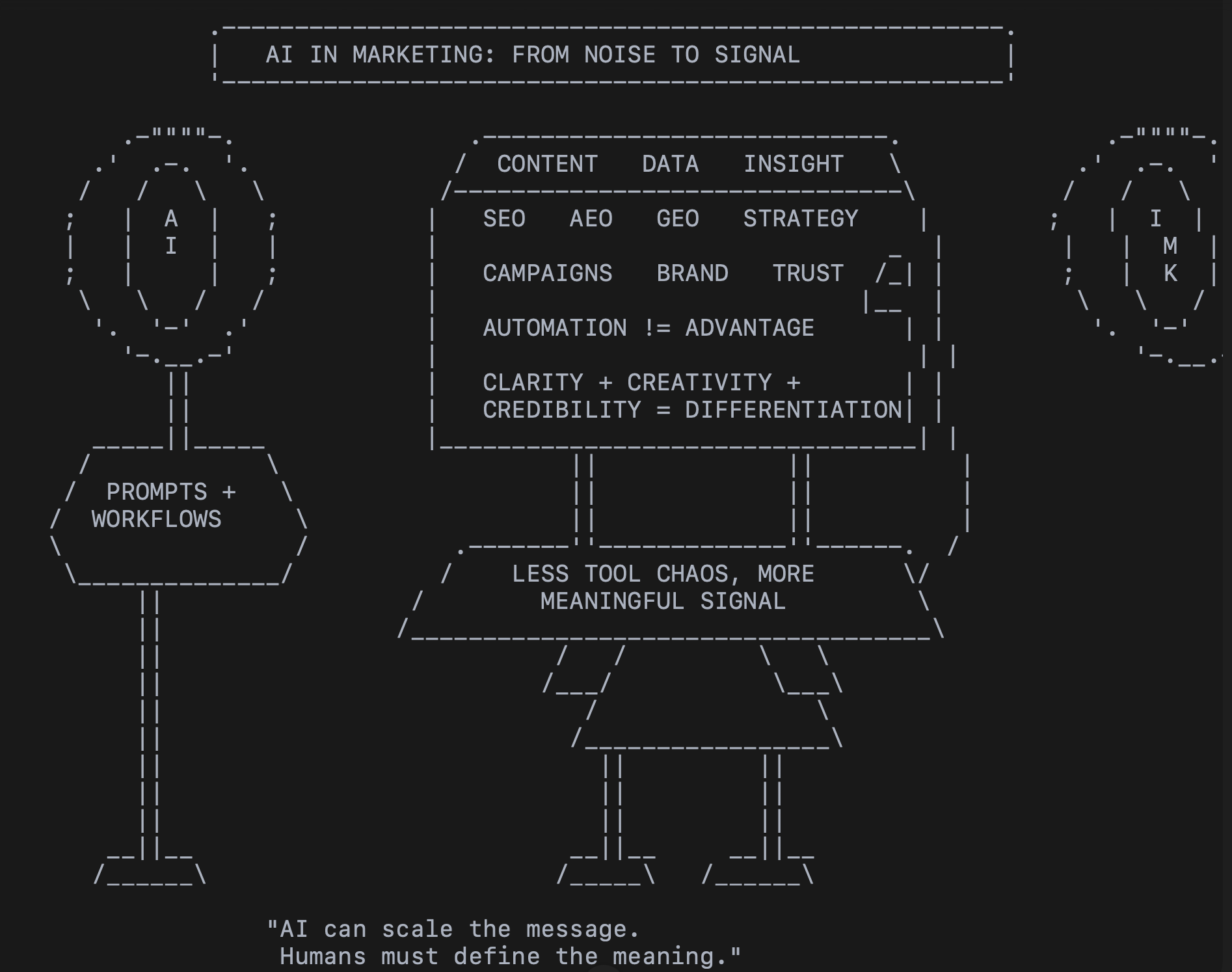
The widespread availability of AI has lowered the baseline for execution in marketing, making it easier for more teams to operate at a higher level of efficiency. However, this also means that differentiation is harder to achieve. Advantage no longer comes from simply using AI, but from using it with intent and precision. Marketers who focus on clarity, strategy, and customer understanding will leverage AI to amplify their strengths, while those who rely on it as a shortcut will generate volume without value. The distinction between adoption and advantage lies in how thoughtfully AI is integrated into the broader marketing strategy.
The Path Forward for Marketers
The future of marketing will be defined by those who can balance the speed and scale of AI with the judgment and insight of human decision-making. As tools continue to evolve, the temptation to prioritize efficiency will remain strong, but the true opportunity lies in using AI to enhance, not replace, strategic thinking. Marketers must remain grounded in fundamentals while embracing new capabilities, ensuring that every action contributes to a coherent and meaningful brand narrative. AI can accelerate execution, but it cannot determine what matters. That responsibility remains firmly in the hands of those who understand not just how to market, but why it matters.
Q & A
Who is featured in this discussion and what expertise do they bring?
Harjiv Singh, founder and CEO of CambrianEdge, shares insights on how AI is transforming modern marketing, with a focus on strategy, execution, and leveraging AI-native platforms effectively.
What is the main theme of this piece?
It explores how AI is reshaping marketing by addressing complexity, improving workflows, and challenging teams to rethink how they operate in a fragmented digital landscape.
How has marketing evolved in the AI era?
Marketing has shifted from a few traditional channels to a highly fragmented ecosystem of platforms, data streams, and performance metrics, increasing both opportunity and complexity.
What major challenge do modern marketers face today?
They are overwhelmed by fragmented tools and data, often spending more time managing systems and metrics than focusing on strategy and creativity.
How does AI both help and complicate marketing?
AI can unify workflows and improve decision-making, but if added without intention, it can increase fragmentation and operational complexity.
What is the “fragmentation problem” in marketing?
It refers to the proliferation of tools and metrics that pull marketers away from core strategic work into managing dashboards and optimizing isolated performance indicators.
Why is measuring everything not always beneficial?
Because not all measurable actions contribute to meaningful outcomes—data without context can lead to misguided decisions.
What is the “illusion of productivity” created by AI?
AI enables rapid content generation, which can create the appearance of productivity, but high output does not necessarily lead to effective or impactful marketing.
Why can AI-generated content lead to saturation?
Because it allows teams to produce large volumes of similar content quickly, often lacking differentiation, depth, and strategic alignment.
What foundational principle of marketing remains unchanged?
Marketing still centers on understanding customer needs, communicating value clearly, and building trust over time.
When should marketing begin in a company’s lifecycle?
It should start alongside product development, not after, to gather early feedback, refine messaging, and validate assumptions.
How has the role of content evolved in modern marketing?
Content must now serve both human audiences and AI systems, requiring it to be structured, clear, and easily interpretable by machines.
What is changing about how users discover information?
AI-driven systems are replacing traditional search lists with direct answers, shifting the focus from ranking to being a credible, referenced source.
Why is credibility becoming more important in marketing?
Because AI systems prioritize trusted sources, making signals like media mentions, testimonials, and consistent messaging critical for visibility.
How do most organizations misuse AI in marketing?
They layer AI onto existing processes without rethinking workflows, leading to more activity but not necessarily better outcomes.
Why is mindset change important for AI adoption?
Because tools alone don’t transform results—teams must change how they think, collaborate, and make decisions to fully leverage AI.
How does AI impact creativity in marketing?
It amplifies the importance of creativity, as differentiation increasingly depends on original thinking, storytelling, and strategic insight.
What role does the marketer play in an AI-driven environment?
The marketer shifts from executor to orchestrator, guiding AI outputs to ensure they align with brand voice, strategy, and audience needs.
What does it mean for marketing to “compound over time”?
Consistent efforts like content creation, thought leadership, and customer engagement build cumulative value, strengthening brand presence and trust.
What distinguishes AI adoption from true competitive advantage?
Adoption is simply using AI tools, while advantage comes from using them thoughtfully with clear strategy and deep customer understanding.
What is the key takeaway for the future of marketing?
Success will come from balancing AI’s speed and scale with human judgment, ensuring that efficiency enhances—rather than replaces—strategic thinking.